Extract:
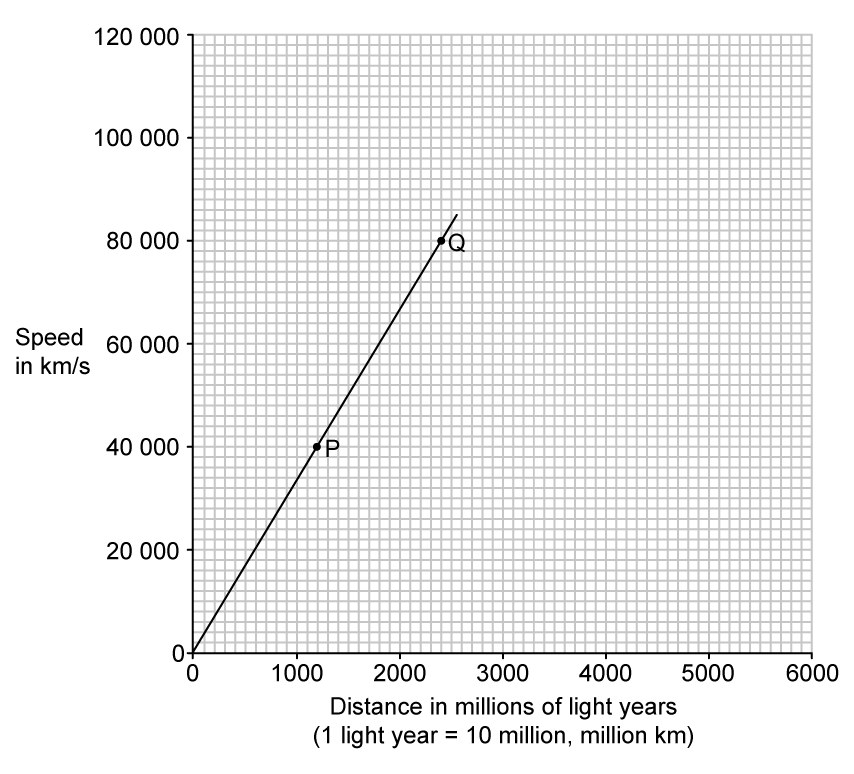
The graph in Fig 1.1 was used to calculate the most up-to-date value of the Hubble constant, H_0. Megaparsecs are a unit for large distances commonly used in Astronomy and Cosmology. 1 megaparsec = 3.1 × 10^22 m. Calculate H_0 in km/s megaparsec.
State how to calculate H_0 from the graph:
- H_0 / the Hubble constant is the gradient of the graph; [1 mark]
Calculate H_0:
- H_0 = gradient = Δv / Δdistance from Earth = 64,000 / 960 [1 mark]
- H_0 = 66.67 ≈ 67 km/s megaparsec [1 mark]
On the y axis, there are 10 small squares that equal 20,000. This means each small square is worth 2,000 km/s. The scale for the x axis is slightly different, 10 small squares equals 400 megaparsecs.
Extended tier only
By measuring the redshift of galaxies, Hubble was able to calculate the speed at which they move away from the Earth. Hubble was also able to calculate the distance of these galaxies from the Earth.
The graph in Fig 1.1 shows some of the data calculated by Hubble.
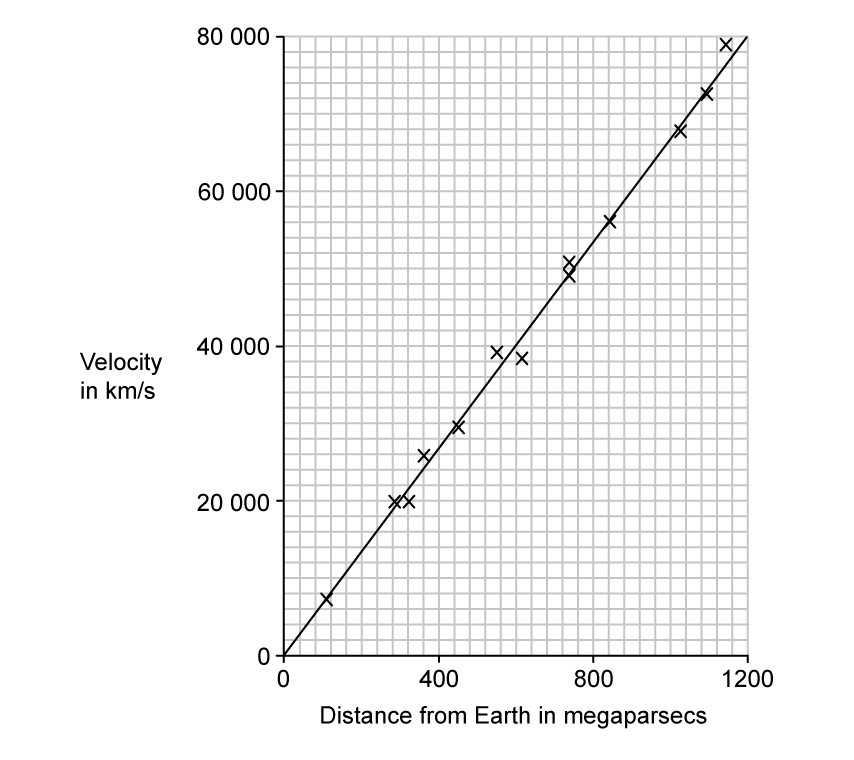
Fig 1.1
The graph in Fig 1.1 was used to calculate the most up-to-date value of the Hubble constant, H0.
Megaparsecs are a unit for large distances commonly used in Astronomy and Cosmology. 1 megaparsec = 3.1 × 10²² m.
Calculate H0 in km/s megaparsec.