The Demographic Transition Model (Cambridge International IGCSE Geography)
Specification link
This page covers section 6.1.4 of the CIE IGCSE specification .
- 6.1.4- The demographic transition model (DTM) and its strengths and limitations.
What is the demographic transition model?
Spec point — The demographic transition model (DTM) and its strengths and limitations.
- The demographic transition model (DTM) shows the five generalised stages of population change that countries pass through as they develop
- It shows how birth and death rates change over time and how this affects the overall population as the country
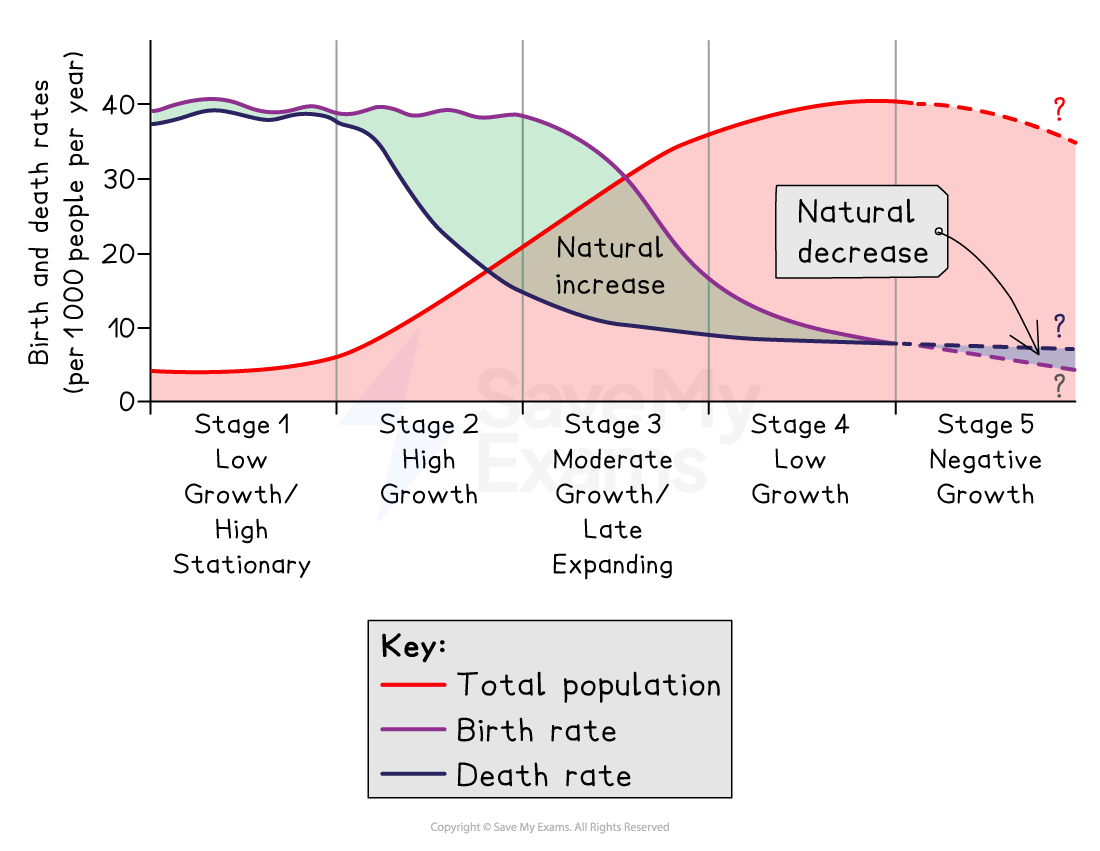
The demographic transition model
Stages of the demographic transition model
Stage 1
-
The total population is low
-
High birth rates due to lack of contraception/family planning
-
High death rates due to:
- poor healthcare
- poor diet
- famine
-
High infant mortality leads people to have more children so that some children survive to adulthood
Stage 2
-
The total population starts to rise rapidly
-
Birth rates remain high as people continue to have large families because:
- children are needed as workers
- no pensions or elderly care means people have children to look after them in their old age
-
Death rates decrease as a result of:
- improved diets
- better healthcare
- lower infant mortality
- increased access to clean water
Stage 3
-
The total population continues to increase but the rate of growth begins to slow
-
The birth rate begins to fall rapidly due to:
- increased birth control
- family planning
- increased cost of raising children
- low infant mortality rate
- more access to education for women
-
The death rate is still decreasing, but at a slower rate, as there have been improvements in:
- medicine
- hygiene
- diet
- water quality
Stage 4
-
The total population is high and is increasing slowly
-
The low and fluctuating birth rate can be attributed to
- accessible birth control and the choice of having fewer children
- women delaying the age they start to have children
-
The death rate is low and fluctuates
Stage 5
- The total population starts to slowly decline as the death rate exceeds the birth rate
- The birth rate is low and slowly decreasing
- The death rate is low and fluctuates
Strengths of the demographic transition model
Spec point — The demographic transition model (DTM) and its strengths and limitations.
- The DTM simplifies population change, making the trends easy to identify and analyse
- It can be easily applied to different settings
- The DTM shows what happened to the population in Western Europe before, during and after industrialisation
- It can help governments plan for predicted future changes
Limitations of the demographic transition model
Spec point — The demographic transition model (DTM) and its strengths and limitations.
-
The DTM does not take into account migration, natural disasters, pandemics, wars or government policies that impact birth rates, e.g. China’s one-child policy
-
It is based on countries in Western Europe that industrialised between 1800 and 1950
- So it is harder to apply to MICs and LICs today that are industrialising in shorter time-frames due to globalisation
-
The model assumes that all countries will develop in the same way
Was this revision note helpful?
Build on this topic