Population Policies (Cambridge International IGCSE Geography)
Specification link
This page covers section 6.1.3 of the CIE IGCSE specification .
- 6.1.3- An evaluation of the impacts of pro-natalist and anti-natalist policies on birth rates.
Pro-natalist population policies
Spec point — An evaluation of the impacts of pro-natalist and anti-natalist policies on birth rates.
Pro-natalist policies
-
The aim of pro-natalist policies is to increase the population due to:
- an ageing population, which increases social and healthcare costs
- a workforce shortage
- reduced payment of taxes due to fewer workers
-
There are several countries that have implemented pro-natalist policies, including:
- France
- Singapore, after 1987
- Sweden
- Russia
-
Measures used to encourage people to have larger families include:
- improved maternity and paternity leave rights
- increased child benefits
- tax allowances for larger families, which reduce tax payments
- baby bonus (Singapore)
- improved childcare provision
- free pre-school places
French population policy
-
In France, past policies have included:
- discounts on public transport for families with three or more children
- increased paid maternity leave
- better mortgage deals
- tax allowances
- free childcare from 3 to school age
- cash incentives for mothers who stay at home to care for children
- subsidised holidays
-
The policies have led to one of the highest fertility rates in Europe
Anti-natalist population policies
Spec point — An evaluation of the impacts of pro-natalist and anti-natalist policies on birth rates.
-
Anti-natalist policies aim to reduce pressure on resources and improve the quality of life for the whole population
- These are policies introduced to reduce the birth rate
-
Policies can be law, as in China, or they can be voluntary
China's population policy
-
The best-known example is China's one-child policy, which was in effect from 1979 to 2016, although it was relaxed in 1999
-
The policy used various methods to reduce the birth rate, including:
- fines for having more than one child
- increased access to contraceptives and family planning education
- posters and advertisements to promote the advantages of only having one child
- better employment opportunities for those with only one child
- no payment for education or healthcare for second children
- there were also reports of **forced abortions **and sterilisations
- promoting** late marriages**
- abortion was legalised
-
The policy had many impacts; it :
- affected the male/female ratio due to the preference for male children
- led to over 30 million more men under 20 than women under 20
- caused a decrease in the population growth rate
- led to an ageing population
-
Other places and special administrative regions that have had anti-natalist policies in the past include:
- Singapore 1972-1987
- Taiwan 1964 - late 1970s
- India's National Population Policy
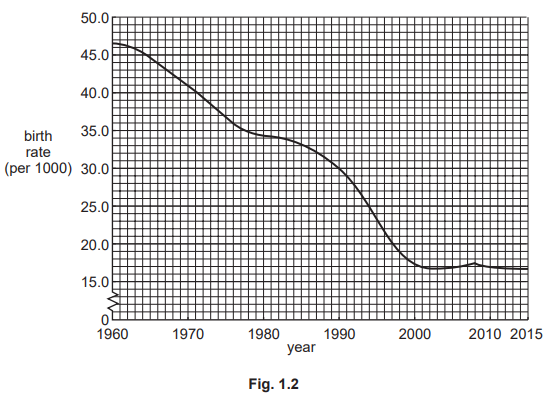
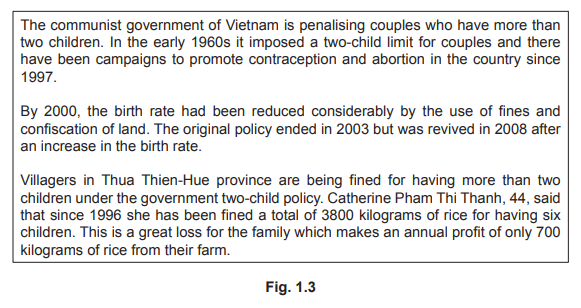
Worked Example Study Figure 1.2 and 1.3 which show information about birth rates in Vietnam (an LIC in South East Asia).
Suggest how government policies and other factors may have reduced Vietnam's birth rate.
[4]
Answer
Any four from the ideas listed would be awarded marks.
- Government restricted family size/restricted number of children [1]
- Fines/land ownership taken away/loss of income [1]
- Contraception/abortions made available or cheaper [1]
- Campaigns for people to use contraception/have abortions [1]
- Education for women [1]
- Family planning education [1]
- Improvement of healthcare for infants/lower infant mortality rate [1]
- Provision of pensions [1]
- Mechanisation of farms/less agricultural work [1]
Was this revision note helpful?
Build on this topic