Question 1(b) Model Answer: Letter (Cambridge International IGCSE English Language)
Question 1(b) is a directed writing task. You will be asked to write a discursive, argumentative or persuasive piece based on two reading texts.
You will be asked to write in a specific form. This will be one of:
- A speech
- A letter
- An article
- A report
The following guide will help you to structure your response in the style of a letter.
Addressing the reading assessment objectives
Up to 10 marks are available in this task for your ability to evaluate both the explicit and implied ideas, opinions and attitudes expressed in one or two texts, and assimilate them to write a developed and sophisticated response.
Let’s take a look at how you do this, using the following example:
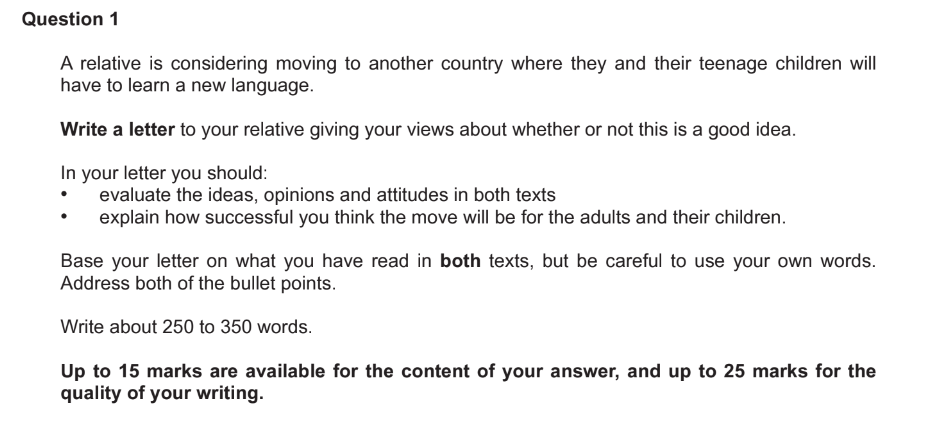
Your response here has to be based on the ideas, opinions and attitudes contained in the following two texts:
This task asks you to evaluate the views given in both texts about a relative's potential move to another country, and give your own views on the subject, based on what you have read. Your response might use the following ideas from these texts:
Text A:
- “Pre-teens” pick up a new language quickly
- New languages can change young people’s personalities
- Picking up on nuance and being able to express humour in a new language is hard
- Arguably, true bilingualism is not possible
- Accents are always obvious
- Attitudes to bilingualism have changed with research
- Bilingualism can help with empathy and help people to see different perspectives
- There is some evidence that bilingualism could protect against dementia and makes our minds more flexible
- But it can make people less articulate/developed in both languages
- Bilingualism can be very enriching and help you to become more eloquent
Text B:
- Gaining a second language is not always a choice
- It can make you a more interesting person
- Bilingual people are rarely equally proficient in both languages and it is easy to make mistakes
- Languages can be lost without effort
- Being able to speak an extra language can make you more employable
- It is not always possible to be fluent in more than one context
- Retaining your first language helps you keep your link to your culture
- Switching from one language to another can lead to personality changes
Planning your response
Before you write your response, you should spend five minutes planning your written response. In your plan:
-
Decide on your “voice” and point of view:
- Write a statement that summarises your point of view, based on your reading
-
Note down which points you can develop that support your point of view
-
Decide whether you are going to make a counter-argument, and note down which points you can develop to support this
-
Return to your main argument, ensuring that you have included ideas and opinions from both texts (if more than one)
-
Note down the points you can make to address the second bullet point in the task
-
Note down how you are going to start and finish your response, ensuring that it establishes the correct style and tone
Question 1(b) letter model answer
The following model answer demonstrates a top-mark response to the above task:
Worked Example Question 1(b)
A relative is considering moving to another country where they and their teenage children will have to learn a new language.
Write a letter to your relative giving your views about whether or not this is a good idea.
In your letter you should:
evaluate the ideas, opinions and attitudes in both texts
explain how successful you think the move will be for the adults and their children
Base your letter on what you have read in both texts, but be careful to use your own words. Address both of the bullet points.
Write about 250 to 350 words.
Up to 10 marks are available for reading and up to 25 marks for writing.
[35]
Answer
Dear Auntie Ruth,
It was lovely to hear from you. Your potential move to France sounds like a thrilling adventure, though we would naturally miss Luke and Harry terribly!
I have been doing some research, and I must be honest about my concerns. Achieving fluency is significantly harder as we get older. Since the boys are teenagers, they may struggle to integrate at school; I would hate for them to feel isolated because their accents mark them out as different. Professionally, you may also face hurdles; missing linguistic nuances like tone can easily lead to workplace confusion. There is also a risk that if the boys adapt faster than you, it could create a frustrating distance within the family.
That said, the benefits are undeniable. Viewing the world through a different cultural lens is enriching, and bilingualism is a fantastic employability skill. I even read that it can help prevent dementia in later life!
However, you must weigh this against the potential loss of identity. Making constant mistakes can leave you feeling like an outsider. More importantly, there is a genuine danger of severing the link to your own culture. You do not want to become "interesting" to others at the expense of losing who you really are.
Please think this through carefully. While I admire the ambition, I worry that the struggle to be articulate in a new language might prove too high a price for your family’s happiness.
Whatever you decide, I wish you all the best!
Take care,
Nadia
[35]
Commentary
- The response is long enough to develop arguments but concise enough to show control
- The response develops the texts' points rather than just listing them
- It replaces general phrases with more precise vocabulary
- It maintains a caring but serious tone suitable for giving advice to a family member, using a clear introduction and sign off
Summary
-
Remember to read the question carefully and highlight:
- What you are writing, who your audience is and why you are writing
- The focus of each bullet point
-
Read the text(s) and highlight the relevant information that could be developed in your answer:
- Bullet-point this information in your own words
-
Plan your writing, focusing on one main idea or opinion per paragraph
-
Address each bullet point in order:
- Make sure you cover all of the bullet points as equally as possible
-
Decide on the voice and style you want to create and maintain that in your answer
-
Do not just repeat details from the text(s):
- You need to evaluate and develop the ideas, opinions and attitudes in the text(s) — you are not summarising them
Was this revision note helpful?
Build on this topic