Question 1(b) Model Answer: Article (Cambridge International IGCSE English Language)
Question 1(b) is a directed writing task. You will be asked to write a discursive, argumentative or persuasive piece based on two reading texts.
You will be asked to write in a specific form. This will be one of:
- A speech
- A letter
- An article
- A report
The following guide will help you to structure your response in the style of an article.
Addressing the reading assessment objectives
Up to 10 marks are available in this task for your ability to evaluate both the explicit and implied ideas, opinions and attitudes expressed in one or two texts, and assimilate them to write a developed and sophisticated response.
Let’s take a look at how you do this, using the following example:
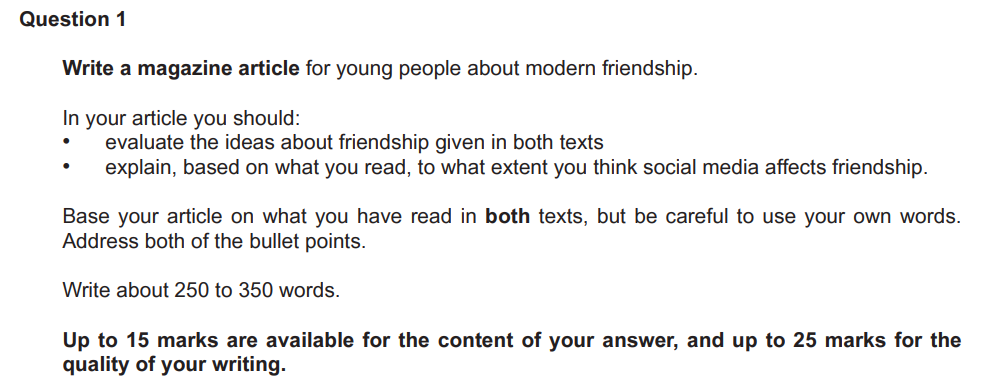
Your response here has to be based on the ideas, opinions and attitudes contained in the following two texts:
This task asks you to evaluate the views given in both texts about friendship, and give your own views on the subject, based on what you have read. Your response might use the following ideas from these texts:
Text A:
- The internet is blamed for everything without reason
- Loneliness, low self-confidence and social isolation are linked to social media, but it is not really known in what way
- The internet can make people less lonely, not more
- People can build meaningful connections over the internet
- Social media can help people find friends and develop a social life
- You can be yourself on the internet as well as in person — our online and real-life personas are being merged
- Online friendships can be made across vast distances
- Talking and friendships online can be just as rich and as valid as in-person ones
- Befriending apps are now increasingly available
- Some people will find it easier to make friends online
Text B:
- Research shows how important real friendship is to people
- We are genetically wired to make a small number of close friends even in larger social groups
- Even though we now have the internet to help us maintain friendships across expanding distances, we don’t actually have more friends with social media
- The nature of friendship is changing
- Shared experience in real life is essential for strong friendships
- Deeper connections take more effort than being online
Planning your response
Before you write your response, you should spend five minutes planning your written response. In your plan:
-
Decide on your “voice” and point of view:
- Write a statement that summarises your point of view, based on your reading
-
Note down which points you can develop that support your point of view
-
Decide whether you are going to make a counter-argument, and note down which points you can develop to support this
-
Return to your main argument, ensuring that you have included ideas and opinions from both texts (if more than one)
-
Note down the points you can make to address the second bullet point in the task
-
Note down how you are going to start and finish your response, ensuring that it establishes the correct style and tone
Question 1(b) article model answer
The following model answer demonstrates a top mark response to the above task:
Summary
-
Remember to read the question carefully and highlight:
- What you are writing, who your audience is and why you are writing
- The focus of each bullet point
-
Read the text(s) and highlight the relevant information that could be developed in your answer:
- Bullet-point this information in your own words
-
Plan your writing, focusing on one main idea or opinion per paragraph
-
Address each bullet point in order:
- Make sure you cover all of the bullet points as equally as possible
-
Decide on the voice and style you want to create and maintain that in your answer
-
Do not just repeat details from the text(s):
- You need to evaluate and develop the ideas, opinions and attitudes in the text(s) — you are not summarising them
Was this revision note helpful?
Build on this topic