Solutions to Market Failure: Maximum & Minimum Prices (Cambridge International IGCSE Economics)
Intervention to address market failure
Spec point — Government intervention in markets to address market failure
-
Four of the most commonly used methods to address market failure in markets are
- maximum prices
- minimum prices
- indirect taxation
- subsidies
-
Additional methods of intervention include regulation, nationalisation, privatisation, and government (state) provision of public goods
Maximum prices
Spec point — Maximum Prices: definition, drawing and interpretation of diagrams, advantages and disadvantages
-
A maximum price is set by the government below the existing free market equilibrium price and sellers cannot legally sell the good/service at a higher price
-
Governments will often use maximum prices in order to help consumers.
- Sometimes they are used for long periods of time e.g. housing rental markets.
- Other times they are short-term solutions to unusual price increases e.g. petrol
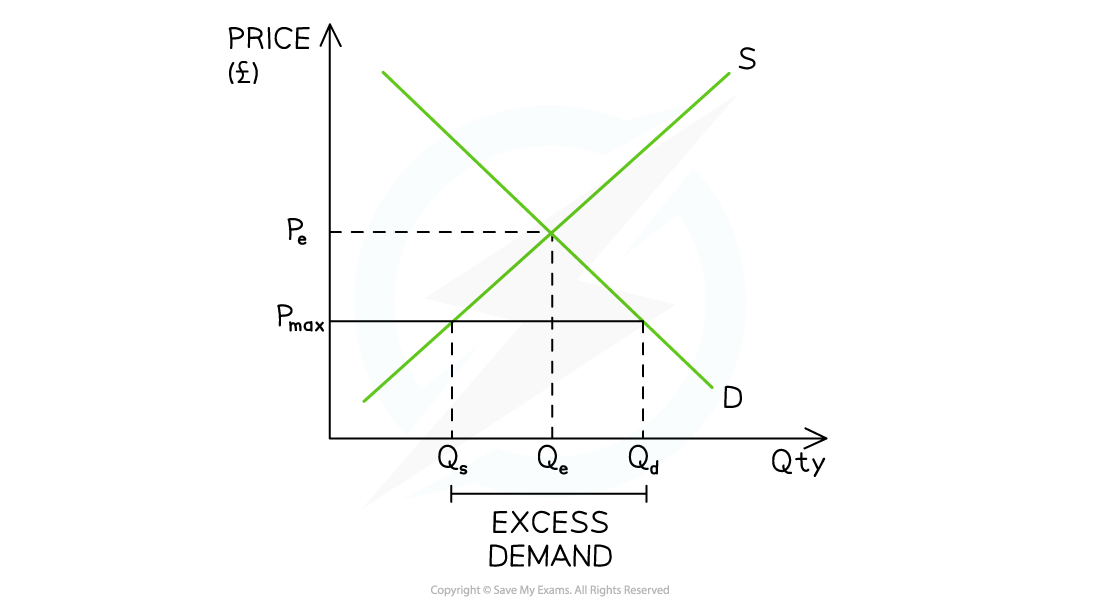
The maximum price (Pmax) sits below the free market price (Pe) and creates a condition of excess demand (shortage)
Diagram analysis
-
The initial market equilibrium is at PeQe
-
A maximum price is imposed at Pmax
- The lower price reduces the incentive to supply and there is a contraction in QS from Qe → Qs
- The lower price increases the incentive to consume and there is an extension in QD from Qe → Qd
- This creates a condition of excess demand equal to QsQd
Evaluating the use of maximum prices
| Advantages | Disadvantages |
|---|---|
| - Some consumers benefit as they purchase at lower prices - Maximum prices can stabilise markets in the short term during periods of intense disruption e.g. Covid supplies at the start of the pandemic | - Some consumers are unable to purchase due to the shortage - The unmet demand usually encourages the creation of illegal markets (black market or grey market) as desperate buyers turn to illegal bidding - Maximum prices distort market forces and therefore can result in an inefficient allocation of scarce resources e.g. maximum prices in rentals in the property market create a shortage |
Minimum prices
Spec point — Minimum prices: definition, drawing and interpretation of diagrams, advantages and disadvantages
- A minimum price is set by the government above the existing free market equilibrium price and sellers cannot legally sell the good or service at a lower price
- Governments will often use minimum prices in order to help producers or to decrease consumption of a demerit good such as alcohol
The imposition of a minimum price (Pmin) above the free market price (Pe) creates a condition of excess supply (surplus)
Diagram analysis
-
The initial market equilibrium is at PeQe
-
A minimum price is imposed at Pmin
- The higher price increases the incentive to supply and there is an extension in QS from Qe → Qs
- The higher price decreases the incentive to consume and there is a contraction in QD from Qe → Qd
- This creates a condition of excess supply QdQs
Evaluating the use of minimum prices in product markets
| Advantages | Disadvantages |
|---|---|
| - In agricultural markets, producers benefit as they receive a higher price (governments will often purchase excess supply and store it or export it) - When used in demerit markets, output falls (Ggovernments will not purchase the excess supply of a demerit good) ** - Producers usually lower their output in the market to match the QD at the minimum price and this helps to reduce the external costs | - It costs the government to purchase the excess supply and an opportunity cost is involved - Farmers may become** over-dependent on the government's help - Producers lower output which may result in an increase in unemployment in the industry |
Minimum prices in labour markets
-
Minimum prices are also used in the labour market to protect workers from wage exploitation
- These are called national minimum wages
-
A national minimum wage (NMW) is a legally imposed wage level that employers must pay their workers
- It is set above the market rate
- The minimum wage per hour varies based on age
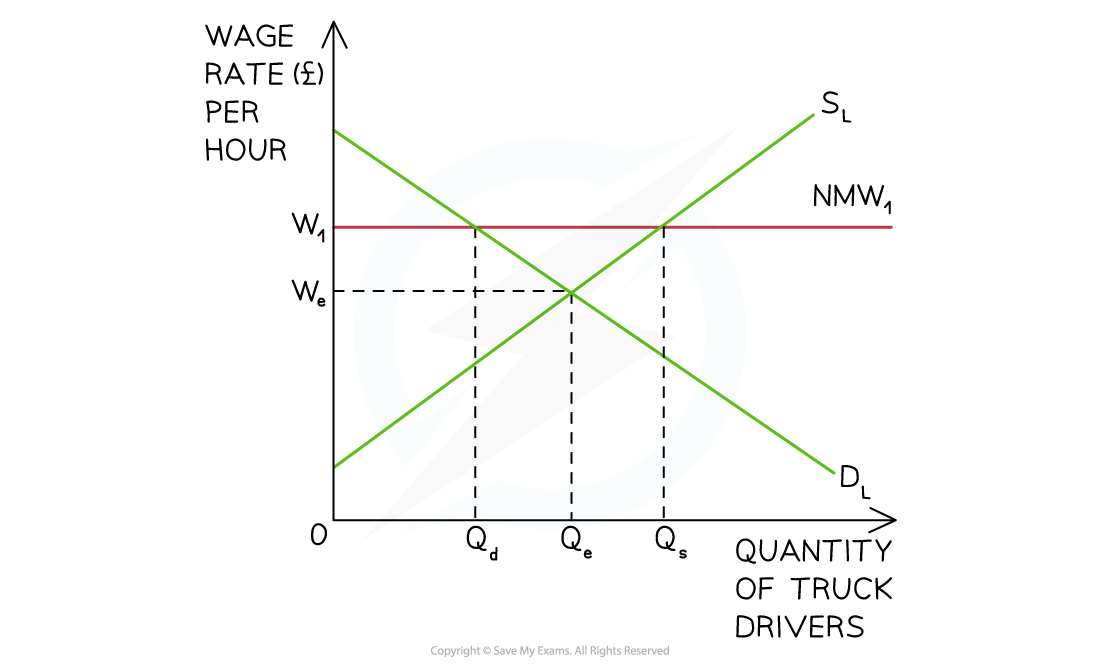
Diagram analysis
- The demand for labour (DL) represents the demand for workers by firms
- The supply of labour (SL) represents the supply of labour by workers
- The market equilibrium wage and quantity for truck drivers in the UK is seen at WeQe
- The UK government imposes a national minimum wage (NMW) at W1
- Incentivised by higher wages, the supply of labour increases from Qe to Qs
- Facing higher production costs, the demand for labour by firms **decreases **from Qe to Qd
- This means that at a wage rate of W1 there is** excess supply of labour** and the potential for unemployment equal to QdQs
Evaluating the use of a minimum wage in labour markets
| Advantages | Disadvantages |
|---|---|
| - Guarantees a minimum income for the lowest-paid workers - Higher income levels help to increase consumption in the economy - May incentivise workers to be more productive | - Raises the costs of production for firms who may respond by raising the price of goods and services - If firms are unable to raise their prices, the introduction of a minimum wage may force them to lay off some workers (increase unemployment) |
Exam Hint The material in this topic is frequently examined in the Paper 2 structured questions. You will be asked to evaluate the effectiveness of taxes, subsidies, maximum or minimum prices.
To do so:
Consider the advantages and disadvantages of each method of intervention
Explain that several methods of intervention are likely to be more effective than a single method e.g. smoking is taxed and highly regulated(age restrictions, packaging restrictions, display restrictions)
Consider different market segments and their responsiveness e.g. wealthy consumers will less responsive (inelastic demand) to tax increases than poorer consumers (elastic demand)
Was this revision note helpful?
Build on this topic