Solutions to Market Failure: Other Solutions (Cambridge International IGCSE Economics)
Direct provision and regulation
Spec point — Direct provision and regulationdefinitions, advantages and disadvantages
Direct provision of goods and services
-
Public goods are beneficial for society and are not provided by private firms due to the free rider problem
-
The government will often step in and provide these goods for its citizens
- Examples include roads, parks, lighthouses, national defence
-
Merit goods are provided by the free market, but they are underprovided so governments will step in to fill the provision gap
-
The government will often step in and provide these goods for its citizens
- Examples include education and healthcare
Evaluating direct provision to solve market failure
| Advantages | Disadvantages |
|---|---|
| - They are usually provided free at the point of consumption - Accessible to everyone regardless of income - Usually provide both private and external benefits to society | - Paid for through general taxation - There is an opportunity cost associated with their provision - Products which are free may result in excess demand and long waiting times - For example, patients may wait for necessary operations at public hospitals for months or years |
Regulation
- Governments create rules to limit harm from the external costs of consumption/production
- They often create regulatory agencies to monitor that the rules are not broken
Evaluating the use of regulation to solve market failure
| Advantages | Disadvantages |
|---|---|
| - Individuals or firms may be fined or imprisoned for breaking the rules - For example, selling cigarettes to minors is a punishable offence - They help to reduce the external costs of demerit goods - Fines can generate extra government revenue | - Enforcing laws requires the government to hire more people to work for the regulatory agencies - Enforcing laws can be difficult as it is a complex process to determine if firms or consumers are breaking the laws - The regulation may create underground (illegal) markets which could generate even higher external costs on society |
Privatisation and nationalisation
Spec point — "Privatisation and nationalisation: definitions, advantages and disadvantages"
Privatisation and nationalisation
Privatisation
-
Privatisation occurs when governments transfer ownership and control of firms or assets from the state (public sector) to the private sector (private firms)
-
Many state firms are monopolies
- By privatising them, it encourages more competition in those markets
-
This may result in more efficiency and lower prices for consumers
Evaluating privatisation to solve market failure
| Advantages | Disadvantages |
|---|---|
| - Increases government revenue in the year the asset is sold - Private firms may run the business more efficiently - The government no longer needs to manage the business or hire people to work for it – this reduces government expenditure | - Government assets are often sold well below their actual market value - Private firms often provide a substandard good or service as they cut quality to increase profits - The price of the good or service usually increases as firms seek to maximise their profit - Many privatised companies still maintain considerable market power and have to be regulated, e.g. water companies |
Nationalisation
-
Nationalisation occurs when the government takes control and ownership of firms which were in the private sector
- Sometime they will pay to nationalise firms
- Other times they will seize the assets and assume ownership
Evaluating nationalisation to solve market failure
| Advantages | Disadvantages |
|---|---|
| - Nationalisation can generate efficiencies, especially when delivering utilities (gas, water, electricity) to the national population - It creates more equity in society, as all citizens have the same access to the same resource at the same price - e.g. Norway nationalised much of the oil industry when oil was first discovered in 1972. The profits belong to the citizens - The business can generate significant revenue for the government | - Government firms can often run very inefficiently - There is an opportunity cost associated with the money required to run it - The government may lack the expertise to run the business |
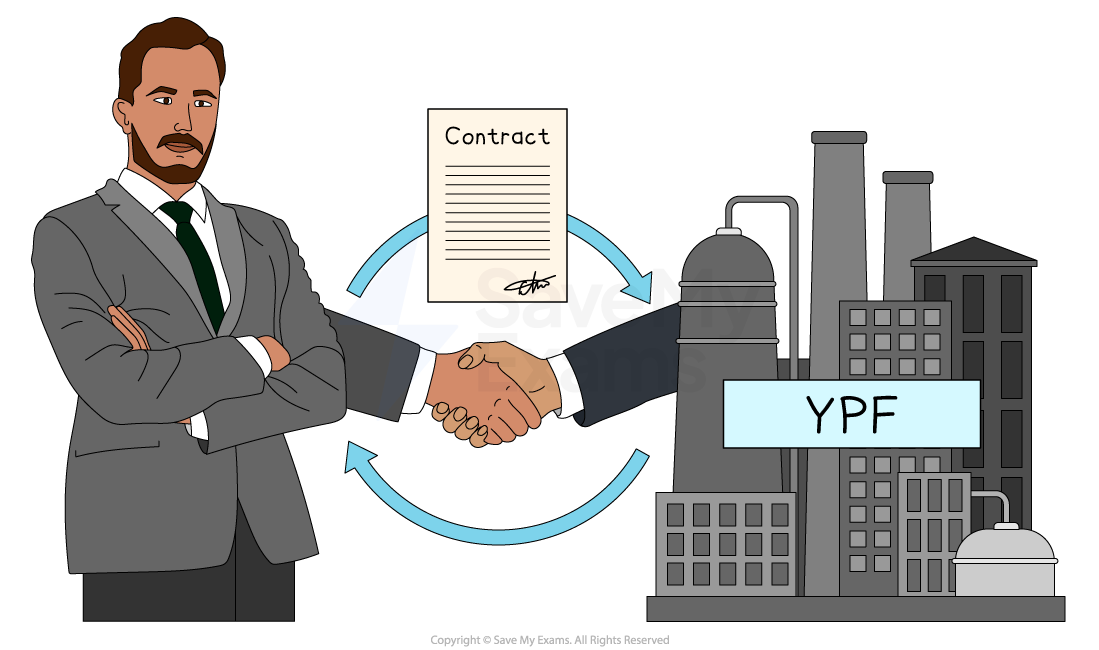
Case Study Nationalisation of YPF in Argentina
In 2012, the Argentine government nationalised YPF, the country’s largest oil and gas company, which had previously been majority-owned by the Spanish firm Repsol.
Context
- Argentina had been facing energy shortages and a growing dependence on imported fuel
- The government accused Repsol of under-investing in oil exploration and production, leading to falling output
The nationalisation
- The Argentine state took control of 51% of YPF’s shares
- The aim was to increase domestic energy production, reduce reliance on imports, and protect strategic national interests
Benefits (from the government's perspective)
- More control over a key industry: Energy is vital to economic stability and growth
- Increased public investment: The government could direct funds into exploration and infrastructure
- Reduced fuel imports: Boosting domestic output helped reduce Argentina’s trade deficit
Challenges and drawbacks
- Legal disputes: Repsol demanded compensation, resulting in a lengthy legal and diplomatic conflict
- Reduced foreign investor confidence: Nationalisation created uncertainty for other foreign companies
- Mixed performance: While production improved slightly, efficiency and profitability remained issues
Outcome
The nationalisation of YPF shows how governments may intervene in strategic industries to protect national interests
However, it also highlights trade-offs between sovereignty and market efficiency and the potential risks to international investment
Quotas
-
A quota is a government-imposed limit on the quantity of a good or service that can be produced, consumed or imported over a specific period
- Quotas can be used to conserve resources, protect domestic industries or control market outcomes
-
In the context of natural resources, a quota may limit the amount of extraction (e.g. tonnes of coal or barrels of oil) allowed per year
- For example, a government might set a quota of 200,000 tonnes per year on timber extraction to prevent deforestation
Evaluating the use of quotas to solve market failure
| Advantages | Disadvantages |
|---|---|
| - Protects scarce natural resources - Helps ensure long-term sustainability of resources like forests, fish stocks or minerals - Supports environmental goals - Reduces overexploitation and negative externalities such as pollution or habitat loss - Stabilises markets - By limiting supply, quotas can prevent oversupply and sharp price falls (especially in agriculture or energy) | - Risk of illegal activity - Strict limits may encourage black markets or unregulated over-extraction - Can raise prices - Reduced supply may lead to higher prices for consumers, especially if demand is inelastic - Difficult to enforce - Especially in developing countries or remote areas, monitoring and enforcement can be costly or ineffective |
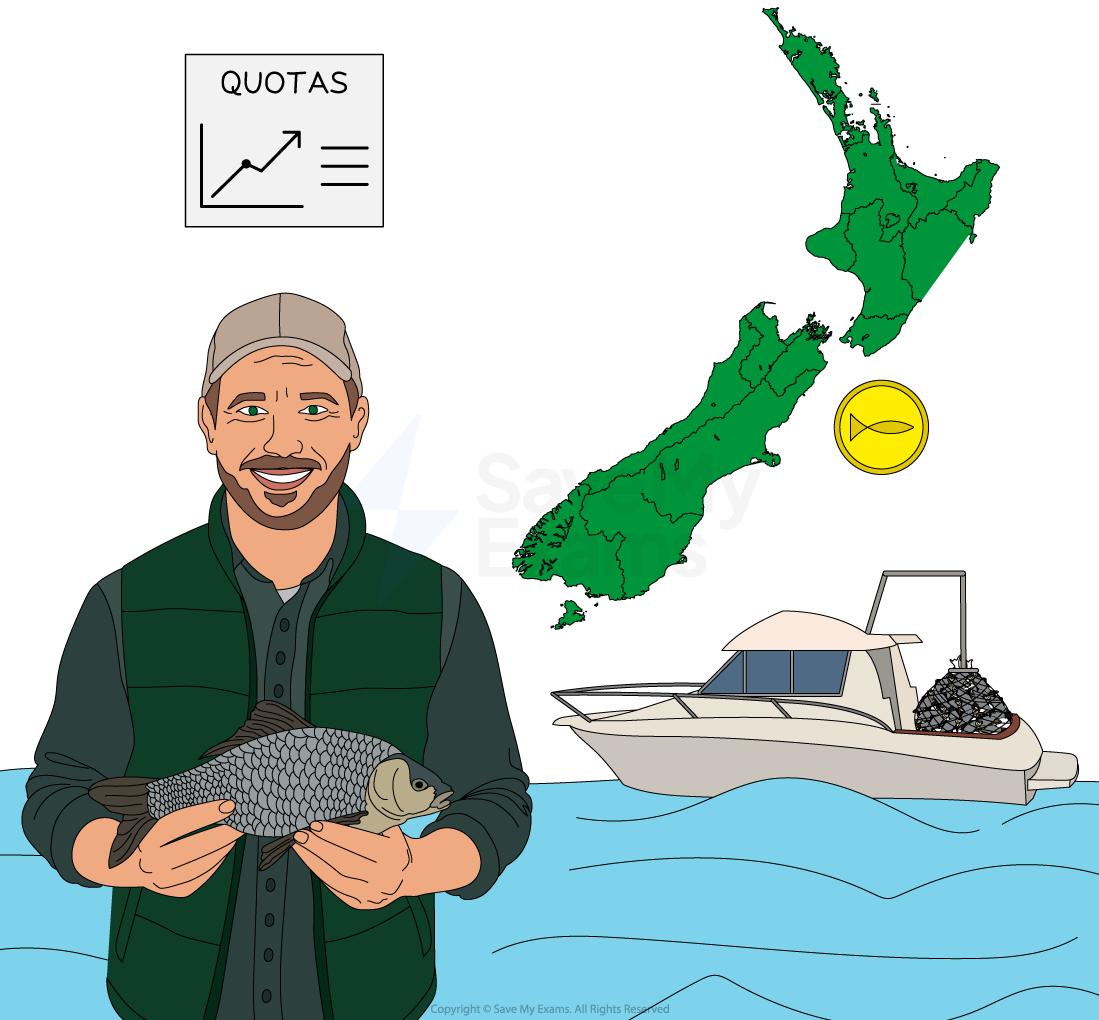
Case Study New Zealand’s Fishing Quotas and Natural Resource Management
Context New Zealand has some of the richest fishing waters in the world. To prevent overfishing, the government introduced a Quota Management System (QMS) in 1986, placing annual limits on how much fish could be caught for each species.
It was designed to conserve stocks, protect biodiversity and ensure long-term industry sustainability
Using quotas
- The government set a Total Allowable Catch (TAC) based on scientific data
- Each fishery was allocated a quota share, which limited how much they could catch
- These quotas were also tradable, allowing fishers to buy or sell unused portions
- This system made sure natural resources weren’t overexploited and encouraged more responsible fishing practices
The outcome
- Some overfished species like hoki have since recovered to sustainable levels
- The industry became more efficient, with fishers investing in better practices
- Illegal fishing reduced due to improved monitoring and enforcement
Why It worked By using quotas to directly control supply, the New Zealand government successfully protected fish stocks, reduced overfishing and balanced economic and environmental goals
Was this revision note helpful?
Build on this topic