Solutions to Market Failure: Indirect Taxation & Subsidies (Cambridge International IGCSE Economics)
Indirect taxation
Spec point — Indirect taxation: definition, drawing and interpretation of diagrams, advantages and disadvantages
-
An indirect tax is paid on the consumption of goods or services
- It is only paid if consumers make a purchase
- It is usually levied by the government on demerit goods to reduce the quantity demanded (QD) and/or to raise government revenue
- Government revenue is used to fund government provision of goods and services esuch as education
-
Indirect taxes are levied by the government on producers. This is why the supply curve shifts
-
Producers and consumers each pay a share (incidence) of the tax
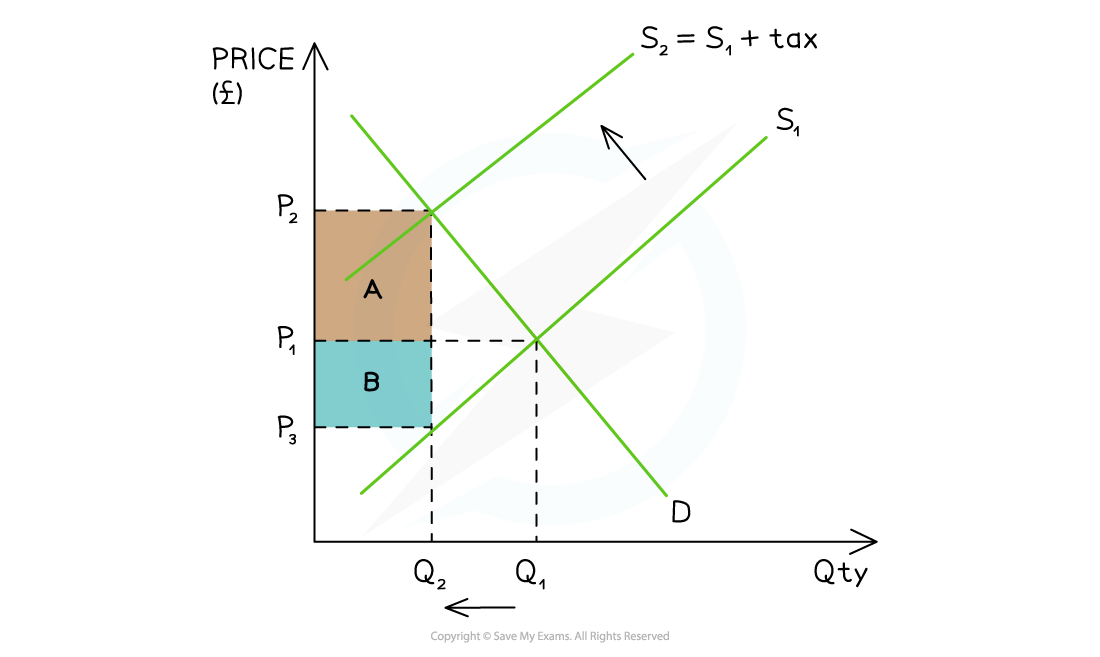
The impact of an indirect tax is split between the consumer (A) and the producer (B)
Diagram analysis
-
The government places a specific tax on a demerit good
- The supply curve shifts left from S1 → S2 by the amount of the tax
-
The price the consumer pays has increased from P1 before the tax, to P2 after the tax
-
The price the producer receives has decreased from P1 before the tax to P3 after the tax
-
The government receives tax revenue = (P2 - P3) x Q2
- The consumer incidence (share) of the tax is equal to area A: (P2 - P1) x Q2
- The producer incidence (share) of the tax is equal to area B: (P1 - P3) x Q2
-
The QD in this market has decreased from Q1 → Q2
- If the decrease in QD is significant enough, it may force producers to lay off some workers
Evaluating the use of indirect taxes to correct market failure
| Advantages | Disadvantages |
|---|---|
| - Reduces the quantity demanded of demerit goods - Raises revenue for government programs | - The effectiveness of the tax in reducing the use of demerit goods depends on the price elasticity of demand (PED) - Many consumers who purchase products that are price inelastic in demand will continue to do so - It may help create illegal markets as consumers seek to avoid paying the taxes - Producers may be forced to lay off some workers as output falls due to the higher prices |
Exam Hint When analysing the impact of taxes on a market, it is worth highlighting the elasticity of the product, as it influences who pays more of the tax (producer or consumer).
The more price inelastic the product, the greater the proportion of the tax that is passed on to consumers by producers, as the quantity demanded will fall less proportionately than the price increase.
The more price elastic the product, the smaller the proportion of the tax that is passed on to consumers by producers, as the quantity demanded will fall more proportionately than the price increase.
Producer subsidies
-
A producer subsidy is a per unit amount of money given to a firm by the government in order to:
- increase production
- increase the provision of a merit good
-
The way a subsidy is shared between producers and consumers is determined by the price elasticity of demand (PED) of the product
- Producers keep some of the subsidy and pass the rest on to the consumers in the form of lower prices
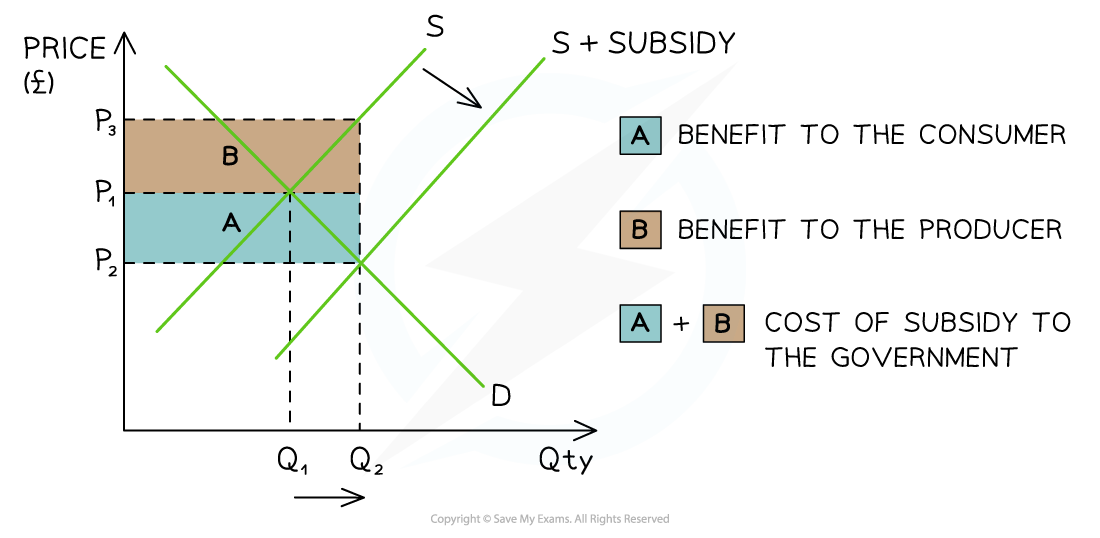
A diagram which demonstrates the cost of a subsidy to the government (A+B) and the share received by the consumer (A) & producer (B)
Diagram analysis
-
The original equilibrium is at P1Q1
-
The subsidy shifts the supply curve from S → S + subsidy:
- This increases the QD in the market from Q1 → Q2
- The new market equilibrium is P2Q2
- This is a lower price and higher QD in the market
-
Producers receive P2 from the consumer PLUS the subsidy per unit from the government
- Producer revenue is therefore P3x Q2
- The producer share of the subsidy is marked B in the diagram
-
The subsidy decreases the price that consumers pay from P1 → P2
- The consumer share of the subsidy is marked A in the diagram
-
The total cost to the government of the subsidy is (P3 - P2) x Q2 represented by area A+B
Evaluating the use of producer subsidies to correct market failure
| Advantages | Disadvantages |
|---|---|
| - Can be targeted to help specific industries - Subsidies lower prices and increases demand for merit goods - They helps to change destructive consumer behaviour over a longer period of time - For example, subsidising electric cars makes them affordable and helps motorists to see them as an option for the masses - and not just the wealthy | - Subsidies distort the allocation of resources in markets - They often result in excess supply when used in agricultural markets - There is an opportunity cost associated with the government expenditure – could the money have been better used elsewhere? - Subsidies are prone to political pressure and lobbying by powerful business interests - For example, most oil companies receive subsidies from their respective governments (despite making $billions in profits each year) |
Was this revision note helpful?
Build on this topic