Factors Affecting the Choice of Occupation (Cambridge International IGCSE Economics)
Exam board Cambridge International · IGCSEUpdated 2025-08-18
Wage factors
Spec point — Wage factors
- The occupational choices of workers are influenced by a range of wage and non-wage factors, which are often held in balance when making decisions about where to work
- Wage factors are financial payments that workers receive for their labour
- Non-wage factors incorporate a range of influences that are meaningful to a worker
Wage factors that influence occupational choices
| Factor | Explanation |
|---|---|
| Wages | - An agreed amount of money per hour - E.g., if a student works in a restaurant for 6 hours, 5 days a week and she gets paid $10/hour, her weekly wage is $300 (6x5x$10) |
| Salary | - Employment contracts often state the agreed annual salary the employee will receive - This is then divided by 12 and paid monthly(in the USA it is divided by 24 and paid every 2 weeks) - The hours worked monthly may vary but the pay received is always the same |
| Commission | - Often used as payment to salespeople - It is typically a percentage of the value of the transaction involved, e.g., estate agents receive 3-7% of the selling price of any property they sell - This can motivate employees to maximise sales |
| Bonus | - Money paid in addition to a salary and is usually a single annual payment - Often paid when the company earns high levels of profits, or as a reward for exceptional worker performance |
| Piece rate pay | - A fixed amount paid to the employee for each completed item produced - e.g., 25 Rupees paid to workers in India for each pair of socks they produce |
| Performance-related pay (PRP) | - Payment based on how well the worker performs - Workers doing exactly the same job may receive different compensation based on different outcomes they achieve |
| Share options | - Payment through the issuing of shares in the company the employee works for - This is usually in addition to a monthly salary - The monetary value of the shares provided to the employee can be calculated on any given day as: number of shares x share price |
Non-wage factors
Spec point — Non-wage factors
- Many different non-wage factors influence a worker's choice of occupation
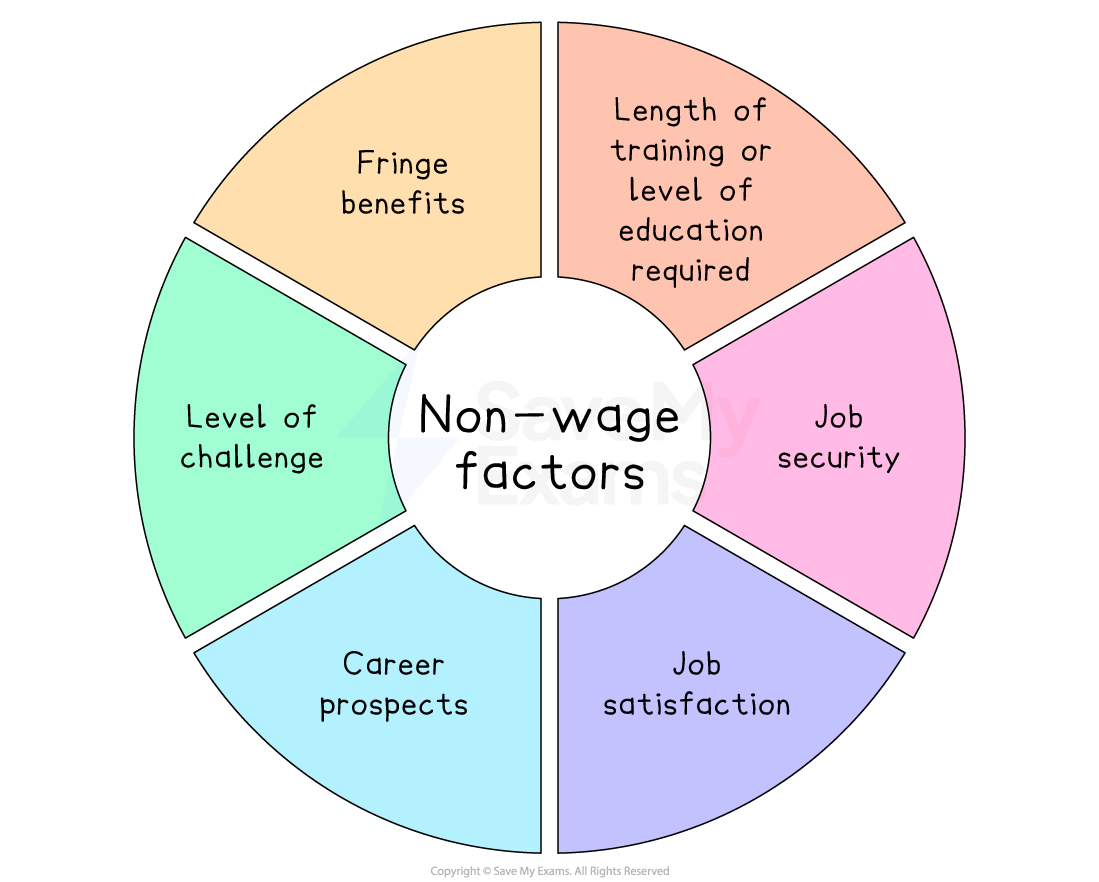
Non-wage factors that can influence the choice of occupation
Fringe benefits
-
Benefits provided in addition to a normal salary, such as:
- Childcare
- Free lunches
- Gym membership
- Company car
-
These can be a significant influence on a person’s choice of occupation
Length of training or level of education required
-
Longer training or study requirements may discourage people from entering the occupation
-
Fewer workers are willing to invest the time and cost needed for lengthy qualifications.
- For example, becoming a lawyer usually takes seven years of study and training
Job security
- Stability of employment can be an important deciding factor
- Some industries offer permanent contracts; others have short‑term contracts (e.g. 1–4 years)
- Workers may avoid jobs in industries with high redundancy risk
Job satisfaction (enjoyment of work)
- Enjoying work is a major contributor to overall job satisfaction
- Workers often change jobs or careers to improve enjoyment and fulfilment
Career prospects
- Occupations with clear pathways for promotion and skill development are more attractive
- Opportunities for salary increases and advancement encourage workers to stay in or choose certain careers
Level of challenge
-
Some workers choose roles for the challenge and variety they offer
- For example, firefighters often value the physical and mental challenges of their work
Status
-
Certain jobs carry high social recognition, which can be appealing.
- For example, doctors, surgeons, and lawyers are often seen as prestigious professions
Was this revision note helpful?
Build on this topic