Division of Labour & Worker Specialisation (Cambridge International IGCSE Economics)
Exam board Cambridge International · IGCSEUpdated 2025-08-06
Specialisation and the division of labour
Spec point — Specialisation and the division of labour
-
The division of labour is when a task is broken up into several component tasks
-
This allows workers to specialise by focusing on one (or a few) of the components that make up the production process and thereby gain significant skill in doing it
- This results in higher output per worker and so increases productivity
-
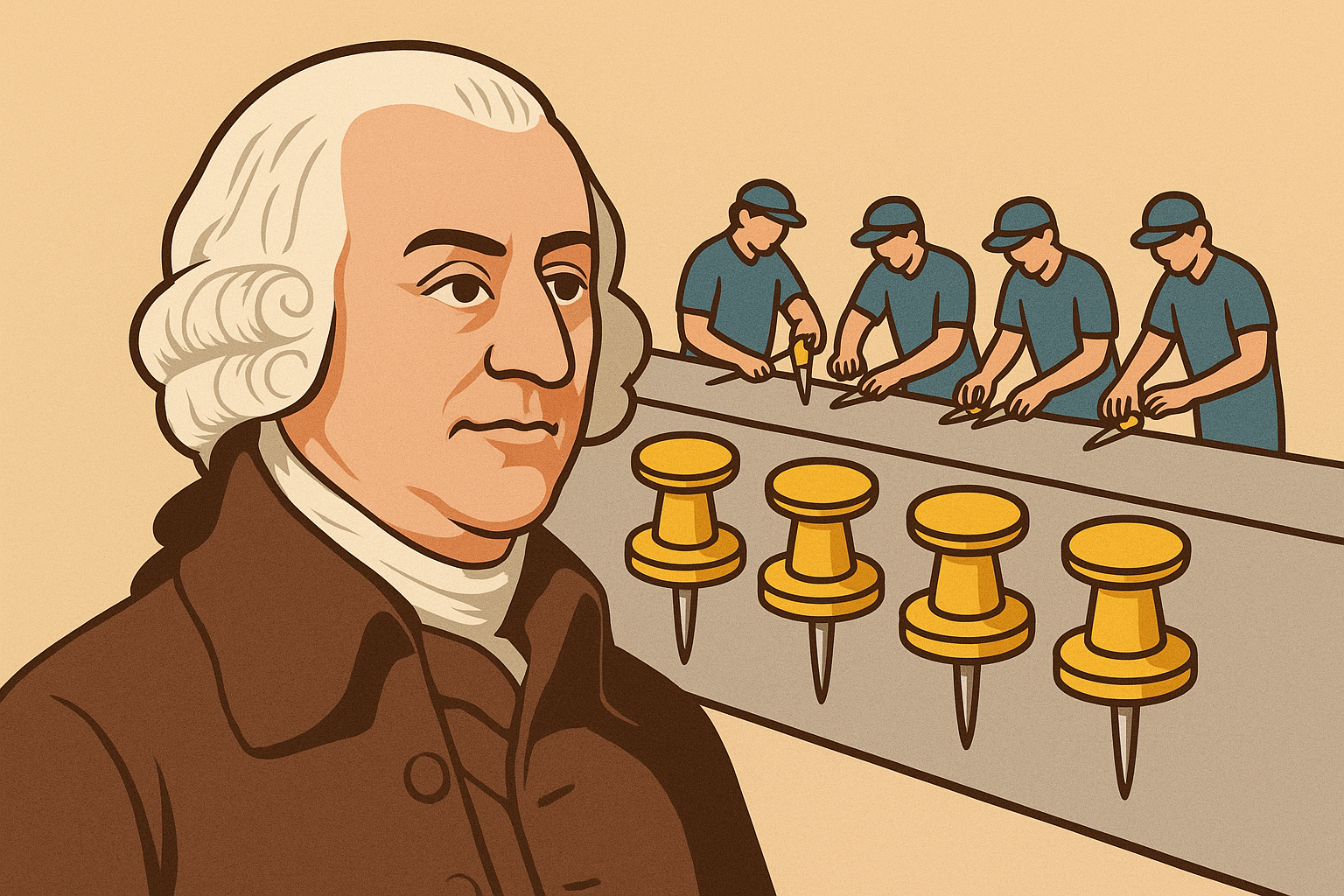
Adam smith observing work behaviour in a factory
-
Based on observations made during a visit to a pin factory, famous economist Adam Smith developed the ideas of specialisation and the division of labour
- He noted that a single worker could not make more than 20 pins a day as it involved around 18 different processes, such as cutting the wire, sharpening the end, stamping the head etc.
- However, if the labour was divided up into different tasks and workers specialised in just that one task, Adam Smith estimated that just 10 workers could produce 48,000 pins per day
-
Specialisation occurs on several different levels
- On an individual level
- On a business level, for example, one firm may only specialise in manufacturing drill bits for concrete work
- On a regional level, for example, Silicon Valley has specialised in the tech industry
- On a global level, as countries seek to trade, for example Bangladesh specialises in textiles and exports them to the world
Advantages and disadvantages of the division of labour
Spec point — Advantages and disadvantages of the division of labour
Evaluating the impact on workers, firms and the ecnomy
| Stakeholder | Pros | Cons |
|---|---|---|
| Worker | - Workers can acquire the single skill required relatively quickly - Workers gain recognition and status for performing their skill well | - The work can be repetitive and boring - There is limited opportunity to gain additional skills - If the firm replaces labour with capital, the worker may find it difficult to find employment elsewhere due to their limited skill base |
| Firm | - Time spent training new workers is relatively short - Increased output allows firms to generate more sales and profit - Higher labour productivity lowers cost per unit for firms, which makes their goods more competitive internationally (exports) | - Worker productivity can fall due to the boredom/ decreased motivation experienced - Staff turnover may be high as workers seek new, interesting opportunities elsewhere - International trade is beneficial for the firms that can compete globally. However, some firms will be unable to compete and will go out of business - Entire industries may close leading to structural unemployment |
| Economy | - Increased exports can result in economic growth for the nation - Economic growth usually leads to higher income and a better standard of living - Income gained from exports can be used to purchase other goods from around the world (imports). This increases the variety of goods available in a country | - Specialisation may create over-dependency on other countries' resources - This may cause problems if conflict arises (E.g. Europe's reliance on Russian natural gas during the Ukraine crisis) - Specialisation using a country's own resources will lead to resource depletion |
Was this revision note helpful?
Build on this topic