Conditions of Demand (Cambridge International IGCSE Economics)
Shifts of the Demand Curve
Spec point —
2.3.2· A demand curve to be drawn and used to illustrate movements along a demand curve with appropriate terminology, for example extensions and contractions in demand.
-
There are numerous factors that will change the demand for a good/service, irrespective of the price level
- Collectively, these factors are called the conditions of demand
-
Changes to each of the conditions of demand, shift the entire demand curve (as opposed to a movement along the demand curve)
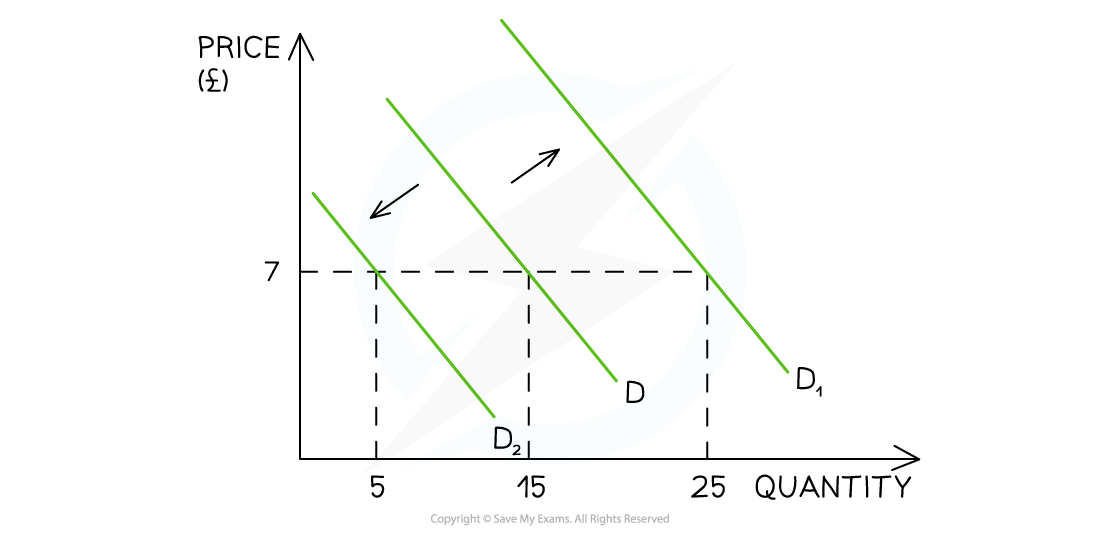
A graph that shows how changes to any of the conditions of demand shifts the entire demand curve left or right, irrespective of the price level
-
For example, if a firm increases their Instagram advertising, there will be an increase in demand as more consumers become aware of the product
-
This is a shift in demand from D to D1
- The price remains unchanged at £7 but the demand has increased from 15 to 25 units
-
How Each of the Conditions of Demand Shifts the Entire Demand Curve
| A Change in Real Income | |
|---|---|
| - Real Income determines how many goods/services can be enjoyed by consumers - There is a direct relationship between income and demand for goods and services | - Income increases - D Increases - Shifts right - (D→D1) - Income decreases - D Decreases - Shifts left - (D→D2) |
| A Change in Tastes and Fashion | |
| - If goods and services become more fashionable, then demand for them increases - There is a direct relationship between changes in taste/fashion and demand | - Good becomes more fashionable - D Increases - Shifts right - (D→D1) - Good becomes less fashionable - D Decreases - Shifts left - (D→D2) |
| Improved Advertising and Branding | |
| - If more money is spent on advertising or branding, then demand for goods and services will increase as more consumers become aware of the product - There is a direct relationship between branding or advertising and demand | - Advertising increases - D Increases - Shifts Right - (D→D1) - Advertising decreases - D Decreases - Shifts left - (D→D2) |
| Changes in the Prices of Substitute Goods | |
| - Changes in the price of substitute goods will influence the demand for a product/service - There is a direct relationship between the price of good A and demand for good B - For example, the price of a Sony 60" TV increases so the demand for LG 60" TV increases | - Price of Good A increases - D for Good B increases - Shifts Right - (D→D1) - Price of Good A decreases - D for Good B decreases - Shifts left - (D→D2) |
| Changes in the Prices of Complementary goods | |
| - Changes in the price of complementary goods will influence the demand for a product/service - There is an inverse relationship between the price of good A and demand for good B - E.g. The price of printer ink increases so the demand for ink printers decreases | - Price of Good A increases - D for Good B decreases - Shifts left - (D→D2) - Price of Good A decreases - D for Good B increases - Shifts right - (D→D1) |
| Changes in Population Size or Distribution | |
| - If the population size of a country changes over time, then the demand for goods/services will also change - There is a direct relationship between the changes in population size and demand - Demand will also change if there is a change to the age distribution in a country, as different ages demand different goods and services E.g. An ageing population will buy more hearing aids | - Population Increases - D Increases Shifts Right (D→D1) - Population Decreases - D Decreases Shifts Left (D→D2) |
Exam Hint The difference between a movement along the demand curve and a shift in demand is essential to understand. You will be repeatedly examined on this and it is important that you use the correct language to show that you understand the difference between a change in quantity demanded and a change in demand.
When price changes (ceteris paribus), there is a movement along the demand curve resulting in a change to quantity demanded. When a condition of demand changes, there is a shift of the entire demand curve resulting in a change to demand.
Was this revision note helpful?
Build on this topic