Silicon(IV) Oxide (Cambridge International IGCSE Chemistry)
Exam board Cambridge International · IGCSEUpdated 2024-09-23
Structure of silicon(IV) oxide
Spec point —
2.4.2· Describe the giant covalent structure of silicon(IV) oxide, SiO2
What is the structure of silicon(IV) oxide?
Extended tier only
- Silicon(IV) oxide (also known as silicon dioxide or silica), SiO2, is a macromolecular compound which occurs naturally as sand and quartz
- Each oxygen atom forms covalent bonds with 2 silicon atoms and each silicon atom in turn forms covalent bonds with 4 oxygen atoms
- A tetrahedron is formed with one silicon atom and four oxygen atoms, similar to diamond
The structure of silicon(IV) oxide
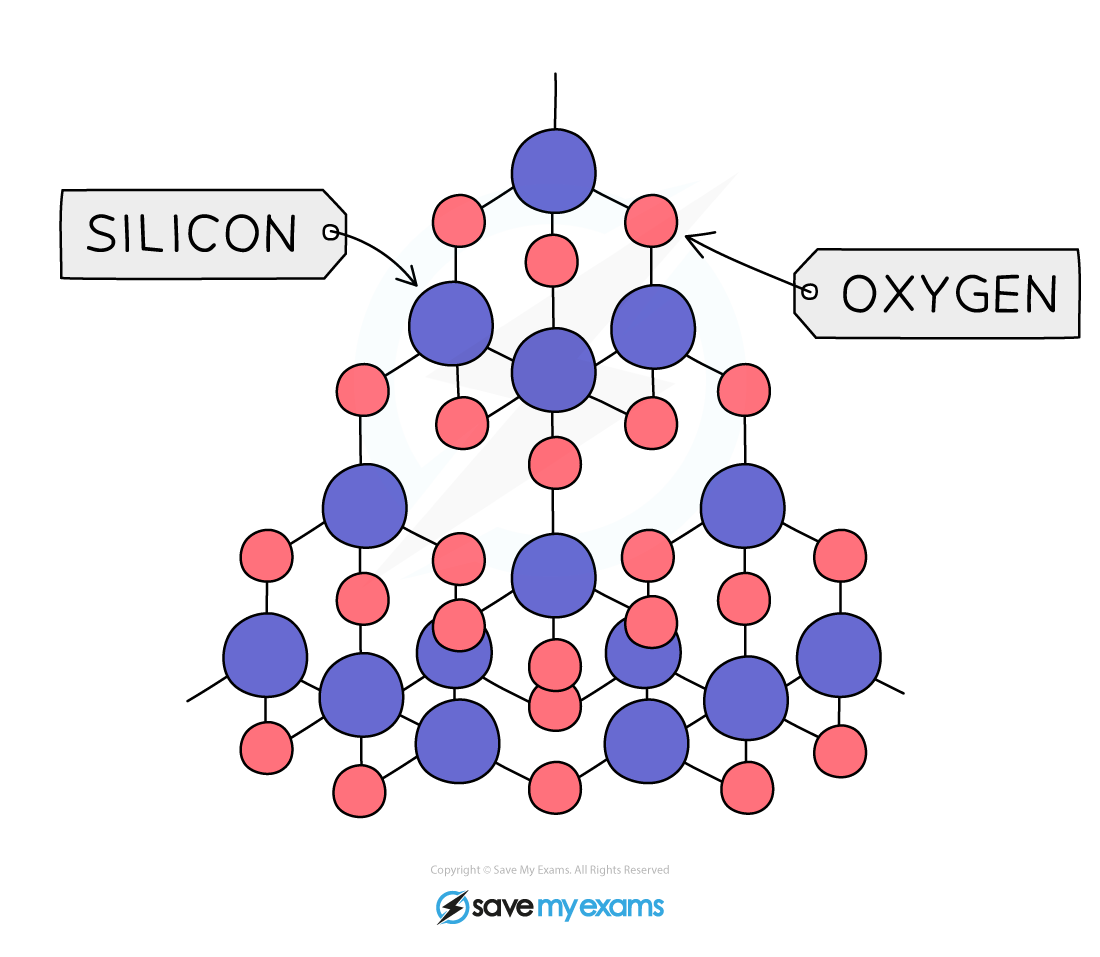
Diagram showing the structure of SiO2with the silicon atoms in blue and the oxygen atoms in red
Comparing diamond & silicon(IV) oxide
Spec point —
2.4.2· Describe the similarity in properties between diamond and silicon(IV) oxide, related to their structures
How does diamond compare to silicon(IV) oxide?
Extended tier only
- SiO2 has lots of very strong covalent bonds and no intermolecular forces so it has similar properties to diamond
- It is very hard, has a very high boiling point, is insoluble in water and does not conduct electricity
- SiO2 is cheap since it is available naturally and is used to make sandpaper and to line the inside of furnaces
Was this revision note helpful?
Build on this topic