Formulae (Cambridge International IGCSE Chemistry)
Molecular formulae
Spec point —
3.1.1· State the formulae of the elements and compounds named in the subject content
Define the molecular formula of a compound as the number and type of different atoms in one molecule Deduce the formula of a simple compound from the relative numbers of atoms present in a model or a diagrammatic representation
Molecular formulae
- Elements are often represented using their chemical symbol from the Periodic Table
Chemical symbols of elements table
| Element | Symbol | Element | Symbol |
|---|---|---|---|
| Lithium | Li | Calcium | Ca |
| Chromium | Cr | Gold | Au |
| Aluminium | Al | Sulfur | S |
-
Seven elements exist as diatomic molecules, which means that they are molecules made of two atoms:
- Hydrogen, H2
- Nitrogen, N2
- Oxygen, O2
- Fluorine, F2
- Chlorine, Cl2
- Bromine, Br2
- Iodine, I2
Periodic Table identifying the 7 diatomic elements
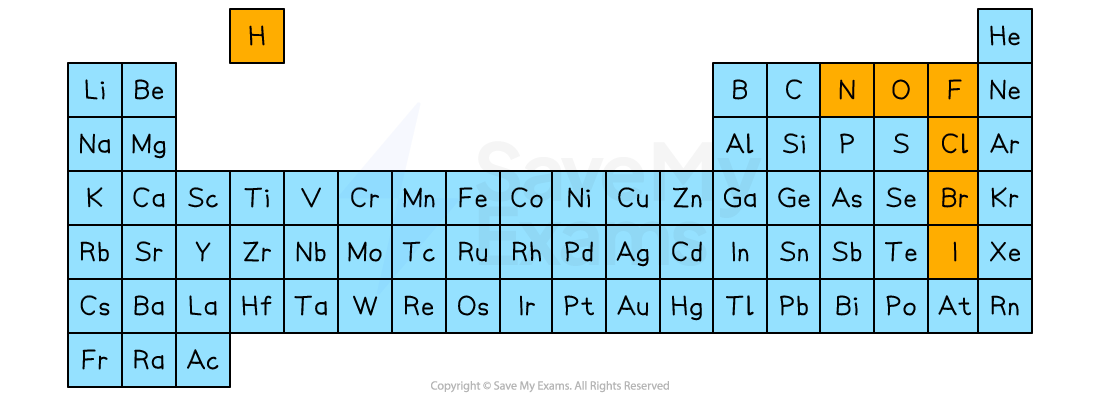
The highlighted elements all exist as diatomic molecules with the formula X2
-
These 7 elements are also classed as simple molecules
-
Atoms combine together in fixed ratios that will give them full outer shells of electrons
- When this happens, a molecule is formed
-
The molecular formula of a molecule shows:
- The type of atoms involved, given by the chemical symbol AND
- The number of atoms, given by the subscript (little) number after a chemical symbol
Examples of molecular formulae
| Substance | Molecular formula | Made from |
|---|---|---|
| Hydrogen | H2 | 2 hydrogen atoms |
| Chlorine | Cl2 | 2 chlorine atoms |
| Water | H2O | 2 hydrogen atoms 1 oxygen atom |
| Methane | CH4 | 1 carbon atom 4 hydrogen atoms |
| Ammonia | NH3 | 1 nitrogen atom 3 hydrogen atoms |
| Sulfuric acid | H2SO4 | 2 hydrogen atoms 1 sulfur atom 4 oxygen atoms |
-
The table also shows that the molecular formula can be deduced from the relative number of atoms present
- E.g. Ammonia contains 3 atoms of hydrogen and 1 atom of nitrogen, which means its molecular formula is NH3
Diagrammatic representation of chemicals
- Diagrams or models can be used to represent and/or deduce the molecular formula of elements and simple compounds:
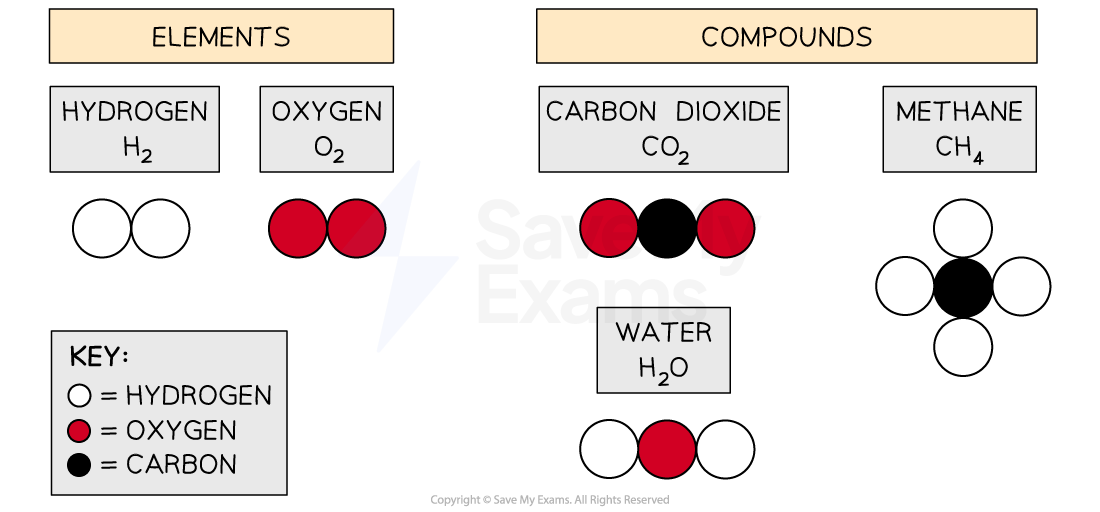
When simple molecules are represented using coloured atoms, a key is used to show the colours for each type of atom
-
Using the water examples, it is important to know that these representations also show the arrangement of the atoms in the molecule
-
Water, H2O
- The hydrogen atoms are on either side of the oxygen atom
- It does not have two hydrogen atoms and an oxygen atom all joined together in a row
-
Worked Example What is the molecular formula of the following compound?
Answer:
The molecule contains:
- 4 carbon atoms
- 10 hydrogen atoms
Therefore, the molecular formula is C4H10

Was this revision note helpful?
Build on this topic