Enthalpy Change & Activation Energy (Cambridge International IGCSE Chemistry)
Spec point —
5.1.2· State that the transfer of thermal energy during a reaction is called the enthalpy change, ∆H, of the reaction. ∆H is negative for exothermic reactions and positive for endothermic reactions Define activation energy, Ea, as the minimum energy that colliding particles must have to react
Enthalpy change & activation energy
Extended tier only
-
For atoms or particles to react with each other in a chemical system they must collide together
-
A number of factors affect the success of a collision:
- Energy
- Orientation
- Number of collisions per second - the frequency of collisions
What is activation energy?
-
In terms of the energy of collisions, there is a minimum amount of energy required for a successful collision
- A successful collision is where the particles in the reactant(s) are rearranged to form the products
-
This minimum amount of energy is called the activation energy, Ea
-
Different reactions have different activation energies, depending on the chemical identities involved
-
Reactions with higher activation energies require more energy to start than those with lower activation energies
What is enthalpy change?
-
The transfer of thermal energy during a reaction is called the enthalpy change, ΔH, of the reaction.
-
ΔH is:
- Positive for an endothermic reaction
- Negative for an exothermic reaction
Reaction pathway diagrams
Spec point —
5.1.2· Draw and label reaction pathway diagrams for exothermic and endothermic reactions using information provided, to include: reactants (b) products enthalpy change of the reaction, ∆H activation energy, Ea
Reaction pathway diagrams
Extended Tier Only
Exothermic reactions
-
A reaction is exothermic when more energy is released forming new bonds for the products than absorbed breaking the bonds in the reactants
-
So, the products have less energy than the reactants
- This means that the change in energy is negative
-
Therefore, an exothermic reaction has a negative value for enthalpy, ΔH
-
The reaction pathway diagram for an exothermic reaction is:
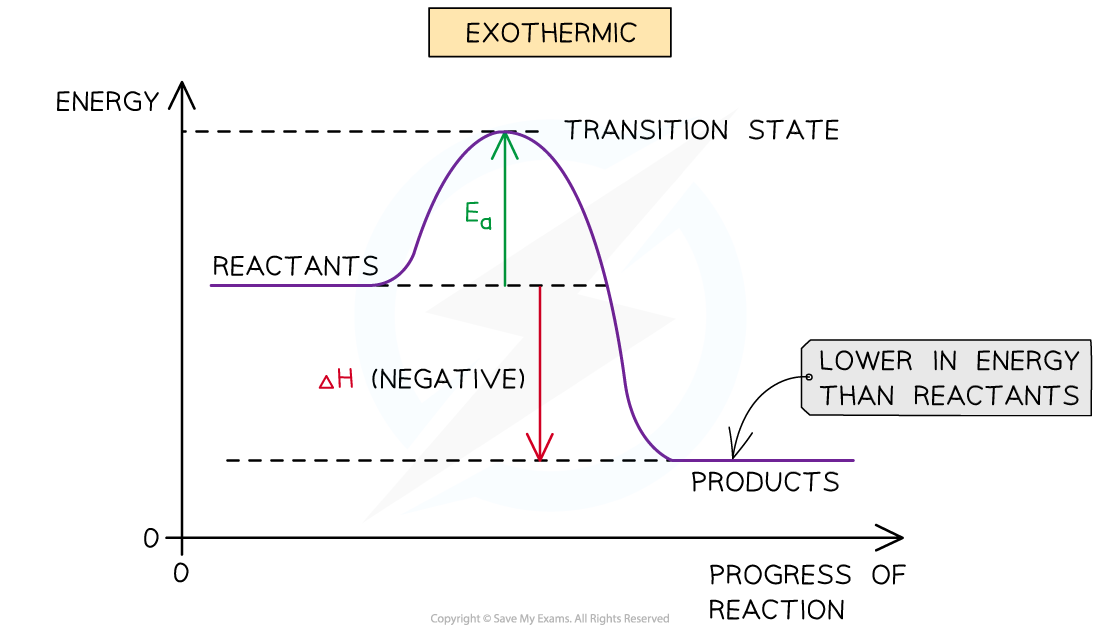
The reaction pathway diagram for exothermic reactions
Endothermic reactions
-
A reaction is endothermic when more energy is absorbed breaking the bonds in the reactants than released forming new bonds for the products
-
So, the products have more energy than the reactants
- This means that the change in energy is positive
-
Therefore, an endothermic reaction has a positive value for enthalpy, ΔH
-
The reaction pathway diagram for an endothermic reaction is:
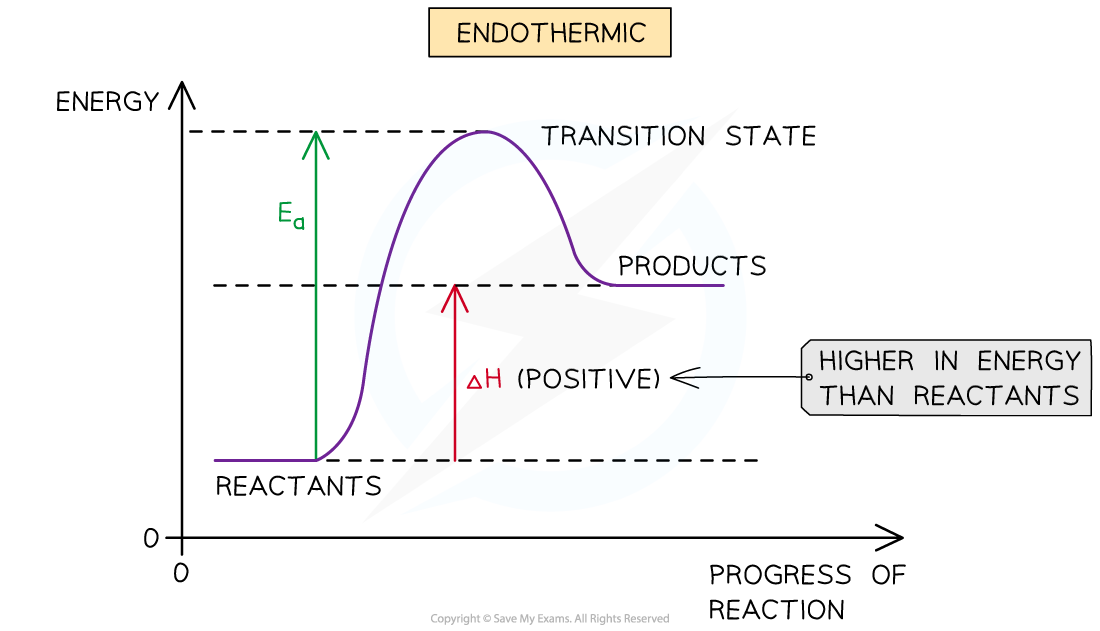
The reaction pathway diagram for endothermic reactions.
Exam Hint You must be able to draw these pathway diagrams and label the following parts:
- Reactants
- Products
- Enthalpy change of the reaction, ΔH
- Activation energy, Ea
Was this revision note helpful?