Group I Properties (Cambridge International IGCSE Chemistry)
Group I properties & trends: basics
Spec point —
8.2.1· Describe the Group I alkali metals, lithium, sodium and potassium, as relatively soft metals with general trends down the group, limited to: decreasing melting point increasing density increasing reactivity
Group I properties & trends: basics
-
The Group I metals are called the alkali metals
- This is because they form alkaline solutions(with high pH values) when reacted with water
-
Group I metals include:
- Lithium, Li
- Sodium, Na
- Potassium, K
-
They all contain just one electron in their outer shell
Physical properties of the Group I metals
- The Group I metals:
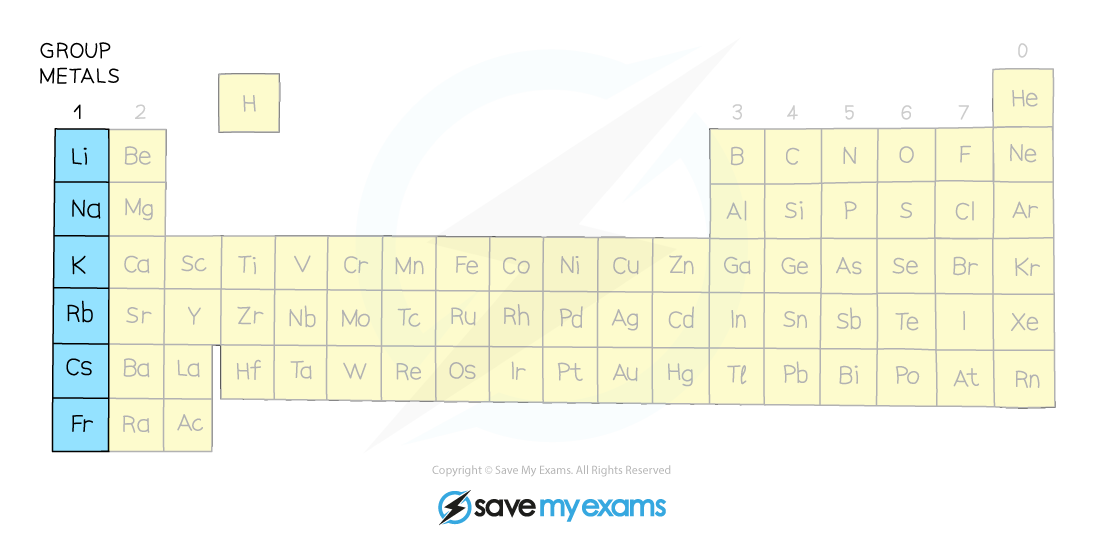
The alkali metals lie on the far left-hand side of the Periodic Table
-
Are soft and easy to cut
- They get softer down the Group
-
Have shiny silvery surfaces when freshly cut
-
Conduct heat and electricity
-
Have low melting points compared to other metals
- The melting point generally decreases as you move down the Group
- Some would melt on a hot day
-
Have low densities compared to other metals
Chemical properties of the Group I metals
-
They react readily with oxygen and water vapour in air
- This is why they are stored under oil, to stop them from reacting
-
Group I metals will react similarly with water
- They react to form an alkaline metal hydroxide solution and hydrogen gas
2M (s) + 2H2O (l) → 2MOH (aq) + H2(g)
-
The Group I metals get more reactive as you move down the group
- Only the first three metals are allowed in schools for demonstrations
Reactions of the Group I metals and water
Lithium
lithium + water → lithium hydroxide + hydrogen
2Li (s) + 2H2O (l) → 2LiOH (aq) + H2 (g)
-
Observations:
- Relatively slow reaction
- Fizzing
- Lithium moves on the surface of the water
Sodium
sodium + water → sodium hydroxide + hydrogen
2Na (s) + 2H2O (l) → 2NaOH (aq) + H2 (g)
-
Observations:
- More vigorous fizzing
- Moves rapidly on the surface of the water
- Dissolves quickly
Potassium
potassium + water → potassium hydroxide + hydrogen
2K (s) + 2H2O (l) → 2KOH (aq) + H2 (g)
-
Observations:
- Reacts more vigorously than sodium
- Burns with a lilac flame
- Moves very rapidly on the surface
- Dissolves very quickly
General trends of the Group I metals
-
As you move down the group:
-
Melting point decreases
-
Density increases
- There is an exception in the early part of the group
-
Reactivity (with water) increases
-
Predicting the Properties of Group I Elements
Spec point —
8.2.1· Predict the properties of other elements in Group I, given information about the elements
- Knowing the reactions of elements at the top of the group allows you to predict the properties of other elements further down Group I
Properties of other alkali metals
-
The reactivity of alkali metals increases down the group
-
This means that rubidium, caesium and francium will react more vigorously with air and water than lithium, sodium and potassium
- Lithium will be the least reactive metal at the top of the group
- Francium will be the most reactive at the bottom
-
Francium is rare and radioactive so is difficult to confirm predictions
-
For example the reactions with water can be predicted:
Predicting the reaction with water
Rubidium
-
Predicted observations:
- Very violent reaction
- May explode with sparks
Caesium
-
Predicted observations:
- Extremely violent reaction
- Can explode due to rapid production of heat and hydrogen
Francium
-
Predicted observations:
- Extremely reactive
- Difficult to confirm experimentally due to rarity and radioactivity
You can use any given data for Group 1 elements to identify trends and make predictions about other elements in the group.
Was this revision note helpful?
Build on this topic