Calculating Concentration (Cambridge International IGCSE Chemistry)
Units of concentration
Spec point — State that concentration can be measured in g /dm3 or mol/dm3
-
A solute is a solid substance that dissolves into a liquid
- The amount of solute can be expressed in grams (g) or moles (mol)
-
A solvent is the liquid that a solute dissolves in
- The amount / volume of a solvent is measured in cm3 or dm3
-
Most chemical reactions occur between solutes which are dissolved in solvents, such as water or an organic solvent
-
A solution is the mixture formed when a solute dissolves in a solvent
- The amount / volume of a solution measured in cm3 or dm3
-
Concentration refers to the amount of solute there is in a specific volume of the solvent
-
The greater the amount of solute in a given volume, the greater the concentration
-
Concentration is sometimes commonly referred to as strength
- For example, dissolving more coffee in hot water results in a stronger coffee
-
-
Typically, concentration is expressed in terms of the amount of substance per dm3
-
Therefore, the units of concentration are:
- g / dm3
- mol / dm3
-
Calculating concentration
Spec point — Calculate stoichiometric reacting masses, limiting reactants, volumes of gases at r.t.p., volumes of solutions and concentrations of solutions expressed in g /dm3 and mol/dm3 , including conversion between cm3 and dm3
Extended tier only
Calculating concentration using mass
- The general formula to calculate the concentration in g / dm3 is:
concentration (g / dm3) =
-
Concentration can also be measured in grams per cubic decimetre
- 1 decimetre cubed (dm3) = 1000 cm3
- 1 decimetre cubed (dm3) is the same as 1 litre
-
You may be given data in a question which needs to be converted from cm3 to dm3 or the other way around
Converting cm3 and dm3

To go from cm3to dm3 divide by 1000. To go from dm3 to cm3multiply by 1000
Worked Example A student dissolved 10 g of sodium hydroxide, NaOH, in 2 dm3 of distilled water. Calculate the concentration of the solution in g / dm3.
Answer:
Write down the information you are given in the question:
- Mass of solute: 10 g
- Volume of solution: 2 dm3
Calculate the concentration:
- Concentration =
- Concentration = = 5 g / dm3
Calculating concentration using moles
- It is more useful to a chemist to express concentration in terms of moles per unit volume rather than mass per unit volume
- Concentration can therefore be expressed in moles per decimetre cubed and calculated using the following equation:
-
We can modify the concentration formula to include moles
- The units in the answer can be written as mol / dm3 (this can also be written as mol dm-3)
-
You may have to convert from g / dm3 into mol / dm3 and vice versa depending on the question
-
To go from g / dm3 to mol / dm3
- Divide by the molar mass in grams
-
To go from mol / dm3 to g / dm3
- Multiply by the molar mass in grams
-
Some students find formula triangles help them to understand the relationship:
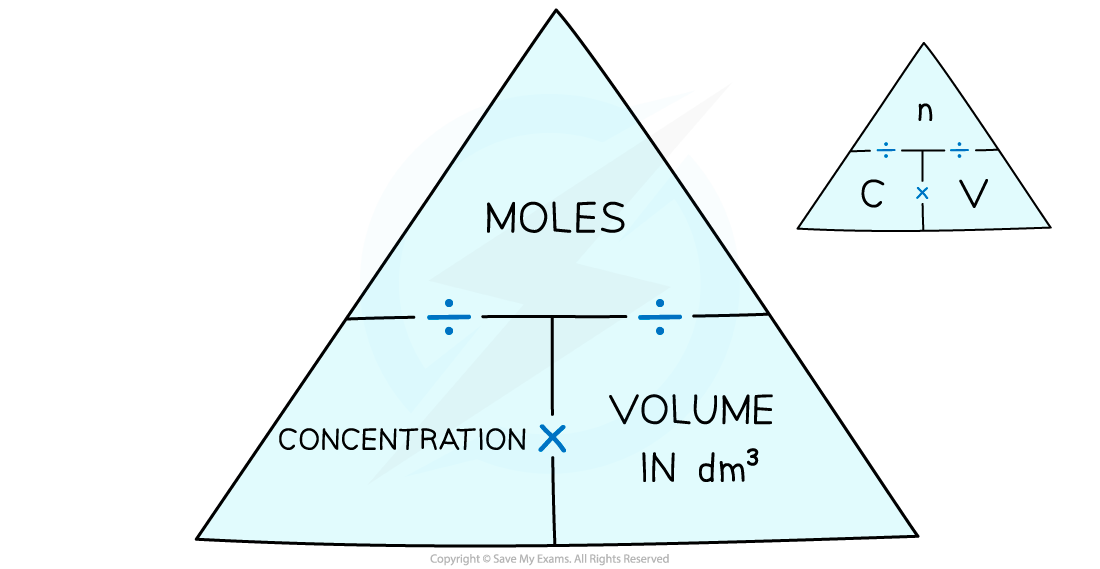
The concentration-moles formula triangle can help you solve these problems
Worked Example Calculate the amount of solute, in moles, present in 2.5 dm3 of a solution whose concentration is 0.2 mol / dm3.
Answer:
Write down the information you are given in the question:
- Concentration of solution: 0.2 mol / dm3
- Volume of solution: 2.5 dm3
Calculate the number of moles:
- Moles = concentration x volume
- Moles = 0.2 x 2.5 = 0.5 mol
Worked Example Calculate the concentration of a solution of sodium hydroxide, NaOH, in mol / dm3, when 80 g is dissolved in 500 cm3 of water.
Relative atomic masses, Ar: Na = 23; H = 1; O = 16
Answer:
Calculate the Mr of NaOH:
- 23 + 16 + 1 = 40
Determine the number of moles of NaOH:
- 40 g = 1 mole
- So, 80 g = 2 moles
Convert cm3 to dm3:
- = 0.5 dm3
Calculate the concentration:
- Concentration =
- Concentration = = 4 mol / dm3
Worked Example 25.0 cm3 of 0.050 mol / dm3 sodium carbonate was completely neutralised by 20.00 cm3 of dilute hydrochloric acid. Calculate the concentration in mol / dm3 of the hydrochloric acid.
Na2CO3 + 2HCl → 2NaCl + H2O + CO2
Answer:
Calculate the moles of sodium carbonate:
Moles of Na2CO3 = concentration x volume
- Remember: The volume needs to be in dm3
Moles of Na2CO3 = 0.05 x = 0.00125
Calculate the moles of hydrochloric acid:
- The balanced symbol equation shows that 1 mole of Na2CO3 reacts with 2 moles of HCl
- So, 0.00125 moles of Na2CO3 reacts with 0.00250 moles of HCl
Calculate the concentration of hydrochloric acid:
Concentration =
- Remember: The volume needs to be in dm3
- 20 cm3 ÷ 1000 = 0.02 dm3
Concentration = = 0.125 mol / dm3
Exam Hint Remember: Always convert the units from cm3 to dm3 by dividing by 1000.
Was this revision note helpful?
Build on this topic