Acid-Base Titrations (Cambridge International IGCSE Chemistry)
Exam board Cambridge International · IGCSEUpdated 2025-09-30
Spec point —
12.1.3· Describe an acid–base titration to include the use of a: burette volumetric pipette suitable indicator
- Describe how to identify the end-point of a titration using an indicator
Acid-base titrations
- Titrations are a method of analysing the concentration of solutions
- They can determine exactly how much alkali is needed to neutralise a quantity of acid – and vice versa
- You may be asked to perform titration calculations to determine the moles present in a given amount or the concentration /volume required to neutralise an acid or a base
- Titrations can also be used to prepare salts
Apparatus
- 25 cm3 volumetric pipette
- Pipette filler
- 50 cm3 burette
- 250 cm3 conical flask
- Small funnel
- 0.1 mol / dm3 sodium hydroxide solution
- Sulfuric acid of unknown concentration
- A suitable indicator
- Clamp stand, clamp & white tile
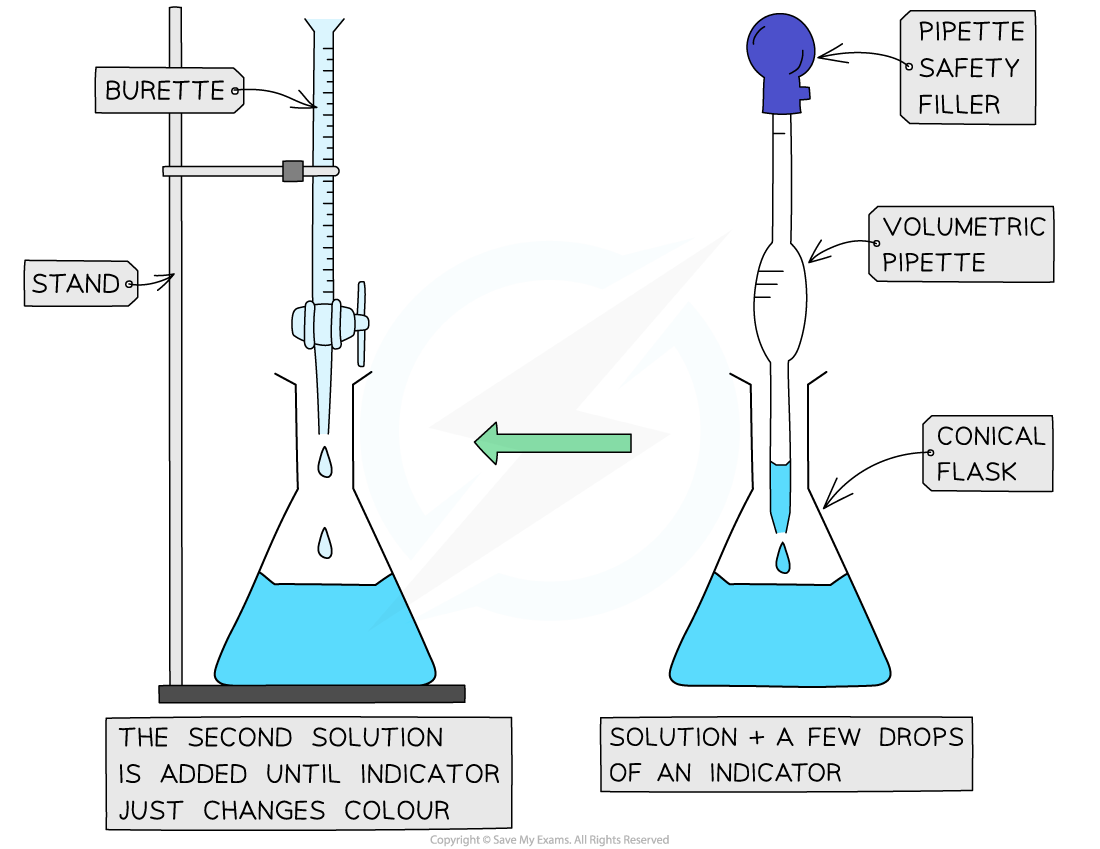
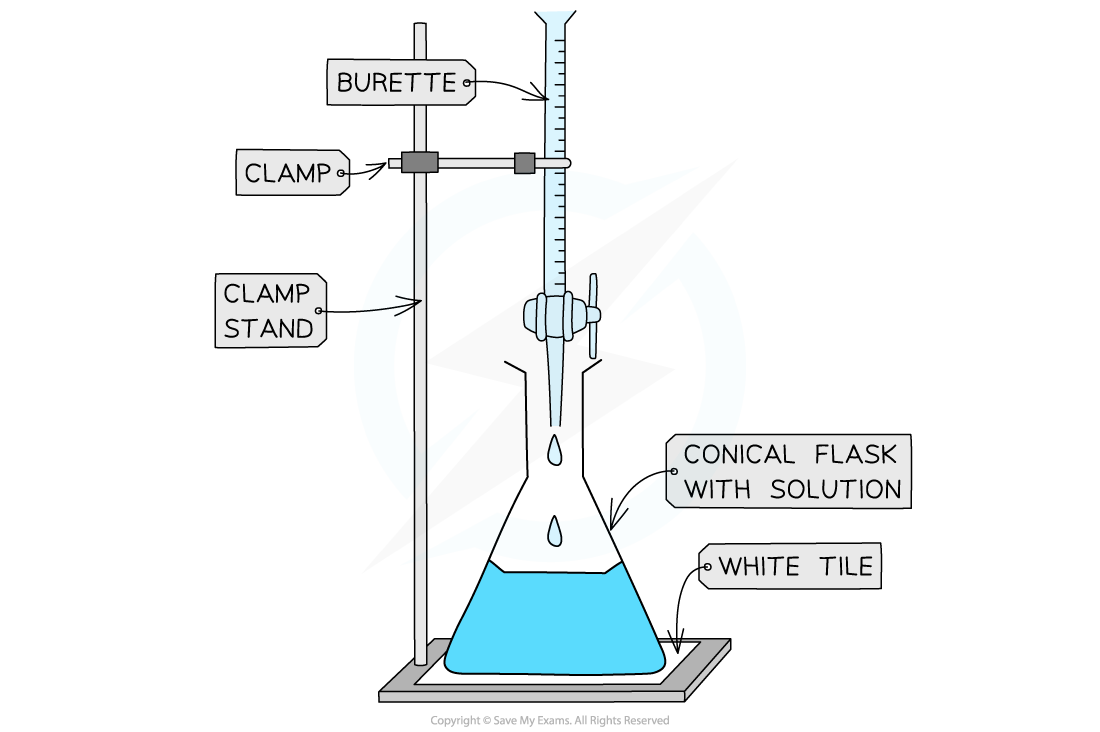
The steps in performing a titration
Method
- Use the pipette and pipette filler and place exactly 25 cm3 sodium hydroxide solution into the conical flask
- Using the funnel, fill the burette with hydrochloric acid placing an empty beaker underneath the tap. Run a small portion of acid through the burette to remove any air bubbles
- Record the starting point on the burette to the nearest 0.05 cm3
- Place the conical flask on a white tile so the tip of the burette is inside the flask
- Add a few drops of a suitable indicator to the solution in the conical flask
- Perform a rough titration by taking the burette reading and running in the solution in 1 – 3 cm3 portions, while swirling the flask vigorously
- Quickly close the tap when the end-point is reached
- The endpoint is when one drop causes a sharp colour change
- Record the volume of hydrochloric acid added, in a suitable results table as shown below
- Make sure your eye is level with the meniscus
- Repeat the titration with a fresh batch of sodium hydroxide
- As the rough end-point volume is approached, add the solution from the burette one drop at a time until the indicator just changes colour
- Record the volume to the nearest 0.05 cm3
- Repeat until you achieve two concordant results (two results that are within 0.1 cm3 of each other) to increase accuracy
| Rough titre | Titre 1 | Titre 2 | Titre 3 | |
|---|---|---|---|---|
| Final reading (cm3) | ||||
| First reading (cm3) | ||||
| Titre (cm3) |
Exam Hint Common errors during a titration include:
Not removing the funnel from the burette
- This can lead to some liquid dripping into the burette and cause false / high readings
Not filling the jet space of the burette
- The jet space is the part of the burette after the tap
- Not filling this space can lead to false readings
Reading the volume from the burette incorrectly
- Readings should be taken from the bottom of the meniscus
- Careful: The scale on the burette has 0.0 cm3 at the top and 50 cm3 (typically) at the bottom
Indicators
-
Indicators are used to show the endpoint in a titration
-
Wide range indicators such as litmus are not suitable for titration as they do not give a sharp colour change at the endpoint
- However, methyl orange and phenolphthalein are very suitable
-
Some of the most common indicators with their corresponding colours are shown below:
Common acid-base indicators
| Indicator | Colour in acid | Colour in alkali | Colour in neutral |
|---|---|---|---|
| Litmus solution | Red | Blue | Purple |
| Red litmus paper | Stays red | Turns blue | No change |
| Blue litmus paper | Turns red | Stays blue | No change |
| Methyl orange | Red | Yellow | Orange |
| Phenolphthalein | Colourless | Pink | Colourless |
| Thymolphthalein | Colourless | Blue | Colourless |
Was this revision note helpful?
Build on this topic