Alloys (Cambridge International IGCSE Chemistry)
Properties & uses of alloys
Spec point — Describe an alloy as a mixture of a metal with other elements, including: brass as a mixture of copper and zinc stainless steel as a mixture of iron and other elements such as chromium, nickel and carbon State that alloys can be harder and stronger than the pure metals and are more useful Identify representations of alloys from diagrams of structure Describe the uses of alloys in terms of their physical properties, including stainless steel in cutlery because of its hardness and resistance to rusting
Properties & uses of alloys
-
An alloy is a mixture of a metal with other elements
- Most alloys contain more than one metal
- Some alloys contain non-metals
Properties and uses of alloys
-
Two examples of alloys are:
-
Brass- an alloy of copper and zinc and is much stronger than either metal
- It is used in musical instruments, ornaments and door knobs
-
Stainless steel - an alloy of iron and other elements, for example, chromium, nickel and carbon
- It is used in cutlery because of its hardness and resistance to corrosion / rusting
-
-
Other alloys include:
- Iron with tungsten - extremely hard and resistant to high temperatures
- Iron with chromium / nickel - resistant to corrosion
- Aluminium with copper, manganese and silicon - the alloy is stronger but still has a low density, which makes it ideal for aircraft body production
-
Alloys often have properties that are different to the metals they contain
-
For example, they can be:
- Stronger
- Harder
- Resistant to corrosion / extreme temperatures
-
These enhanced properties can make alloys more useful than pure metals
-
The structure of an alloy
-
Alloys have a different structure to metals
- Metals have a regular arrangement of ions
- Alloys have an irregular arrangement of atoms
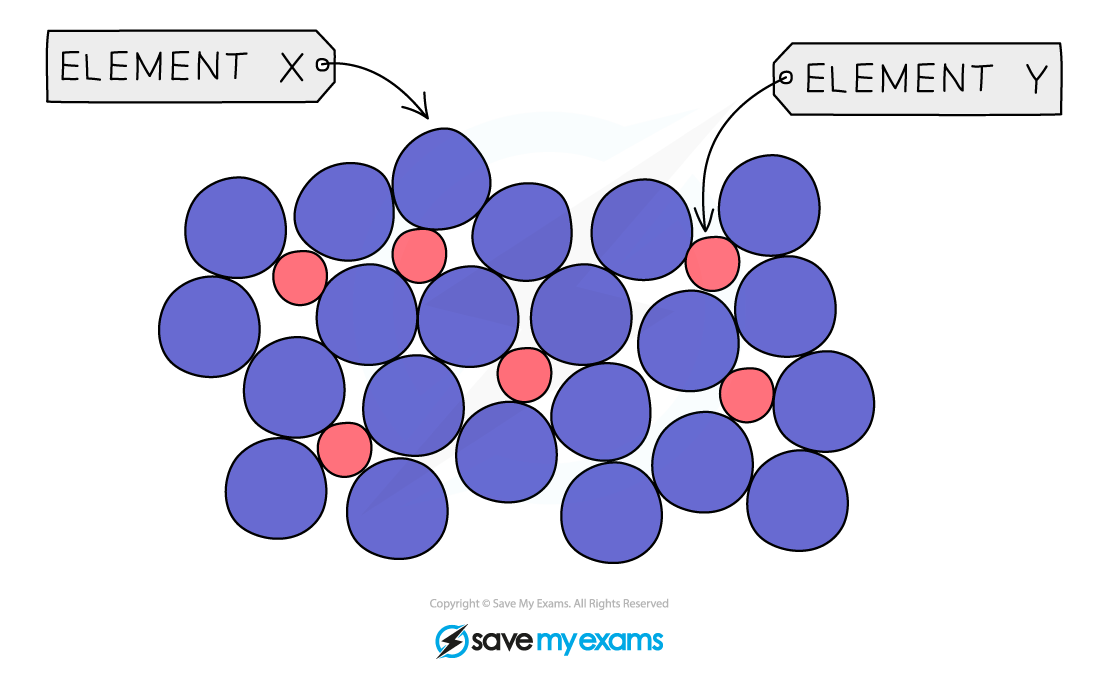
The regular arrangement of a metal lattice structure is distorted in alloys
Exam Hint
Alloys are mixtures of substances.
- They are not chemically combined, which means that alloys are not compounds.
Questions on this topic often give you a selection of particle diagrams and ask you to choose the one which represents an alloy.
- It will be the diagram with uneven-sized particles and distorted layers or rows of particles.
Explaining the properties of alloys
Spec point —
9.3.5· Explain in terms of structure how alloys can be harder and stronger than the pure metals because the different sized atoms in alloys mean the layers can no longer slide over each other
Extended tier only
-
Alloys typically contain atoms of different sizes
-
This distorts the normally regular arrangements of atoms in metals
- The regular arrangement in a metal is layers of positive ions in a sea of delocalised electrons
-
The distortion makes it more difficult for the layers to slide over each other
-
So, alloys are usually harder / stronger than pure metals
Was this revision note helpful?