Identification of Anions (Cambridge International IGCSE Chemistry)
Spec point —
12.3.1· Describe tests to identify the anions: carbonate, CO32–, by reaction with dilute acid and then testing for carbon dioxide gas chloride, Cl –, bromide, Br – , and iodide, I –, by acidifying with dilute nitric acid then adding aqueous silver nitrate nitrate, NO3–, reduction with aluminium foil and aqueous sodium hydroxide and then testing for ammonia gas sulfate, SO42–, by acidifying with dilute nitric acid and then adding aqueous barium nitrate sulfite, SO32–, by reaction with acidified aqueous potassium manganate(VII)
Identification of anions
-
Negatively charged non-metal ions are known as anions
-
You must be able to describe the tests for the following ions:
- Carbonate ions, CO32–
- Halide ions, Cl– , Br– , I–
- Nitrate ions, NO3–
- Sulfate ions, SO42–
- Sulfite ions, SO32–
Test for carbonate ions
-
Carbonate compounds contain the carbonate ion, CO32-
-
The test for the carbonate ion is:
- Add dilute acid
- Bubble the gas released through limewater
- Limewater turns cloudy if the carbonate ion is present
-
If a carbonate compound is present then fizzing / effervescence should be seen as CO2 gas is produced, which forms a white precipitate of calcium carbonate when bubbled through limewater:
CO32- (aq) + 2H+ (aq) → CO2 (g) + H2O (l)
CO2 (g) + Ca(OH)2(aq) → CaCO3(s) + H2O(l)
- The white precipitate turns limewater cloudy
Testing for carbonate ions
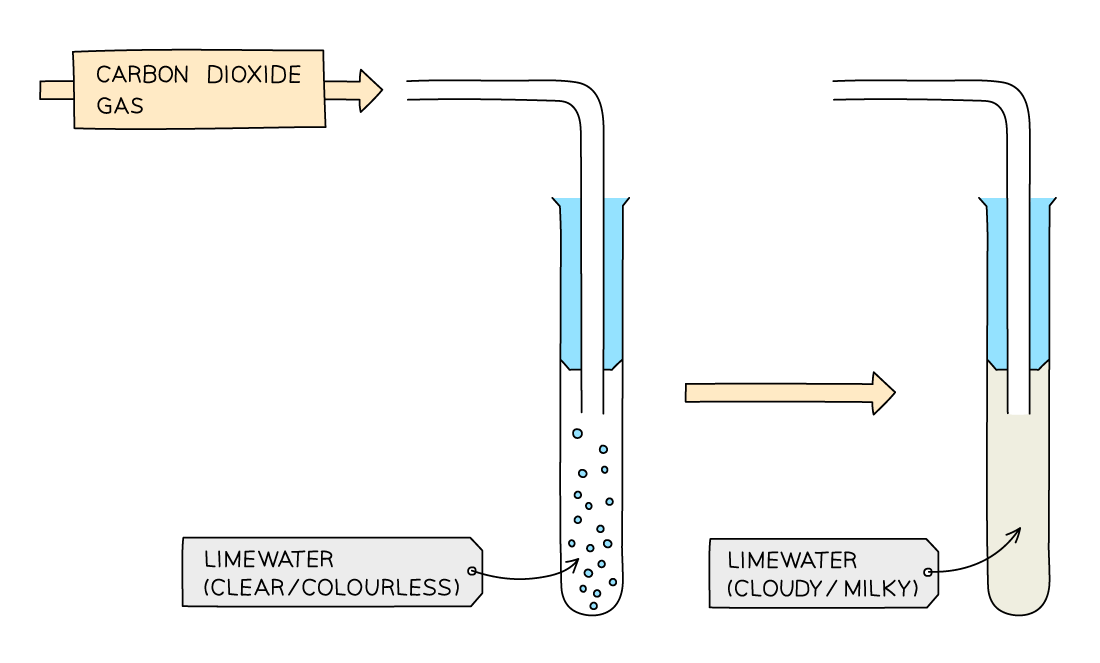
Limewater turns milky in the presence of carbon dixoide caused by the formation of insoluble calcium carbonate
Exam Hint
If you are asked to describe the test for carbonate ions, make sure that you say:
- Bubble the gas produced through limewater, which turns cloudy if the carbonate ion is present
Just saying that limewater turns cloudy is not enough
- This isn't describing the test, it is stating the result
Test for halide ions
-
Halide ions are the negative ions / anions formed by the elements in Group 7
-
The test for the halide ions is:
-
Acidify the sample with nitric acid
-
Add silver nitrate solution, AgNO3,
-
A silver halide precipitate forms if a halide ion is present
- The precipitate is indicated by the state symbol (s)
-
-
The colour of the silver halide precipitate depends on the halide ion:
- The chloride ion forms a white precipitate of silver chloride
potassium chloride + silver nitrate → potassium nitrate + silver chloride
KCl (aq) + AgNO3(aq) → KNO3(aq) + AgCl (s)
- The bromide ion forms a cream precipitate of silver bromide
potassium bromide + silver nitrate → potassium nitrate + silver bromide
KBr (aq) + AgNO3(aq) → KNO3(aq) + AgBr (s)
- The iodide ion forms a yellow precipitate of silver iodide
potassium iodide + silver nitrate → potassium nitrate + silver iodide
KI (aq) + AgNO3(aq) → KNO3(aq) + AgI (s)
Testing for halide ions
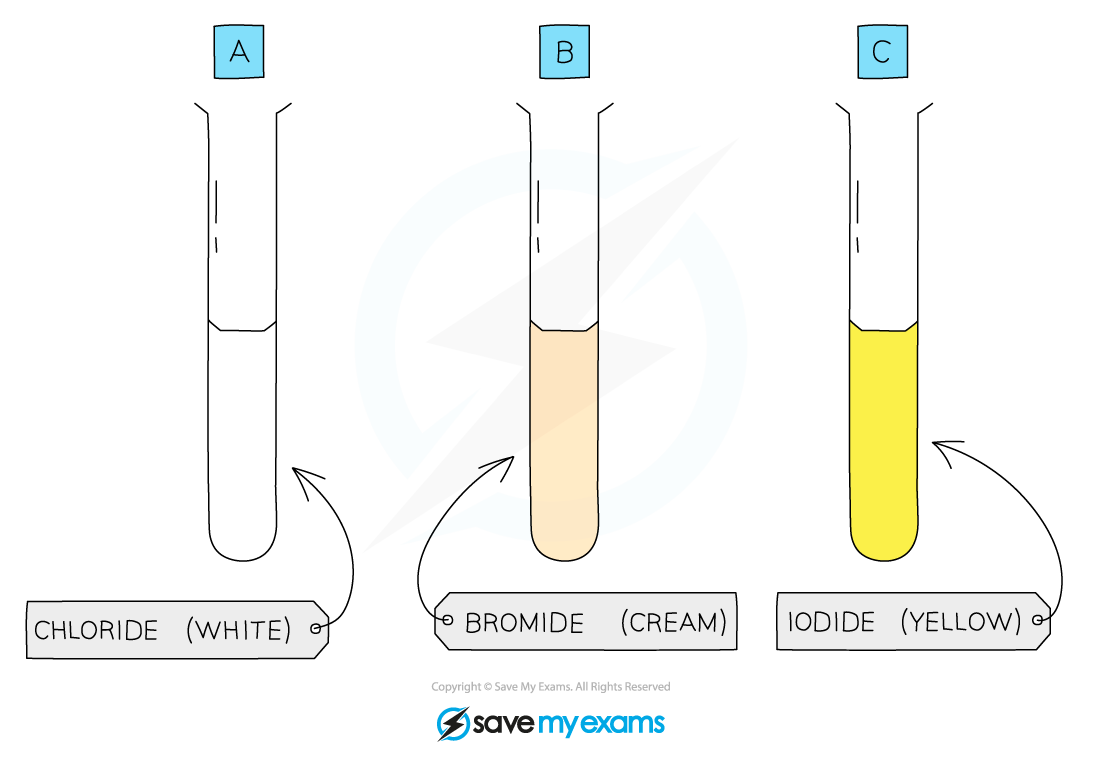
Each silver halide produces a precipitate of a different colour
Exam Hint The acidification step in the halide ion test must be done with nitric acid rather than hydrochloric acid.
HCl contains the chloride ion which would interfere with the results.
Test for nitrate ions
-
Nitrate compounds contain the nitrate ion, NO3–
-
The test for the nitrate ion is
- Add aqueous NaOH and aluminium foil
- Warm gently and test the gas released
- The gas given off is ammonia, NH3
-
Ammonia is a gas with a characteristic sharp choking smell that turns damp red litmus paper blue
Test for sulfate ions
-
Sulfate compounds contain the sulfate ion, SO42-
-
The test for the sulfate ion is:
- Acidify the sample with dilute nitric acid
- Add a few drops of barium chloride solution
- A white precipitate of barium sulfate is formed, if the sulfate ion is present
Ba2+(aq) + SO42-(aq) → BaSO4(s)
- The test can also be carried out with barium nitrate solution
Testing for sulfate ions
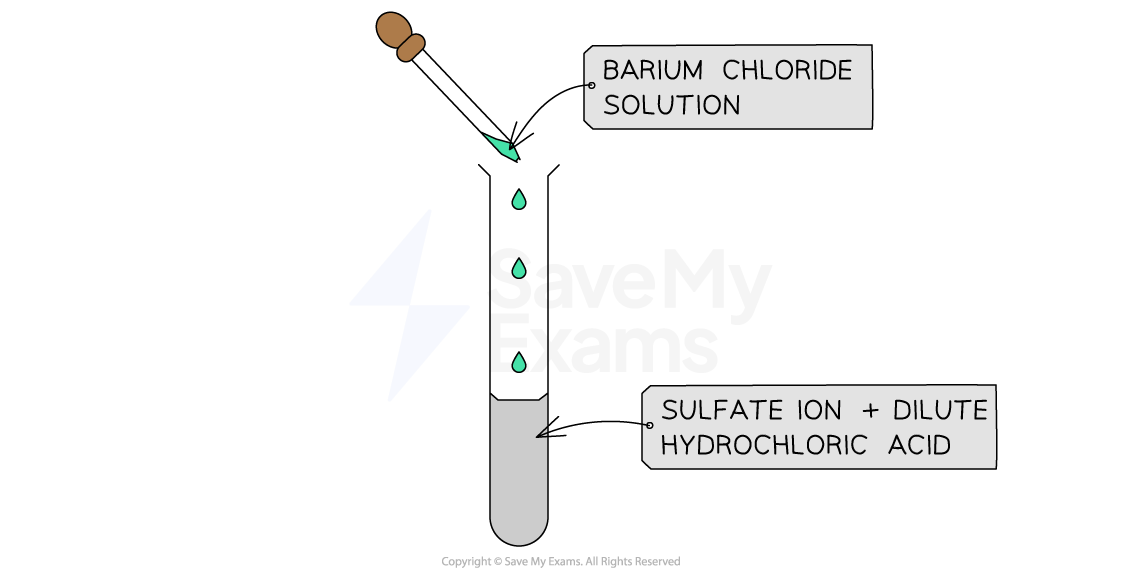
A white precipitate of barium sulfate is a positive result for the presence of sulfate ions
Exam Hint Nitric is added first to remove any carbonates which may be present which would also produce a precipitate and interfere with the results.
Test for sulfite ions
-
Sulfite compounds contain the sulfite ion, SO32-
-
The test for the sulfite ion is:
- Add dilute acid
- Warm the mixture gently
- Bubble the gas released through potassium manganate(VII) solution
- The potassium manganate(VII) solution changes from purple to colourless if the sulfite ion is present
Exam Hint For qualitative inorganic analysis, there will be one test for the metal cation and another test for the non-metal anion.
If you are an extended level student you may be asked to write balanced ionic equations for cation and anions tests, so make sure you know the formulae of all the ions and precipitates formed.
Was this revision note helpful?