The Mole (Cambridge International IGCSE Chemistry)
The mole & the Avogadro Constant
Spec point —
3.2.1· State that the mole, mol, is the unit of amount of substance and that one mole contains 6.02 × 10²³ particles, e.g. atoms, ions, molecules; this number is the Avogadro constant
Extended tier only
-
Chemical amounts are measured in moles
-
The mole, symbol mol, is the SI unit of amount of substance
-
One mole of a substance contains the same number of the stated particles
- This can be atoms, molecules or ions
-
One mole contains 6.02 x 10²³ particles; this number is known as the Avogadro Constant
-
For example:
- One mole of sodium (Na) contains 6.02 x 10²³ atoms of sodium
- One mole of hydrogen (H2) contains 6.02 x 10²³ molecules of hydrogen
- One mole of sodium chloride (NaCl) contains 6.02 x 10²³ formula units of sodium chloride
-
The mass of 1 mole of a substance is known as the molar mass
- For an element, it is the same as the relative atomic mass written in grams
- For a compound, it is the same as the relative molecular or formula mass in grams
The mole & volume of gas
Spec point —
3.2.1· Use the molar gas volume, taken as 24dm3 at room temperature and pressure, r.t.p., in calculations involving gases
Extended tier only
Molar volumes of gas
-
Avogadro’s Law states that at the same temperature and pressure, equal amounts of gases occupy the same volume of space
- e.g. 1 mole of hydrogen gas occupies the same volume as 1 mole of methane gas
-
At room temperature and pressure, the volume occupied by one mole of any gas was found to be 24 dm3 or 24,000 cm3
- This is known as the molar gas volume at RTP
- RTP stands for “room temperature and pressure” and the conditions are 20 ºC and 1 atmosphere (atm)
-
From the molar gas volume, the following formula triangles can be derived:
Molar gas volume (dm3) formula triangle
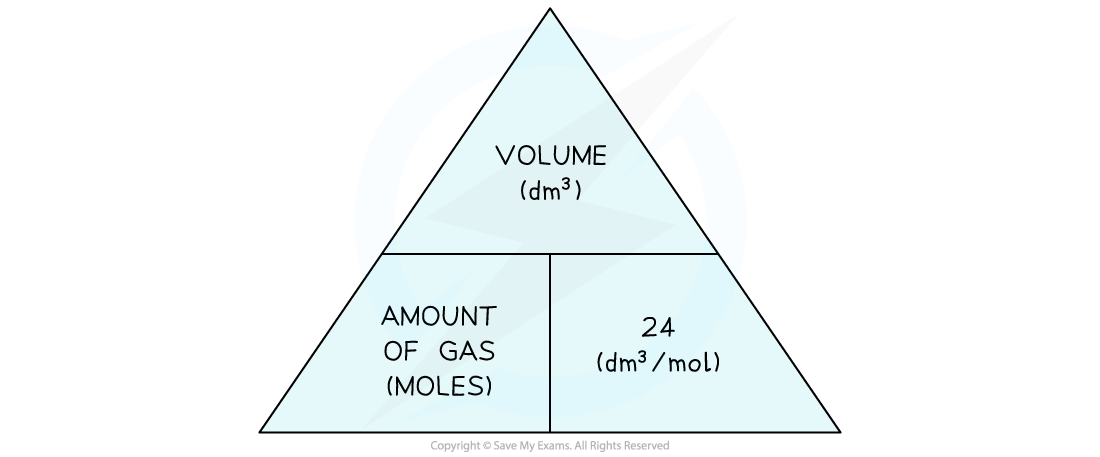
This shows the relationship between moles of gas, volume in dm3and the molar volume
- If the volume is given in cm3 instead of dm3, then divide by 24,000 instead of 24:
Molar gas volume (cm3) formula triangle
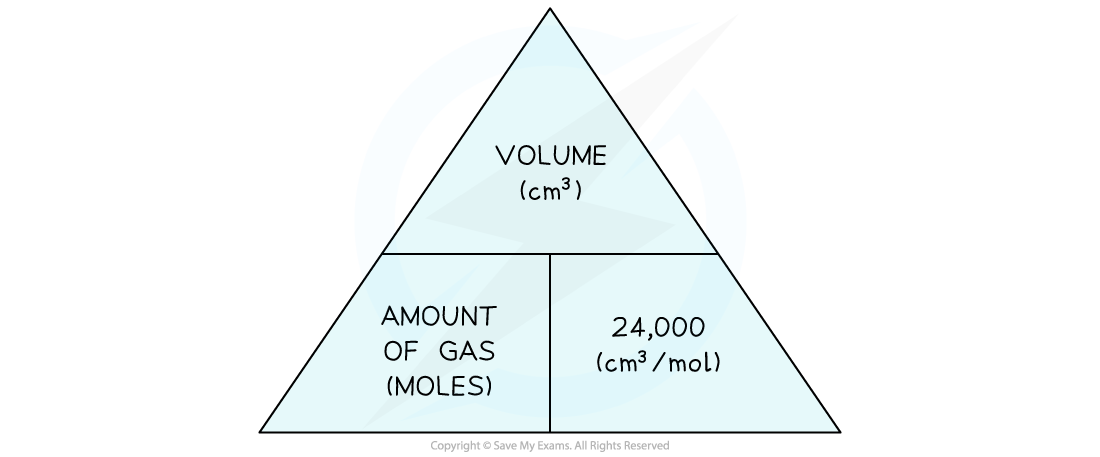
This shows the relationship between moles of gas, volume in cm3and the molar volume
-
The formula can be used to calculate the number of moles of gases from a given volume or vice versa
- Simply cover the one you want and the triangle tells you what to do
-
For example, to find the volume of a gas:
- Volume = Moles x Molar Volume
Examples of Converting Moles to Volume Table
| Gas | Amount (moles) | Volume |
|---|---|---|
| Hydrogen | 3 | (3 x 24) = 72 dm3 (3 x 24000) = 72000 cm3 |
| Carbon dioxide | 0.25 | (0.25 x 24) = 6 dm3 (0.25 x 24000) = 6000 cm3 |
| Oxygen | 5.4 | (5.4 x 24) = 129.6 dm3 (5.4 x 24000) = 129600 cm3 |
| Ammonia | 0.02 | (0.02 x 24) = 0.48 dm3 (0.02 x 24000) = 480 cm3 |
-
For example, to find the number of moles of a gas:
- Moles = Volume ÷ Molar Volume
Examples of Converting Volume to Moles Table
| Gas | Volume | Moles |
|---|---|---|
| Methane | 225.6 dm3 | (225.6 ÷ 24) = 9.4 mol |
| Carbon monoxide | 7.2 dm3 | (7.2 ÷ 24) = 0.3 mol |
| Sulfur dioxide | 960 dm3 | (960 ÷ 24) = 40 mol |
| Oxygen | 1200 cm3 | (1200 ÷ 24000) = 0.05 mol |
Exam Hint
- You are not expected to know the value of Avogadro's constant
- But, you do need to know the equation as well as how to use and re-arrange it
Was this revision note helpful?