Factors Influencing Location Decisions (Cambridge International IGCSE Business)
The location of manufacturing businesses
Manufacturing business locations
-
Location is the site from which a business decides to operate
-
A business will consider location if it is setting up for the first time or its existing location no longer meets its needs
-
A new site may become available that is more attractive to the business
- For example, it has a larger staff car park or room for further expansion
-
-
Choosing a good production location can have significant impacts on a business.
-
A range of factors influence the location a business chooses for production
Factors affecting manufacturing business location
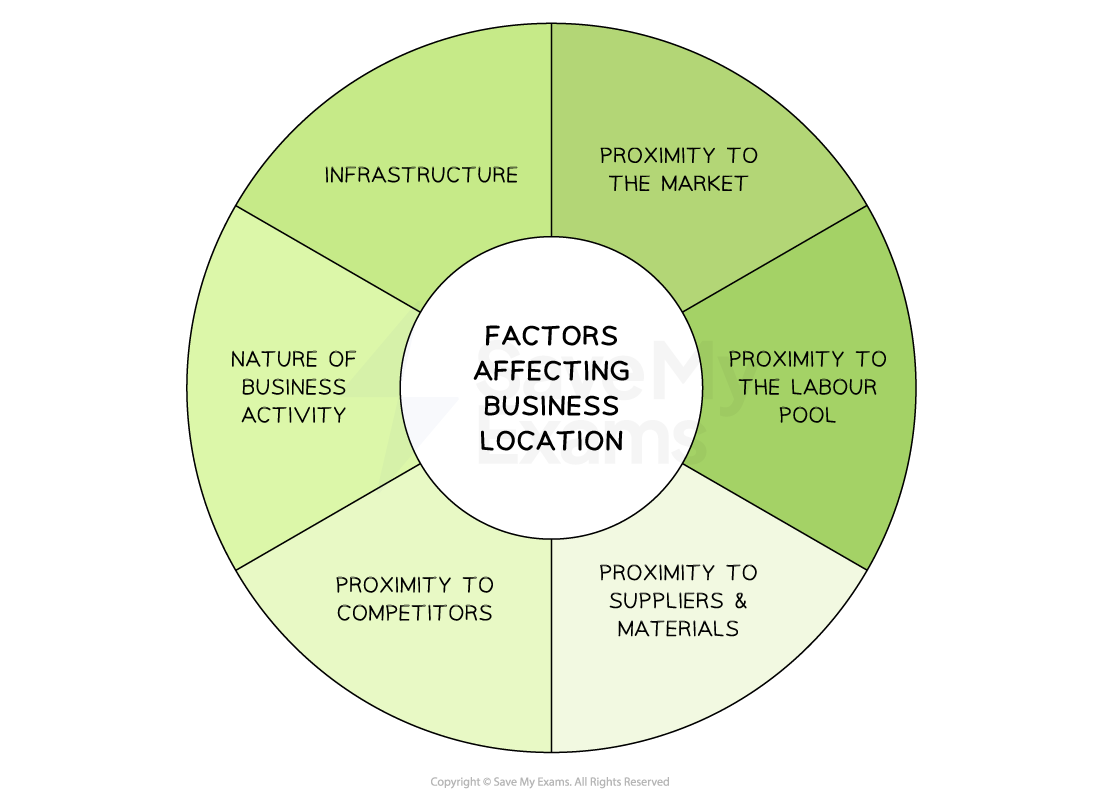
Production locations are affected by multiple factors and if a business chooses the wrong location, it can fail
Proximity to the market
- This refers to how close the business is to its target customers
- Being near the market can reduce transport costs and make it easier for customers to access the business
Proximity to labour
- This means being located near areas where skilled and qualified workers are available
- Businesses often choose locations with a strong local workforce to make it easier to hire the right people and run operations efficiently
Proximity to materials
- This refers to how close a business is to the raw materials or supplies it needs
- Being near materials helps reduce transportation costs and ensures a steady supply
Proximity to competitors
- Some businesses choose to locate near competitors to attract the same customer base or to offer something different
- Others may avoid locating near competitors to reduce direct competition
The nature of the business activity
- Different types of businesses have different location needs based on what they do
- For example, a manufacturing plant may need large space and delivery access, while a law firm may need a smaller, more central office
- For example, a factory needs room for machinery and deliveries, while a law office needs a professional, easy-to-access location
Infrastructure
- This includes transport links and electronic networks like internet connections
- Good transport is essential for businesses that deliver physical goods
- Fast and reliable internet is key for online businesses
- For example, an online fashion retailer needs a location close to the motorway for quick delivery and fast service, helping it compete in the market
Exam Hint Don’t assume “low costs” are always the main factor – examiners expect you to recognise that priorities differ, e.g. a factory may focus on raw materials while a retailer prioritises customer access
The location of service businesses
Service businesses locations
-
Businesses in the service sector consider further factors when determining a suitable location
-
Proximity to customers is very important for retail businesses
- Premises must be accessible and convenient so a location with a car park or close to transport links is likely to be attractive
- Locating in areas with high footfall, such as on a high street or in a shopping mall, is a popular choice for retailers
-
In some cases, a location may be chosen to take advantage of a shared customer base or a particular reputation
- Examples include bookshops on London's Charing Cross Road and luxury fashion brands on New York's Fifth Avenue
-
Climate and geographical factors can be a key factor for some specialist service providers
- For example. businesses that offer ski instruction are located in mountainous areas with high annual snowfall
-
Services businesses that do not rely on passing trade may locate in out-of-town premises
- Rent and business rates tend to be lower
- Incentives for job creation such as grants may be available from local authorities
-
In addition, businesses are likely to avoid locating in areas with high levels of anti-social behaviour and crime, as this could impact insurance costs
Factors to consider when choosing a country to produce in
- When a business chooses which country to locate operations in, such as manufacturing, customer support or regional headquarters, it must consider a range of factors
| Factor | Explanation |
|---|---|
| Trade barriers | - Locating in a country within a trade bloc, such as the EU or USMCA, reduces tariffs and quotas - This can help firms from countries such as China avoid trade barriers |
| Financial incentives | - Some governments offer tax breaks, grants or loans to attract foreign investment that creates jobs and brings in foreign currency |
| Labour costs & skills | - Some countries have low wages, like Bangladesh or Turkey, offering low-cost location for garment manufacture - Technology businesses may be attracted to Ireland's highly-skilled workforce |
| Corporate tax rates | - Low-tax locations (e.g. Ireland’s 12.5%) attract multinational firms like Google, Microsoft, Apple that want to reduce their tax burden |
| Access to raw materials | - Locating near key resources can cut raw material transport costs and reduce supply delays |
| Market access | - Being near customers reduces distribution costs and helps a business serve saturated or new markets quickly |
| Political/legal environment | - Stable economies with clear laws are safer - Weak enforcement of law or unstable government in less developed countries may mean lower costs but greater risks |
| Infrastructure quality | - Good roads, ports, power grids and communications allow smoother production and trade |
Case Study Why Multinationals Choose Ireland
Many multinational companies are increasingly choosing Ireland as a base for both service and manufacturing business operations
- Very low corporation tax rate of around 12.5%
- Access to a highly educated, English-speaking workforce that fits technology or R&D roles
- Open immigration policies attract global skilled workers in technology, healthcare and ICT sectors
- Strategic location that gives easy access to both the US and European markets
- Strong infrastructure and legal environment with stable government and EU membership
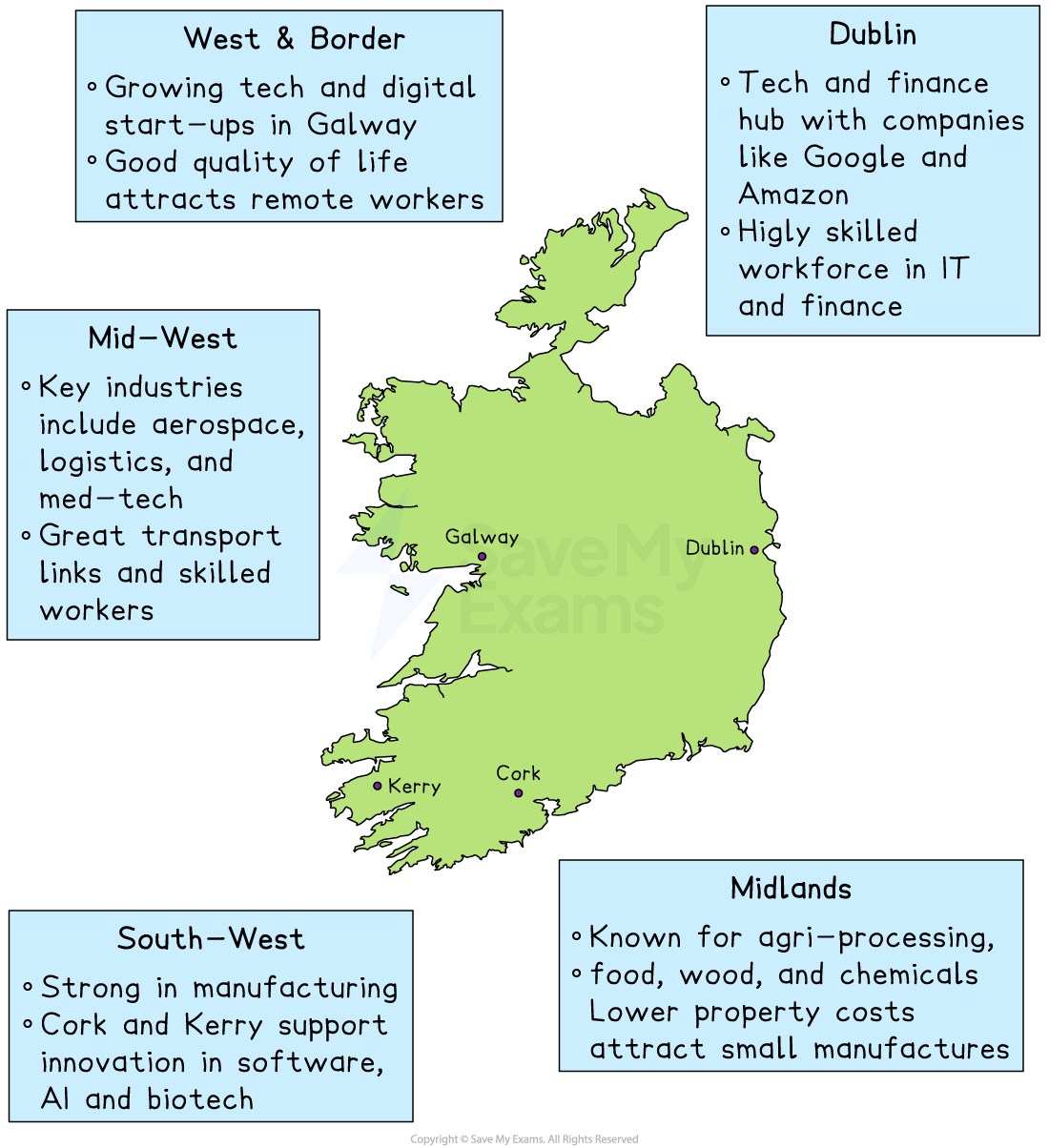
Recommending an appropriate business location
- When a business is choosing between possible locations, it must recommend one option and then justify (explain why) that choice using evidence
Steps in the process
- Identify the options – e.g., two different sites or two different countries
- Weigh up the advantages and disadvantages of each option
- Consider the type of business – e.g., manufacturer vs. service provider
- Think about long-term success – costs, customer access, and growth potential
- Make a clear recommendation – state which option is better
- Justify with reasoning – link back to the case study data (e.g. “This site is closer to customers, which is more important than slightly higher rent, because it increases sales”).
What to include in a justification
- Costs: Which option keeps costs lower in the long run?
- Revenue: Which location gives better access to customers or markets?
- Suppliers: Is one location closer to raw materials or supply chains?
- Labour: Are skilled workers available?
- Competition: Is one site less competitive, or does clustering with rivals increase customers?
- Government: Are there incentives (e.g. tax breaks, grants)?
- Risk & future growth: Which location offers better potential to expand or adapt?
Case Study Choosing a New Production Location for Sabores del Sol
Background: Sabores del Sol is a successful Spanish company producing ready meals and Mediterranean snacks. Rising production costs in Spain and growing demand across Europe mean the business needs to open a new international production facility.
The company is considering three possible countries: Poland, Vietnam, and Mexico.
Option 1: Poland
Benefits
- Lower labour costs than Spain
- Member of the EU → no trade barriers when exporting across Europe
- Strong transport links throughout Europe
- Skilled workforce with experience in food manufacturing
Drawbacks
- Labour costs are rising gradually
- Language and cultural differences
- Regional bureaucracy may cause delays
Option 2: Vietnam
Benefits
- Very low labour costs, ideal for mass production
- Strong government support for foreign investment
- Access to rapidly growing Asian markets
- Expanding industrial infrastructure
Drawbacks
- Long distance from Spain → higher shipping costs and delivery times
- Less reliable logistics compared to Europe
- Language and cultural differences could create training and communication problems
Option 3: Mexico
Benefits
- Competitive labour costs and skilled food processing sector
- Trade advantages when exporting to the US and Latin America
- Good access to fresh raw materials
- Growing export and manufacturing reputation
Drawbacks
- Long distance from Spain → higher shipping costs to Europe
- Political instability and safety concerns
- Complex regulations in some regions
Recommendation and Justification
Poland is the most suitable location for Sabores del Sol
- It offers lower production costs than Spain, while still providing a skilled workforce
- Being inside the EU means there are no tariffs or trade barriers, which supports smooth and cost-effective exports to Sabores del Sol’s main market in Europe
- Its strong transport links ensure reliable delivery across the continent
Vietnam and Mexico provide lower labour costs, but both are much further from Europe. This means longer delivery times, higher shipping costs, and supply chain risks, which are significant disadvantages for a company aiming to grow in the European ready-meals market
Conclusion
Poland offers the best balance of cost savings, skilled labour, and easy access to European customers. It is a low-risk, strategic choice that matches the company’s growth objectives
Was this revision note helpful?
Build on this topic