Diffusion in Biology (Cambridge International IGCSE Biology)
Exam board Cambridge International · IGCSEUpdated 2026-09-02
Diffusion
Spec point —
3.1.1· nan
What is diffusion in biology?
- Diffusion is the movement of molecules from a region of its higher concentration to a region of its lower concentration
- Molecules move down a concentration gradient, as a result of their random movement
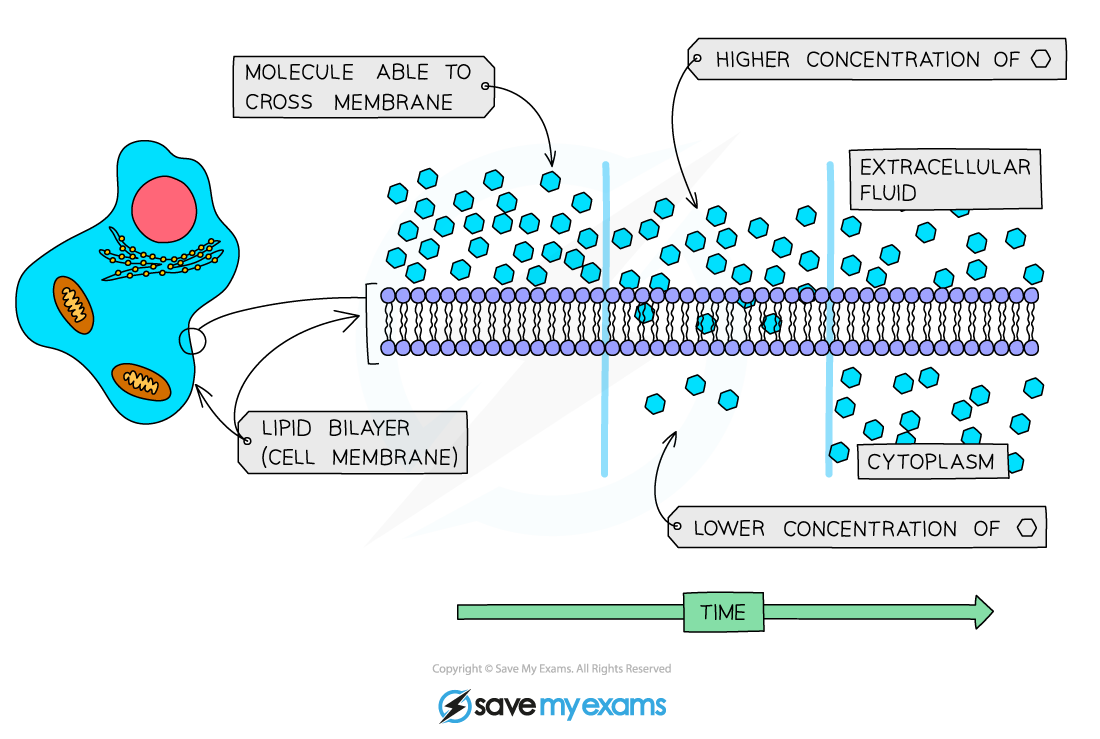
Diffusion across the cell membrane
-
For living cells, the principle of the movement down a concentration gradient is the same, but the cell is surrounded by a cell membrane which can restrict the free movement of the molecules
-
The cell membrane is a partially permeable membrane - this means it allows some molecules to cross easily, but others with difficulty or not at all
-
The simplest sort of selection is based on the size of the molecules
-
Diffusion helps living organisms to:
- Obtain many of their requirements
- Get rid of many of their waste products
- Carry out gas exchange for respiration
Examples of diffusion in living organisms
- Living organisms obtain various substances they need through diffusion, such as oxygen, carbon dioxide, and other nutrients.
- It is worth noting that plants require oxygen for respiration at all times, as well as carbon dioxide for photosynthesis when conditions for photosynthesis are right (e.g. enough light and a suitable temperature)
Examples of diffusion in living organisms
| Site | Molecules moving | From | To |
|---|---|---|---|
| Small intestine | Digested food products: - Glucose - Amino acids - Fatty acids - Glycerol | Lumen of the small intestine | Blood / lymph in villi covering the wall of the small intestine |
| Leaf | Oxygen | Air spaces between mesophyll cells | Mitochondria in all cells |
| Leaf | Carbon dioxide | Air spaces between mesophyll cells | Chloroplasts in mesophyll cells |
| Leaf | Water vapour | Stomatal pores | Air outside stomata |
| Lungs | Oxygen | Alveolar air space | Blood in capillaries around alveoli |
| Lungs | Carbon dioxide | Blood in capillaries around alveoli | Alveolar air space |
Where does the energy for diffusion come from?
- All particles move randomly at all times
- This is known as Brownian motion
- The energy for diffusion comes from the kinetic energy of this random movement of molecules and ions
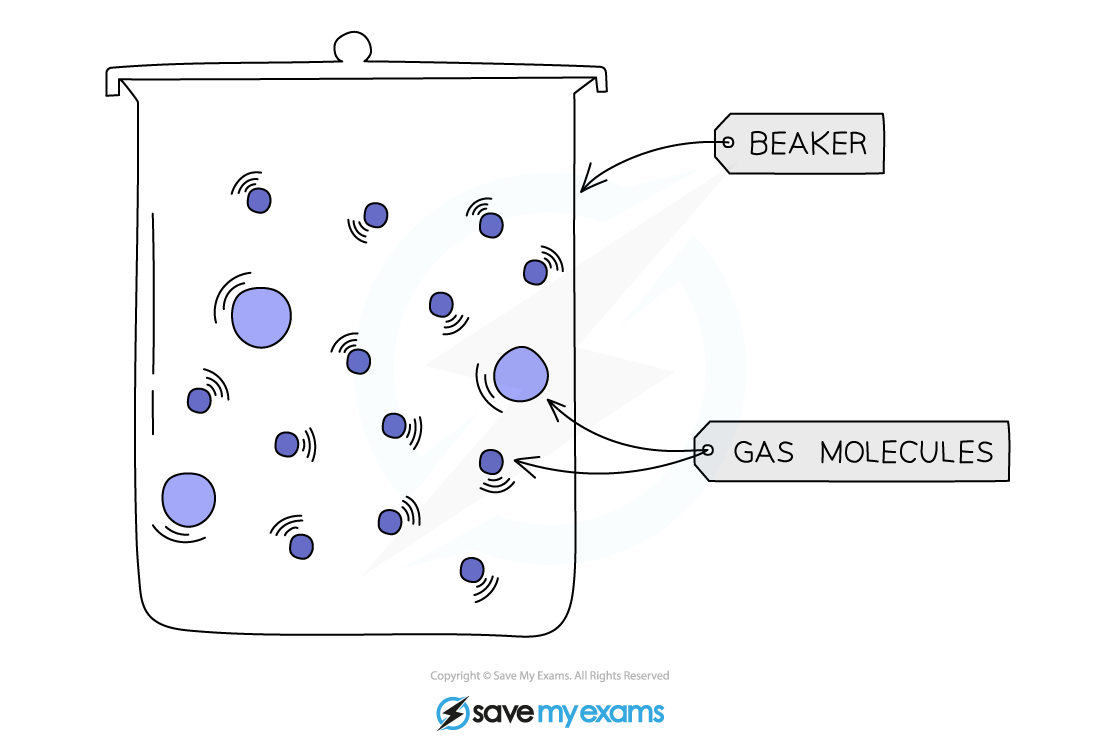
Brownian motion
Was this revision note helpful?
Build on this topic