Conditions for Equilibrium (Cambridge International AS Physics)
Equilibrium
-
A system is in equilibrium when all the forces are balanced
- There is no resultant force
- There is no resultant torque
-
In accordance with Newton's First Law, an object in equilibrium will therefore remain at rest, or at a constant velocity, and will not rotate
-
The system is in an equilibrium state when applying the Principle of Moments
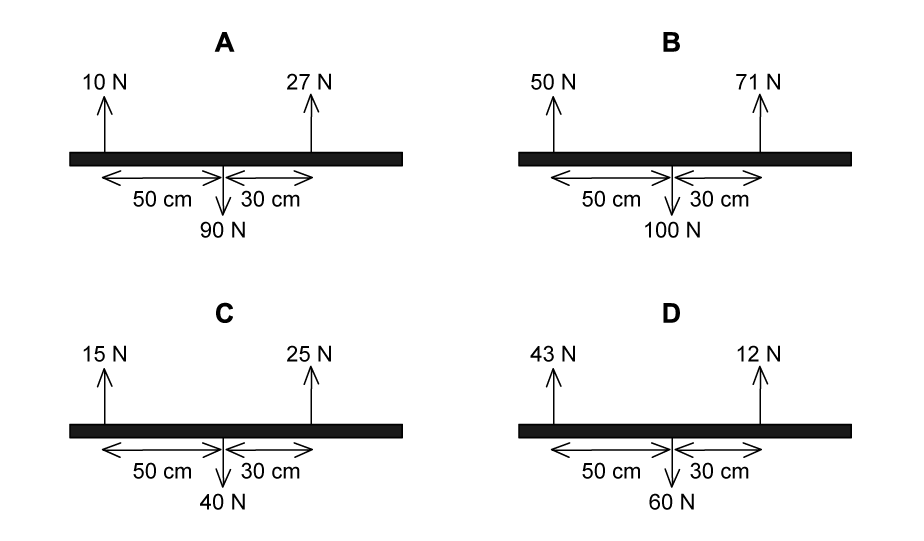
Worked Example Four beams of the same length, each have three forces acting on them.
Which beam has both zero resultant force and zero resultant torque acting?
Answer:
Step 1: Consider the principle of moments
- Zero resultant force and zero resultant torque mean that the beam is in equilibrium
- Therefore, for the correct answer:
clockwise moment = anticlockwise moment
Step 2: Calculate the clockwise moments for each answer option
For answer option C
Taking the pivot to be the point at which the 15 N force acts
- Therefore, there is no moment caused by the 15 N force because d = 0
Step 3: Calculate the anticlockwise moments for each answer option
- For answer option C
Step 4: Determine if the beam is in equilibrium
clockwise moment = anticlockwise moment
- Therefore, beam C is in equilibrium
Coplanar Forces in Equilibrium
Spec point —
4.2.3
-
Coplanar forces can be represented by vector triangles
- For a recap on vector triangles see Scalars & Vectors
-
Forces are in equilibrium if an object is either
- At rest
- Moving at constant velocity
-
In equilibrium, coplanar forces are represented by closed vector triangles
- The vectors, when joined together, form a closed path
-
The most common forces acting on objects are
- Weight
- Normal reaction force
- Tension (from cords and strings)
- Friction
Forming a vector triangle for forces acting on a body in equilibrium
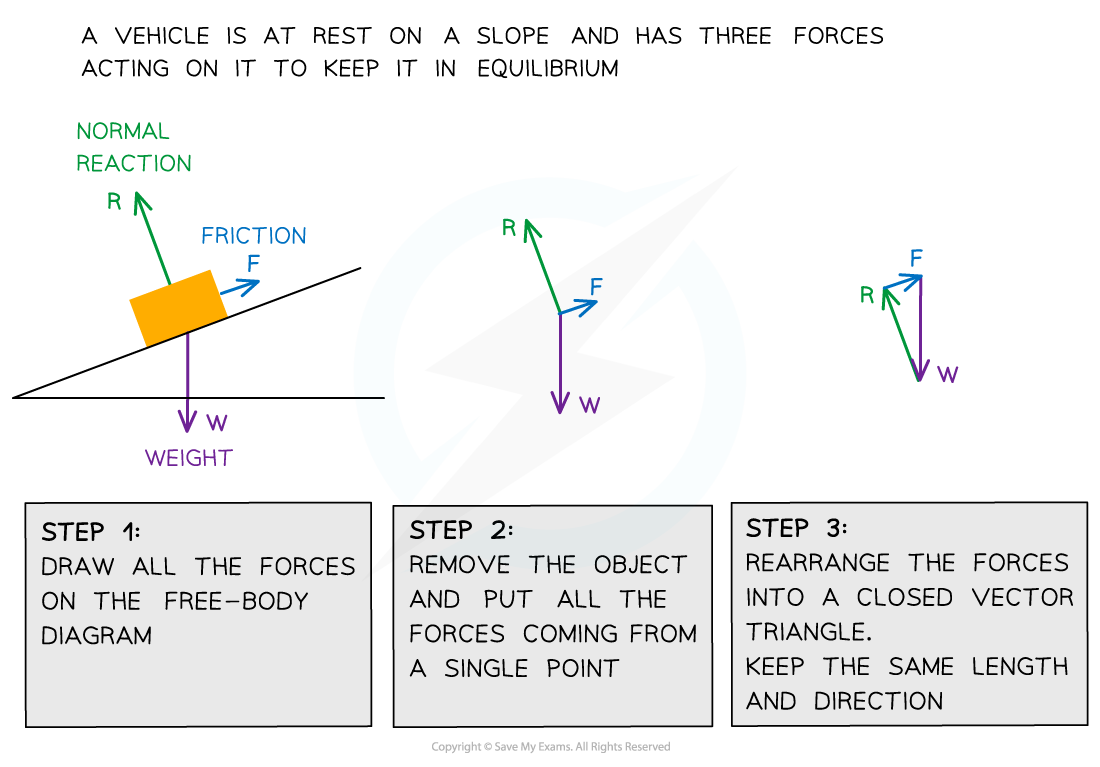
To form a closed vector triangle, draw a free-body force diagram, then rearrange the force arrows tip to tail maintaining the length and directions of the vectors
Worked Example A mass hangs in equilibrium from a cable at point X. The tensions in the cables are T1 and T2 as shown.
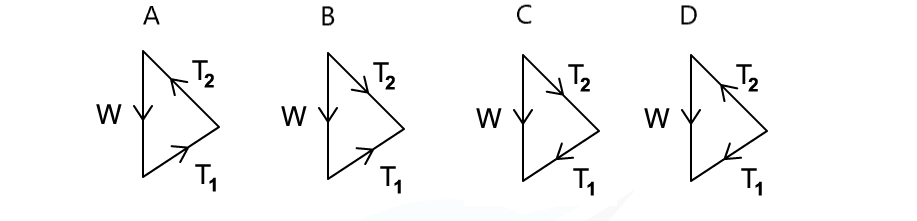
Which diagram correctly represents the forces acting at point X?
Answer:
Step 1: Draw a free-body force diagram identifying the direction of all the forces
Step 2: Arrange the vectors into a triangle, maintaining the magnitudes and directions
Step 3: Check that the vectors form a closed path
The correct answer is A
- This is the only vector triangle forming a closed path




Exam Hint The diagrams in exam questions about this topic tend to be drawn to scale, so make sure you have a ruler handy!
Was this revision note helpful?
Build on this topic