Turning Effects of Forces (Cambridge International AS Physics)
Couples
-
A couple is a pair of forces that acts to produce rotation only
-
The moment of a single force depends on the perpendicular distance to the pivot
-
However, the moment of a couple depends on the perpendicular distance between the two forces
-
A couple consists of a pair of forces that are:
- Equal in magnitude
- Opposite in direction
- Perpendicular to the distance between them
A pair of forces, or couple
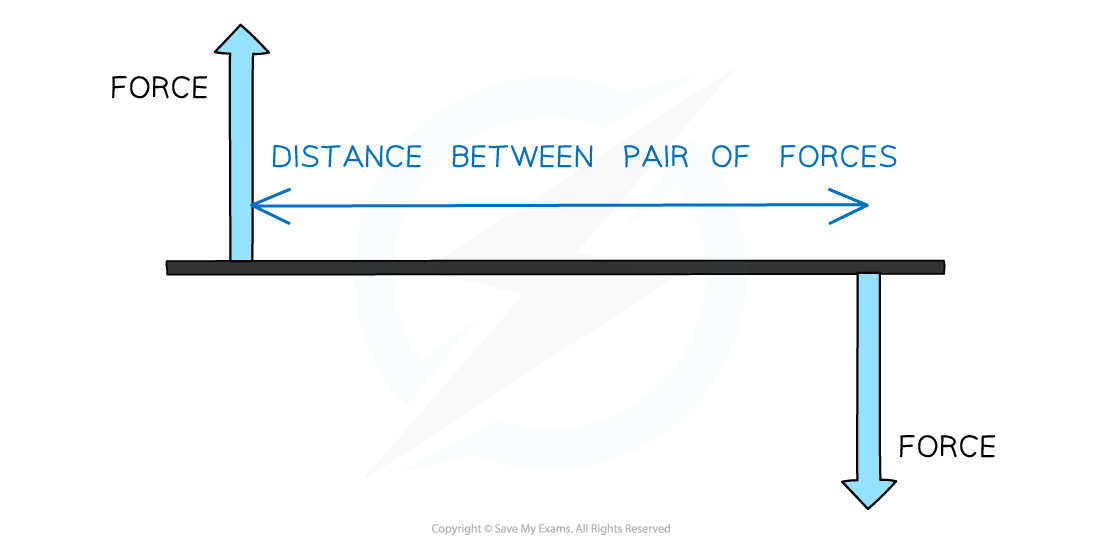
The moment of a couple depends on the perpendicular distance between the two forces
- Couples produce a resultant force of zero
- Therefore, due to Newton’s second law of motion, F= ma, the object does not accelerate
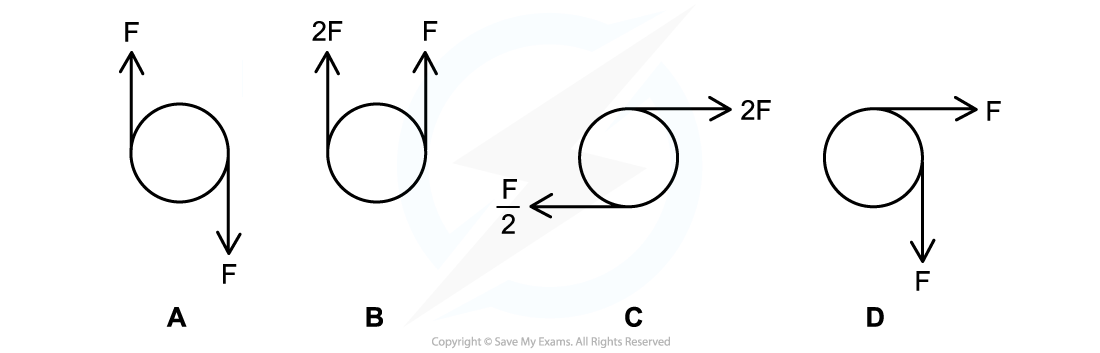
Worked Example Which pair of forces acts as a couple on the circular object?
Answer: A
In diagram A, the forces are:
- Equal in size
- In opposite directions
- Perpendicular to the distance between them
B is incorrect as the forces are in the same direction
C is incorrect as the forces are different in size
D is incorrect as the distance between the forces is not perpendicular
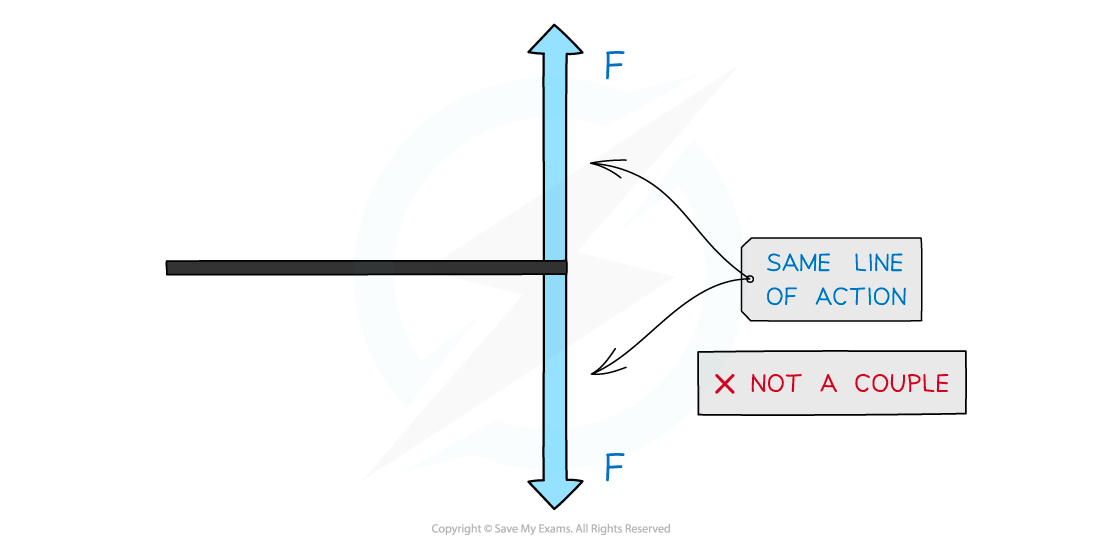
Exam Hint The forces that make up a couple cannot share the same line of action. The line of action is a line through the point at which the force is applied.
Torque
- The moment of a couple is known as a torque
- You can calculate the torque of a couple with the following equation:
-
Where:
- (Greek letter tau) = torque in newton metres (N m)
- F = one of the forces in the couple in newtons (N)
- d = perpendicular distance between the forces
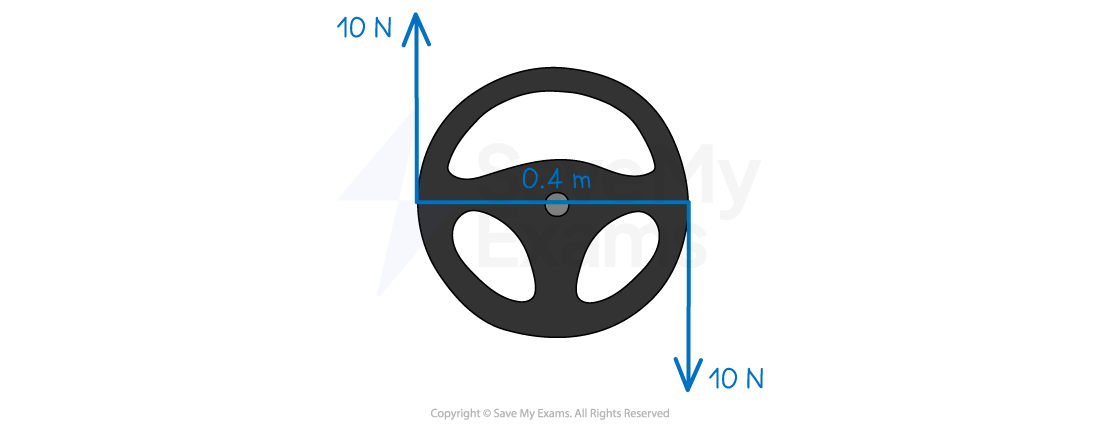
Worked Example A steering wheel has a diameter of 40 cm, and the force of the couple needed to turn it is 10 N.
Calculate the torque on the steering wheel.
Answer:
Step 1: List the known quantities converting to SI units
- Force, F = 10 N
- Perpendicular distance between forces, d = 0.4 m
Step 2: Sketch a diagram of the scenario
Step 3: State the torque equation
Step 4: Substitute in the known values to calculate
τ = 4 N m
Worked Example A ruler of length 0.3 m is pivoted at its centre. Equal and opposite forces of magnitude 4.0 N are applied to the ends of the ruler, creating a couple.
Determine the magnitude of the torque of the couple on the ruler at the position shown in the diagram.
Answer:
Step 1: List the known quantities
- Forces applied = 4 N at 30°
- Perpendicular distance between forces, d = 0.3 m
Step 2: State the equation for torque
Step 3: Determine the component of the force that is perpendicular to the distance between the forces
or
Step 4: Substitute in the known values to calculate


Exam Hint The forces given in a question might not always be perpendicular to the distance between them. In this case, remember to find the component of the force vector that is perpendicular.
You can recap how to do this in Scalars & Vectors.
Was this revision note helpful?
Build on this topic