Coefficient of Friction (Cambridge International AS Mathematics)
Spec point —
4.1.6
Coefficient of Friction
What is friction?
-
Friction is a force between a surface and an object that acts to resist motion of the object across the surface
-
On a horizontal surface with no forces acting on a stationary object other than gravity and the surface's normal reaction force, there is no force of friction
-
If an additional force acts on the object parallel to the surface then friction manifests as a force in the opposite direction
- Friction always acts in a direction parallel to the surface
- Friction acts in the opposite direction to the resultant force that would cause the object to move parallel to the surface
- Up to a certain limiting value (see next section) the force of friction prevents motion entirely
- Beyond that limiting value friction is a force of constant magnitude in the opposite direction to the motion of the object
What Is the coefficient of friction?
-
The magnitude of the frictional force satisfies the inequality: F ≤ μR where F is the force of friction, R is the normal reaction force between the object and the surface, and μ is the coefficient of friction between the object and the surface
- If there is no friction then μ= 0 and the surface is smooth **
- Otherwise** μ > 0
-
The maximum possible frictional force is given by the equation FMAX = μR where FMAX is the maximum possible force of friction, and R and μ are as above
-
FMAX serves as a limiting value for mechanics problems involving friction
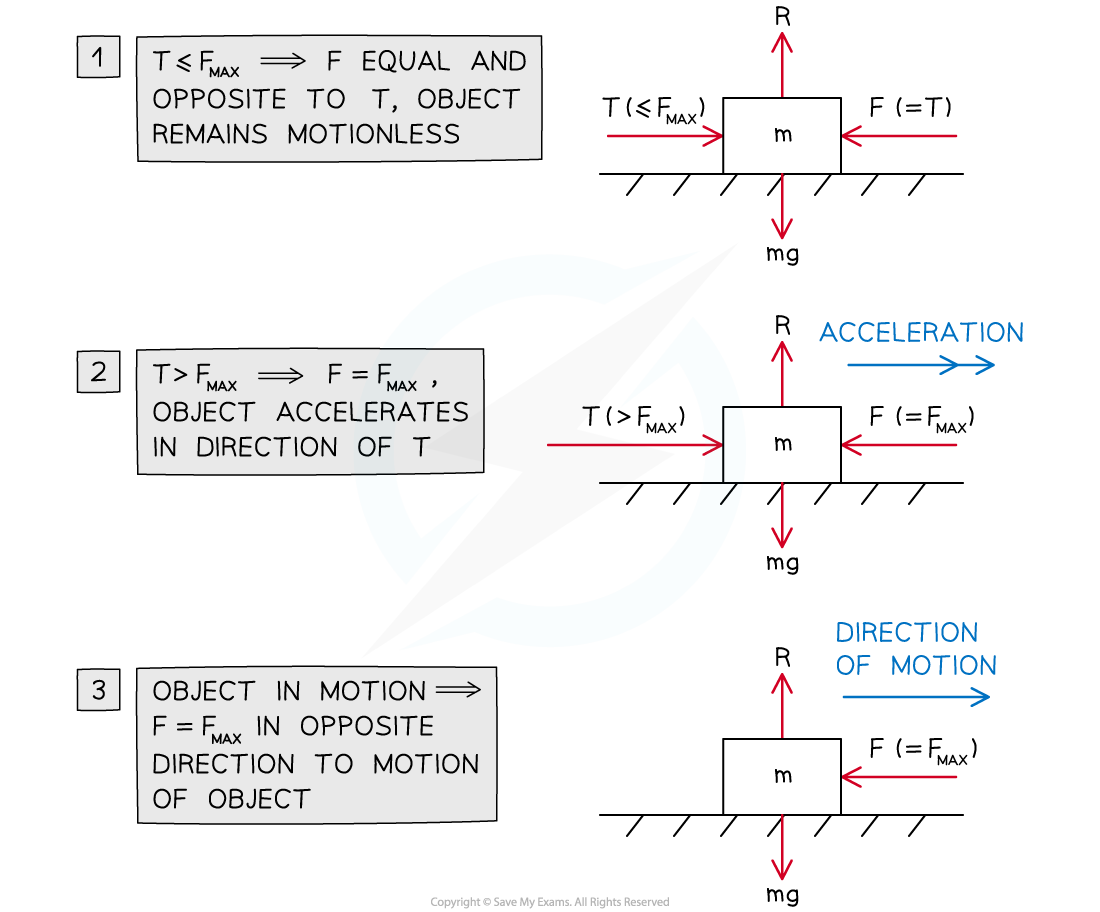
- If the object is stationary and the resultant of other parallel forces to the surface is less than or equal to FMAX then
- the object remains stationary
- the frictional force is always equal and opposite to the resultant of the other horizontal forces
- if the resultant of other horizontal forces is **equal to FMAX then the object is said to be in limiting equilibrium
- If the object is stationary and the resultant of other horizontal forces becomes** greater than FMAX then
- the object begins to accelerate in the direction of the resultant force
- the frictional force is equal to FMAX with a direction always opposite to that of the object's motion
- If the object is in motion parallel to the surface then (regardless of any other forces) the frictional force will always be equal to FMAX with a direction opposite to that of the object's motion
Worked Example A box with a mass of 12 kg is at rest on a horizontal floor. The coefficient of friction between the box and the floor is 0.7 . A horizontal force of 80 N is applied to the box. Describe the force of friction in this situation and determine whether or not the box will begin to move.
Answer:
Exam Hint
Always draw a force diagram and label it clearly*.*
Look out for the words smooth and rough in mechanics problems involving an object moving (or potentially moving) along a surface:
- If the surface is described as smooth then you can ignore friction in the problem (i.e μ= 0)
- If the surface is described as rough than you need to include the force of friction in solving the problem.
If a friction question states that an object is on the point of moving that means that the object is in limiting equilibrium.
Was this revision note helpful?
Build on this topic