Momentum (Cambridge International AS Mathematics)
Momentum
What is momentum?
-
Any object that has mass and is moving has momentum
-
Momentum measures the quantity of motion that an object has
-
The momentum of a particle is defined as the product of its mass ( kg) and its velocity ()
- Momentum =mv
-
The SI unit for momentum is (equivalent to newton seconds N s)
-
Momentum is a vector quantity - so it has a magnitude and direction
- The direction of the momentum of a particle is the same as the direction of motion of the particle
- The momentum is negative if the velocity is negative
- If an object is falling vertically then momentum will be downwards
What happens when two objects are in contact?
-
If two objects are in contact with each other then by Newton’s Third Law there will be equal and opposite reaction forces
-
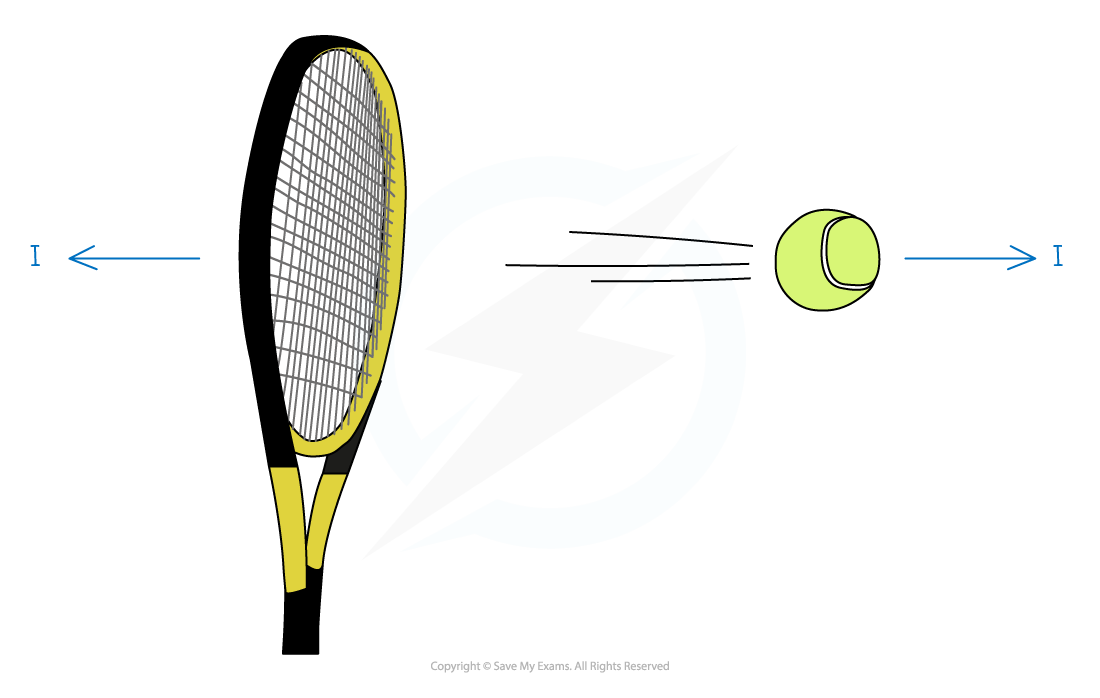
One object gains momentum from the impact and the other loses momentum
-
The change in momentum will be equal for each particle provided there are no external forces
- Remember momentum is a vector and can be negative
-
For example, consider the scenario where a tennis ball is struck by a racket, suppose the momentum of the racket and the ball before the impact is 5 kg m s-1 and -3 kg m s-1 and the momentum of the racket afterwards is -2 kg m s-1
- This means the racket has a loss of 7 kg m s-1 in momentum
- Therefore the ball has a gain of 7 kg m s-1 in momentum
- Therefore the momentum of ball after the impact is 4 kg m s-1
Worked Example A dog of mass 15 kg is running with speed .
Find the momentum of the dog.
Answer:
Was this revision note helpful?
Build on this topic