Determining Subatomic Structure (Cambridge International AS Chemistry)
Key Terms of Atomic Structure
-
The atomic number (also called the proton number) is the number of protons in the nucleus of an atom
- Symbol: Z
- In a neutral atom, the number of electrons equals the number of protons
- E.g. Lithium has an atomic number of 3, so it has 3 protons and 3 electrons
-
The mass number (also called the nucleon number) is the total number of protons and neutrons in the nucleus
- Symbol: A
- To calculate the number of neutrons:
Number of neutrons = A − Z
- Protons and neutrons are collectively known as nucleons, since they are located in the nucleus
Mass and atomic numbers
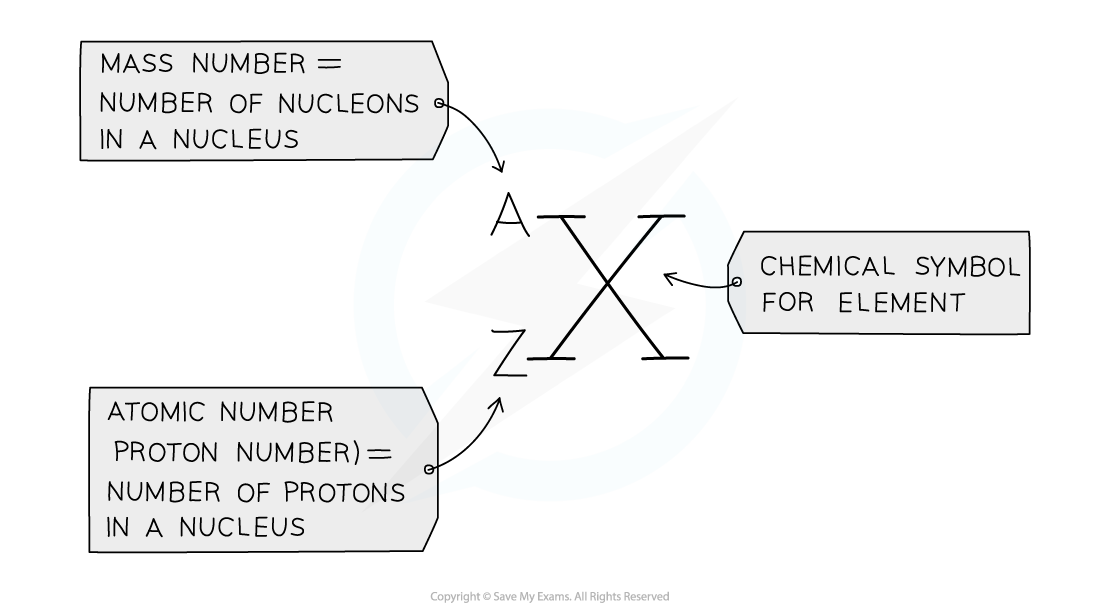
The mass (nucleon) and atomic (proton) number are given for each element in the Periodic Table
Determining the Subatomic Structure of Atoms & Ions
-
An atom is electrically neutral, meaning the number of protons = electrons
-
An ion forms when an atom gains or loses electrons, giving it an overall charge:
- Positive ions (cations) lose electrons
- Negative ions (anions) gain electrons
Protons
-
The atomic number (Z) tells you the number of protons in the nucleus.
-
All atoms and ions of the same element have the same number of protons.
- Lithium: Atomic number = 3 = 3 protons
- Beryllium: Atomic number = 4 = 4 protons
mass number (A) = number of protons (Z) + number of neutrons
number of protons = A − number of neutrons
Worked Example Determine the number of protons in the following ions and atoms:
- Mg2+ ion
- Carbon atom
- An unknown atom of element X with mass number 63 and 34 neutrons
Answer 1:
- The atomic number of a magnesium atom is 12 suggesting that the number of protons in the magnesium element is 12
- Therefore, the number of protons in a Mg2+ion is also 12
Answer 2:
- The atomic number of a carbon atom is 6 suggesting that a carbon atom has 6 protons in its nucleus
Answer 3:
Use the formula to calculate the number of protons
- Number of protons = mass number - number of neutrons
- Number of protons = 63 - 34
- Number of protons = 29
Element X is therefore copper
Electrons
-
A neutral atom has the same number of electrons and protons
-
In ions, the number of electrons differs:
- Positive ions: fewer electrons than protons (electrons lost)
- Negative ions: more electrons than protons (electrons gained)
Worked Example Determine the number of electrons in the following ions and atoms:
- Mg2+ ion
- Carbon atom
- An unknown atom of element X with mass number 63 and 34 neutrons
Answer 1:
- The atomic number of a magnesium atom is 12 suggesting that the number of protons in the neutral magnesium atom is 12
- However, the 2+ charge in the Mg2+ ion suggests it has lost two electrons
- It only has 10 electrons left now
Answer 2:
- The atomic number of a carbon atom is 6 suggesting that the neutral carbon atom has 6 electrons orbiting around the nucleus
Answer 3:
The number of protons of element X can be calculated by:
- Number of protons = mass number - number of neutrons
- Number of protons = 63 - 34
- Number of protons = 29
The neutral atom of element X therefore also has 29 electrons
Neutrons
- Use the mass number (A) and atomic number (Z):
Number of neutrons = mass number (A) - number of protons (Z)
Worked Example Determine the number of neutrons in the following ions and atoms:
- Mg2+ ion
- Carbon atom
- An unknown atom of element X with an atomic number of 29 and a mass number of 63
Answer 1:
The atomic number of a magnesium atom is 12 and its mass number is 24
- Number of neutrons = mass number (A) - number of protons (Z)
- Number of neutrons = 24 - 12
- Number of neutrons = 12
The Mg2+ion has 12 neutrons in its nucleus
Answer 2:
The atomic number of a carbon atom is 6 and its mass number is 12
- Number of neutrons = mass number (A) - number of protons (Z)
- Number of neutrons = 12 - 6
- Number of neutrons = 6
The carbon atom has 6 neutrons in its nucleus
Answer 3:
The atomic number of an element X atom is 29 and its mass number is 63
- Number of neutrons = mass number (A) - number of protons (Z)
- Number of neutrons = 63 - 29
- Number of neutrons = 34
The neutral atom of element X has 34 neutrons in its nucleus
Was this revision note helpful?
Build on this topic