The Purposes of Market Research (Cambridge International AS Business)
The main features of a market
Market size
-
Market size is the value or volume of sales of all businesses within a market
-
It can be measured by sales volume or sales value
- E.g. in 2024, the UK vinyl record market was worth £159m, with 5.9m units sold, the highest annual level since 1990
-
-
The total size of a market will be a key factor in determining whether it is worth a business entering and competing within it
- A larger market size suggests more potential customers, which means greater opportunities to sell products and earn revenue
- Knowing the size of the market helps businesses judge whether there is room to grow or if the market is already saturated
- Investors are more likely to support a business operating in a large or growing market, as it promises better returns
Market growth
-
The speed of growth of a market is another key factor to consider when weighing up whether to enter and compete within it
-
More customers are entering the market, which makes it easier for new or smaller businesses to gain sales without taking customers from rivals
-
When demand is rising, competition tends to be less aggressive because most firms can grow at the same time
- This reduces the pressure to lower prices or fight over market share
-
A growing market is a sign that it has long-term potential
- Businesses can plan for future expansion, build customer loyalty early and benefit from rising demand
-
-
Market growth is expressed as a percentage and calculated using the formula
Worked Example Supermarket sales data shows shoppers are putting more plant-based milk in their baskets. In the year to February 2025, market sales were up 2.1%. Oat milk sales have grown particularly strongly. Annual sales reached £275m in 2024, up from £155m in 2020.
**Calculate **the percentage increase in the size of the UK oat milk market since 2020.
[2]
Step 1: Subtract 2020 sales from 2024 sales to determine the increase
$= \pounds 275 \mathrm{m} - \pounds 155 \mathrm{m}
= \pounds 120 \mathrm{m}$** (1)**
Step 2: Divide the difference by 2020 sales
$= \pounds 120 \mathrm{m} \div \pounds 155 \mathrm{m}
= 0.7742$
Step 3: Multiply the outcome by 100 to determine market growth
$= 0.7742 \times 100
= 77.42 %$(1)
Competitors
-
The number and nature of rivals in a market is a key consideration for a business looking to enter and compete within a market
-
The level of competition affects pricing and profitability
-
If there are many competitors, prices are often lower because businesses compete to attract customers. This can reduce profit margins.
- E.g. A new café in a street full of other cafés might struggle to charge higher prices or attract loyal customers.
-
-
Many rivals makes It harder to stand out
-
In markets with many similar businesses, it can be difficult to offer something different or unique.
- E.g. A new clothing brand may find it difficult to stand out in the fast fashion market unless it offers something distinctive, like sustainable materials or custom designs
-
-
Strong, well-established competitors are hard to challenge
-
If existing businesses have strong brands, loyal customers or economies of scale, it can be difficult for new firms to compete.
- E.g. A small soft drink company would find it very hard to take market share from Coca-Cola or Pepsi
-
-
Market research, customer characteristics, profiles, wants and needs
- Marketing research is the process of finding out information about the market in which a business operates by collecting, presenting and analysing information about customer characteristics, their profiles and their wants and needs
Market research, consumer characteristics and profiles
-
Market research gathers data directly from potential and existing customers using methods such as surveys, interviews, focus groups, and observation
- This helps businesses learn about who their customers are and what they want.
-
It can identify consumer characteristics such as:
- Age
- Gender
- Income level
- Occupation
- Location
- Lifestyle, tastes and preferences
-
This information is then used to create customer profiles, which are detailed descriptions of target customers
- E.g. A customer profile might describe a typical buyer as a 30-year-old, urban, environmentally conscious professional who shops online and prefers sustainable products
The importance of identifying consumer characteristics and profiles
| Benefit | Explanation |
|---|---|
| Improves targeting and promotion | - By understanding who the customer is, businesses can design marketing messages that are more likely to appeal to them |
| Helps design better products and services | - Knowing what customers value enables businesses to develop products that match their needs more closely |
| Supports market segmentation | - Customer profiles help divide the market into meaningful groups, making it easier to meet the needs of each segment effectively |
| Increases customer satisfaction and loyalty | - When customers feel understood and valued, they are more likely to return and recommend the brand to others |
| Reduces marketing waste | - Targeting the right people avoids spending money on those who are unlikely to buy the product. |
Market research and understanding customer needs and wants
-
Effective research can help a business understand customer needs and wants
- They can then ensure that the products, as well as the price and location at which they are sold, closely match what customers want to buy
What market research can discover
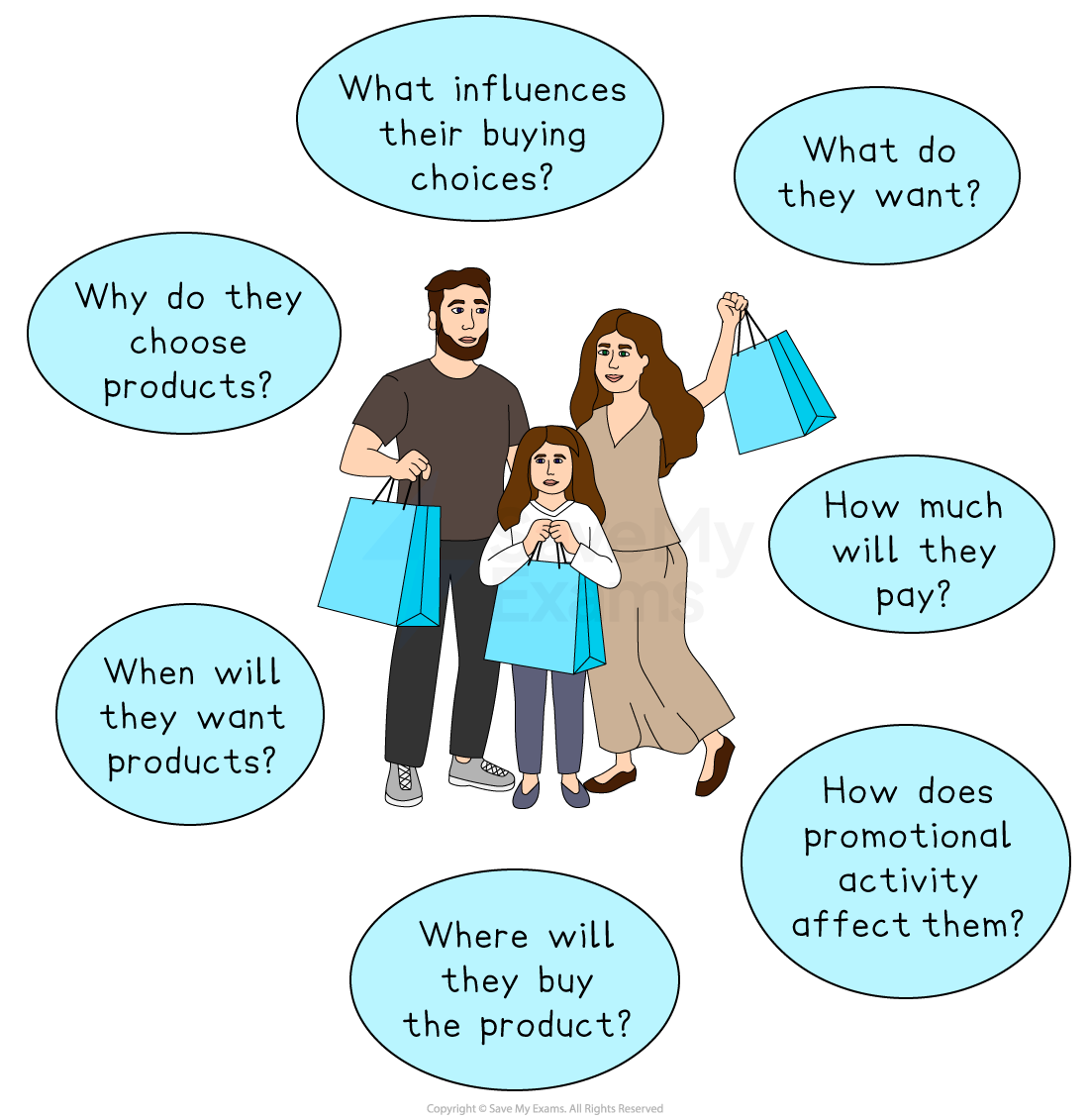
Marketing research can provide insights on customer behaviour
| Insight | Example |
|---|---|
| What do they want? | - Cadbury tracked Facebook groups and YouTube comments where thousands of fans begged for the old Wispa bar - Seeing a clear demand, Cadbury relaunched Wispa in 2008 — and sold 20m bars in the first seven weeks |
| How much will they pay? | - A 2023 UK study found that Netflix subscribers would still stay if fees rose a little, showing that price elasticity was very low |
| How does promotional activity affect them? | - Aldi measured weekly sales and social media feedback during its 2023 “Kevin the Carrot” Christmas advertising campaign - The data showed a sharp jump in festive food sales and a gain in market share, proving that the cartoon character encourages shoppers into stores |
| Where will they buy the product? | - Office for National Statistics (ONS) data shows online now makes up around 26% of UK retail sales - Grocers such as Morrisons have adjusted by adding more home‑delivery slots. |
| When will they want products | - Starbucks tracks autumn demand data and now launches its Pumpkin Spice Latte in late August because sales jump immediately |
| Why do they choose products? | - A 2023 UK survey found 82% of shoppers will pay more for eco-friendly packaging, encouraging brands towards greener materials |
| What influences their buying choices? | - A 2023 UK report by Traakr found that social media influencers now sway buying choices for half of 18–34-year-olds |
Was this revision note helpful?
Build on this topic