Marketing Mix: Place (Cambridge International AS Business)
Introduction to place
An introduction to place
-
Place in the marketing mix refers to where customers purchase a business's products and the distribution channels used to move the product from producer to consumer
-
In a competitive environment, location and distribution decisions can give a company a competitive advantage
- Businesses could locate themselves in areas with high foot traffic to achieve high sales volumes
- They may use innovative online channels to reach customers who prefer to shop online
-
Changing consumer needs can impact the way businesses distribute their products
-
E-commerce makes it easier for consumers to shop online and have products delivered to their doorstep
- Many businesses have therefore invested in their online presence, offering convenience and fast delivery to meet customer needs
-
Channels of distribution
Spec point —
3.3.6
- Channels of distribution are the intermediaries through which physical products move from the business to the end consumer
Different distribution channels
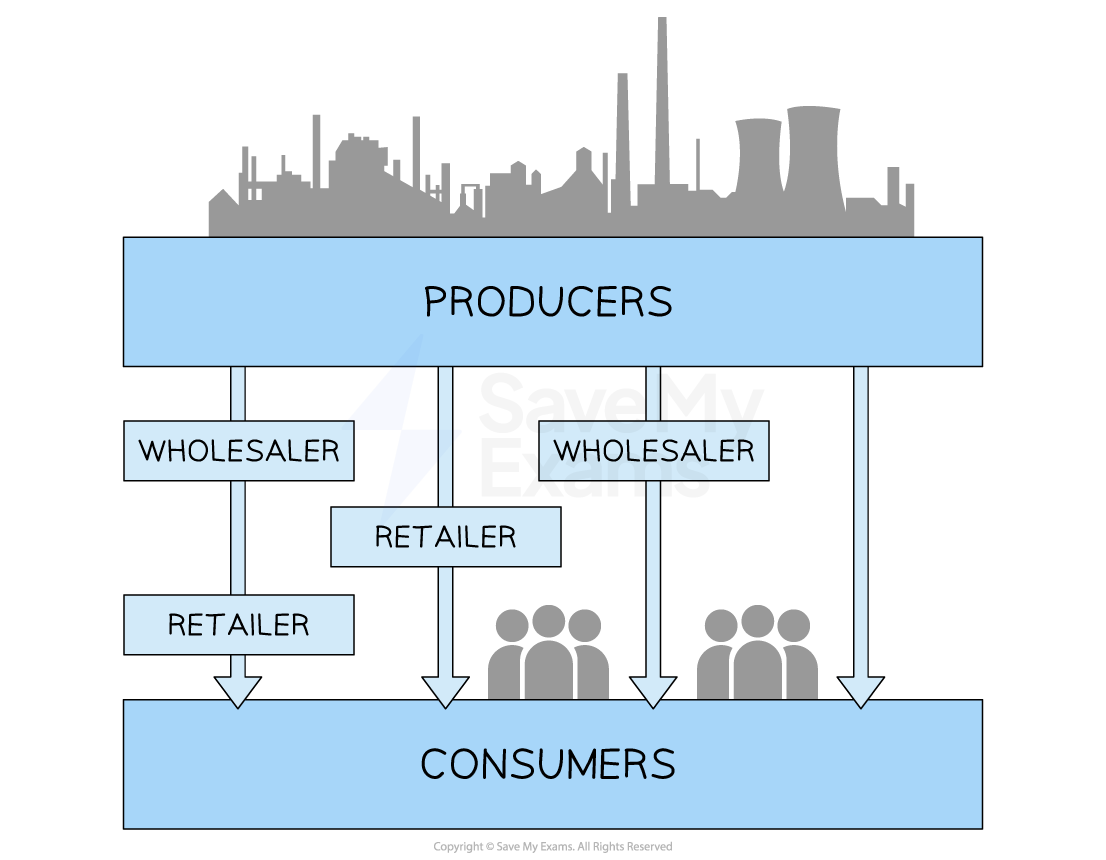
*The two different types of distribution channels businesses can use to move products to the end customer *
Explanation of the distribution channels
| Channel | Explanation | Example |
|---|---|---|
| Producer → Wholesaler → Retailer → Consumer | - This channel is commonly used by smaller retail businesses that lack space or sufficient cash flow to hold large amounts of inventory - Advantage: Small shops can buy little and often from the wholesaler, so they do not need big, costly storage space - Disadvantage: Two extra markups (wholesaler and retailer) push the selling price up for customers | - The Coca-Cola Company produces soft drinks, which are sold in bulk to a wholesaler - The wholesaler sells smaller quantities to a convenience store - The convenience store then sells individual soft drinks to the customer |
| Producer → Wholesaler → Consumer | - This channel is less common but can be used when there are no physical retail stores, or for products where the wholesaler can sell directly to bulk-buying consumers (e.g. institutions or large events) - Advantage: It can reduce distribution costs by cutting out the retailer, allowing slightly lower prices for large-scale buyers - Disadvantage: It is not suitable for everyday consumers who want to buy in small quantities or need advice before purchasing | - CleanPro Chemicals, a manufacturer of industrial cleaning supplies, sells bulk quantities of detergent to a wholesaler - The wholesaler then sells large tubs of cleaning products directly to schools, hotels or industrial users without going through a retail store |
| Producer → Retailer → Consumer | - This channel is often used for products with high demand or where the cost of distribution is high - This method is also common where customers require support or advice in selecting the product - Advantage: Retail staff can give advice and after‑sales help, which suits complex goods such as laptops - Disadvantage: Inventory sits in the retailer’s warehouse or shop, tying up cash until each item is sold | - Toshiba produces laptops and sells them directly to electronics retailers - Currys employs knowledgeable sales staff who sell Toshiba laptops to end customers |
| Producer → Consumer | - This channel is commonly used for products that are sold online or through direct sales channels - Advantage: No intermediaries mean lower costs, so the firm can offer low online prices or keep more profit - Disadvantage: The producer must handle delivery, returns and customer service itself, which can be expensive and time-consuming | - GermanWings sells its service (airline passenger tickets) directly to the end customer on its website |
Digital versus physical distribution
- Digital distribution is the process of delivering products or services electronically, usually over the internet, without the need for physical transportation or traditional retail outlets
- It allows businesses to reach customers directly and instantly, using online platforms, software or digital files
Examples of digital distribution
-
E-commerce platforms
-
Websites or apps where goods are purchased and delivered digitally
-
Examples include
- Amazon for eBooks
- Steam for games
- Udemy for online courses
-
-
Downloads and streaming
-
Files are delivered digitally to the user’s device or accessed on-demand
-
Examples include
- Spotify for streaming
- Netflix for video
- Adobe Creative Cloud for software
-
-
Cloud-based delivery
-
Products are accessed online through cloud services rather than downloaded
-
Examples include
- Google Docs
- Microsoft 365
-
-
Digital wallets and app stores
-
Payment and delivery systems that host apps, games and tools for immediate use
-
Examples include
- Apple App Store
- Google Play
-
Comparison of digital and physical channels of distribution
| Digital distribution | Traditional distribution |
|---|---|
| - Delivered electronically – no physical stock or transport needed | - Physical delivery through wholesalers, retailers, or direct sellers |
| - Instant access for consumers, often 24/7 | - Delivery takes time and depends on stock and location |
| - Can be global from the start, reaching wide markets | - Often restricted by geography, transport and store networks |
| - Typically lower cost per unit (no packaging or delivery) | - Higher cost due to shipping, warehousing, and staff |
| - Ideal for intangible goods (e.g. media, software, NFTs) | - Required for tangible goods (e.g. clothing, furniture) |
Was this revision note helpful?
Build on this topic