Primary Research and Secondary Research (Cambridge International AS Business)
The features of primary and secondary research
Primary research
- Primary research is the process of gathering information directly from consumers in the target market using field research methods such as surveys and interviews
Common features of primary research
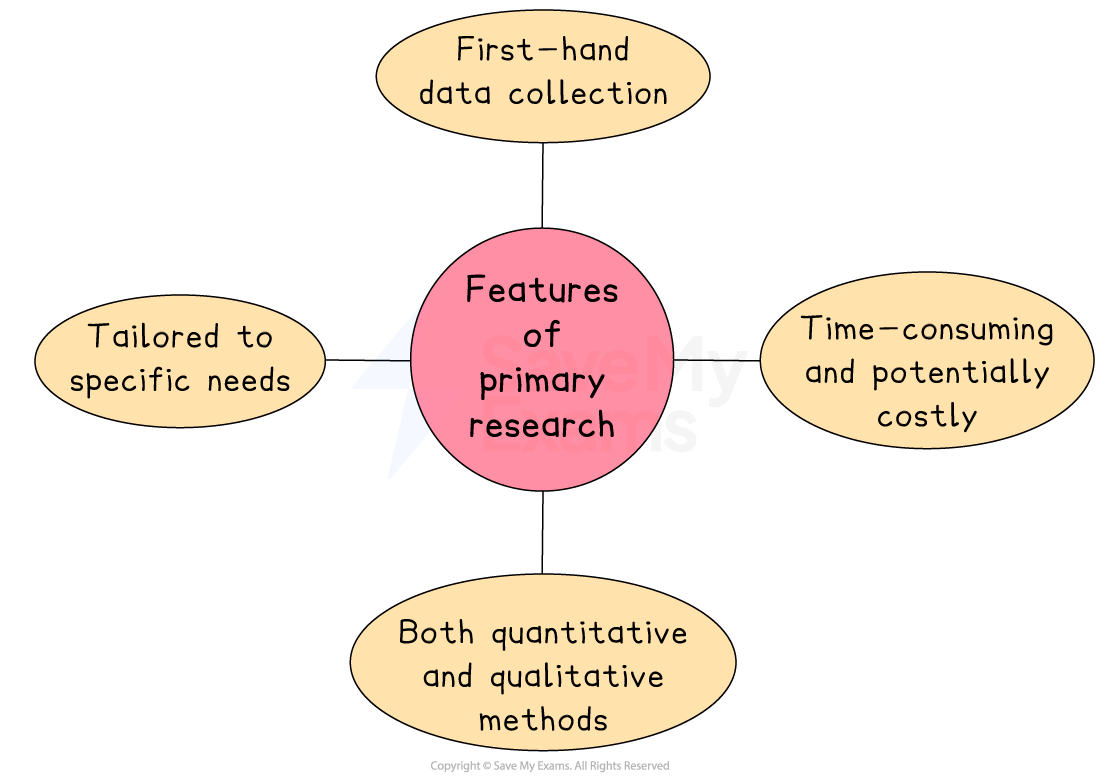
Primary research data is first-hand and tailored to specific needs
-
First-hand data collection
- Primary research involves gathering new information directly from people, rather than using existing sources
-
Tailored to specific needs
-
The questions and methods are designed to collect information that is directly relevant to the business’s goals
- E.g. A restaurant could ask customers what new dishes they’d like added to the menu
-
-
Time-consuming and potentially costly
-
Collecting and analysing primary data takes time, money, and effort, especially for large samples
- E.g. Organising focus groups or conducting interviews may require trained staff and payment to participants
-
-
Includes both quantitative and qualitative methods
-
Primary research can gather numerical data (quantitative) or opinions and attitudes (qualitative)
- E.g. A business may run a questionnaire with rating scales and follow-up interviews for deeper insight
-
Secondary research
-
Secondary research involves the collection, compilation and analysis of data that already exists
-
It is likely to have been collected for a broad purpose by another organisation, such as the government or a research specialist
-
Since the data is already available, it’s usually faster and often cheaper to access than primary research
- E.g. downloading a report on consumer habits from a trade organisation's website may be free or low-cost
-
Usefulness of primary market research data
- Businesses can choose from a range of primary marketing research methods and may combine a selection of methods to obtain comprehensive first-hand data
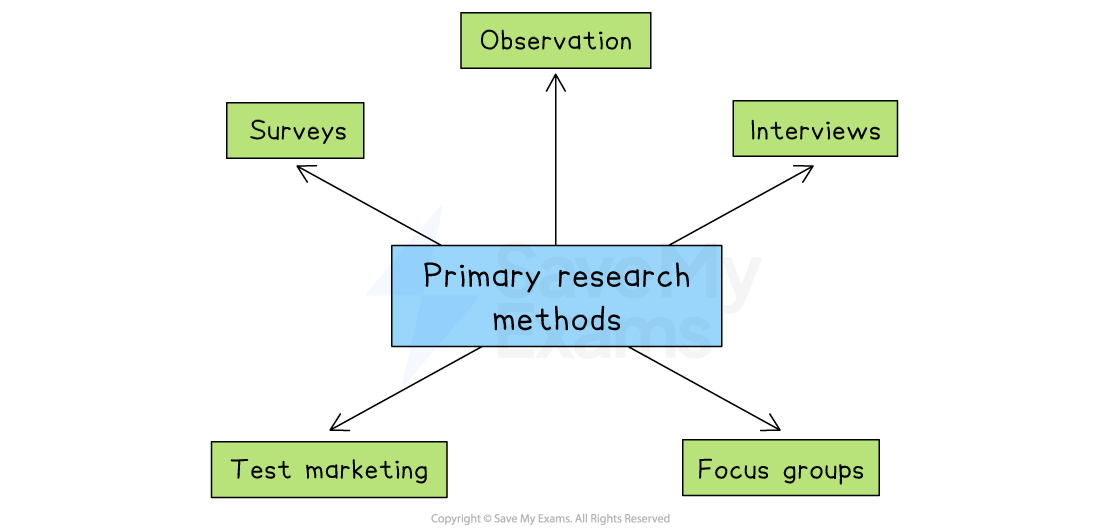
Primary research methods include surveys, observation, interviews, test marketing and focus groups
Surveys
-
The most widely used method for gathering primary research data is sampling through surveys
- A series of questions are posed to a certain number of people (respondents)
- The results from the "sample" are used to make inferences, which tare extrapolated to be true for the wider population
| Advantages | Disadvantages |
|---|---|
| - A large amount of data can be collected relatively quickly - Well-designed surveys can be completed easily by the respondents, especially online surveys | - Poorly designed and conducted surveys will result in poor results - Poor response rates are typical, especially when a random sampling method is used |
Observation
-
This involves hiring someone to stand in an appropriate location and study consumer behaviour in a store or perhaps judge the potential consumer traffic at a particular location
- Researchers may observe the impact of packaging or the particular placement of a product in a store on consumer choice
| Advantages | Disadvantages |
|---|---|
| - A useful method to capture data on human behaviour - Large numbers can be observed in a short period of time | - Observation needs to be combined with other primary research methods to understand the causes of behaviour |
Interviews
- The questions may be set up in a very similar way to a survey; however, an interviewer asks the questions
- This method takes longer, but it does allow the interviewee to ask follow-up questions and gather information that might easily be missed when conducting surveys
| Advantages | Disadvantages |
|---|---|
| - In-depth question elicit detailed opinions and perceptions from participants - High response rates can be achieved | - A time-consuming process, as interviews are carried out one-on-one - Interviewer bias can affect the validity of results |
Test marketing
- Free samples are provided to the target market for a limited period to gauge their response to the product
- Adjustments to the product or other elements of the marketing mix can be made following feedback
| Advantages | Disadvantages |
|---|---|
| - Perceptions and opinions can be gathered prior to a full product launch - Can attract early attention from potential customers | - Producing and distributing free samples can be expensive - Competitors may become aware of new products to be launched |
Focus groups
- A marketing specialist leads free-form discussions to collect detailed feedback from the target market on all aspects of the marketing mix
- Usually limited to a small group of 12–15 people
- The group typically meets for 90 minutes to 3 hours
| Advantages | Disadvantages |
|---|---|
| - Detailed information on opinions and perceptions can be gathered - Small groups make focus groups relatively easy and inexpensive to organise | - Participants may be reluctant to share their true opinions in a group situation - Rewards for participation make focus groups more expensive than other methods such as surveys or observation |
-
Businesses must choose a primary marketing research method that allows them to capture the correct form of data that can support decision-making
- Each method has a range of advantages and disadvantages, which must be considered when making this choice
Evaluation of primary marketing research
| Advantages | Disadvantages |
|---|---|
| - Information gathering is focused on the needs of the business and will not be available to its rivals | - The sample size may be too small and unrepresentative of all of the customers, leading to unreliable results |
| - The business can get in-depth information from respondents, e.g. reasons behind certain behaviour | - Bias may mean that researchers can guide respondents to answer questions in a particular way - Similarly, respondents may be influenced by the responses of others or not provide accurate information |
| - Primary marketing research is **more up-to-date and **can be used to ask specific questions, making it more relevant | - A business** may need to hire a specialist marketing research agency** to help, which can be an expensive and time-consuming process |
Sampling
Spec point —
3.2.3
-
Sampling involves getting opinions from a selected group of people in order to find out about the market as a whole
- It is expensive and time-consuming to collect data from all customers in a market
- Marketing researchers use carefully designed sampling methods from which conclusions can be drawn about the market as a whole
- In general, the larger the sample size, the more likely that results from marketing research activities will reflect the market as a whole
The main sampling methods: random, stratified and quota
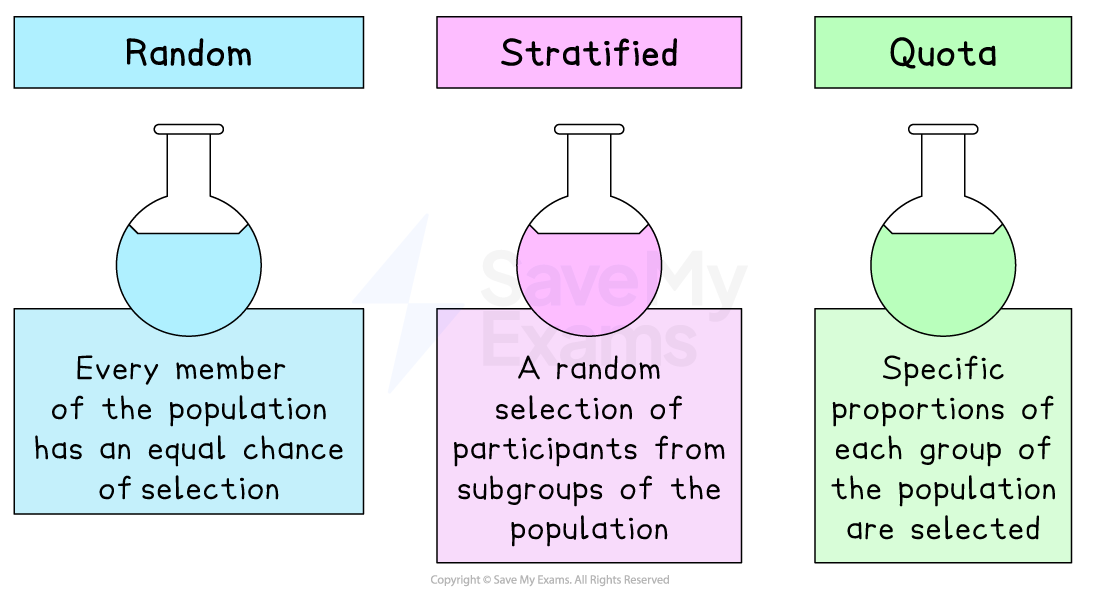
Sampling methods include random, stratified and quota
Random sampling
-
This method ensures that every member of the population has an equal chance of selection
- E.g. a survey of gym members may be sent to a random selection of customers taken from the membership database
Stratified sampling
-
This method involves the random selection of participants from subgroups of the population, such as age, gender, income level or education groups
- E.g. a survey of school pupils may be carried out only on Year 10 girls
Quota sampling
-
This method obtains a representative sample by determining specific proportions of each group of the population upon which to carry out research
- E.g. a researcher conducting a survey for a family car manufacturer may seek to interview a sample comprising 25% of individuals aged 18–24, 50% aged 25–45 and 25% aged 46 and above
The choice of sampling method
-
The choice of sampling method will depend upon a wide range of factors
- Time available
- Where little time is available to carry out marketing research, a random sample may be most appropriate, as it is usually very quick and straightforward to organise
- Knowledge of the target population
- Where a business has good knowledge of the target population, a quota sample should provide a set of research data that lacks bias
- Skills of researchers
- Where researchers lack experience or expertise in marketing research, a focused stratified sample is likely to provide a useful set of data that can be easily interpreted
Limitations of sampling
-
The sample might not reflect the views of the whole target market
-
If the group chosen for the research is too small or not *diverse *enough, the results may not represent the wider population
-
This can lead to incorrect assumptions about customer preferences or behaviour
- E.g. If a sportswear company only surveys customers in one city, it may miss preferences in other regions
-
-
Sampling can be biased if certain groups are over- or under-represented
-
When the sample includes too many people from one group and too few from another, the results become unbalanced
-
This kind of bias can happen by mistake or due to poor sampling methods
- E.g. If a technology company surveys only younger people online, it may ignore the views of older customers who shop in-store
-
-
Human error can reduce the reliability of the findings
-
Mistakes in how the sample is selected, how questions are asked, or how responses are recorded can affect the accuracy of the research
- E.g. An interviewer may ask leading questions, or a poorly designed questionnaire might confuse participants
-
Exam Hint A research population refers to the group of people in whom the business has an interest when conducting marketing research — a common mistake is to assume that research focuses on, say, the whole population of a country or region.
Usefulness of secondary market research data
Sources of secondary research
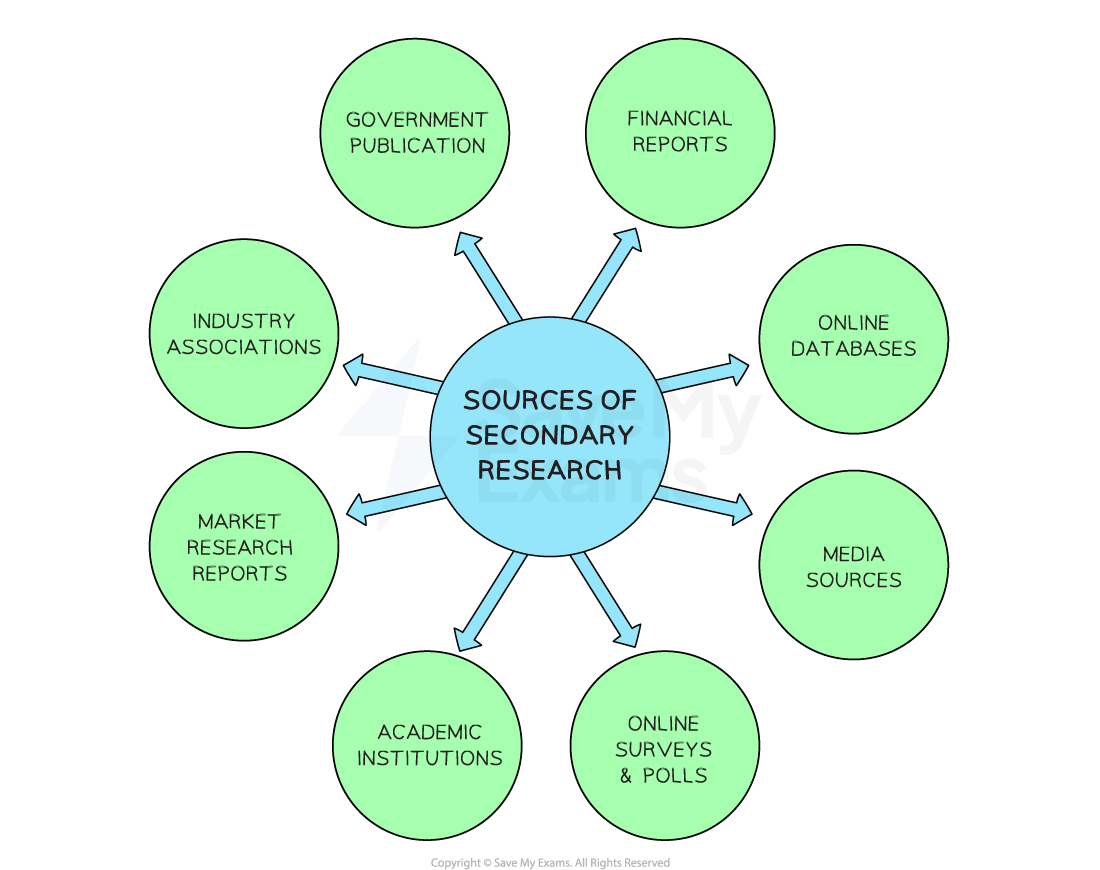
Businesses can consult a wide range of secondary sources to gather marketing research data
| Source | Explanation |
|---|---|
| Government publications | - National governments and trading blocs such as the EU publish reports and statistics on the economy, demographics, industry trends and consumer behaviour* * |
| Academic institutions | - Universities conduct studies and publish research papers that provide insights and data on specific industries, consumer behaviour and market trends - For example, Stanford University is a globally significant research centre for engineering and medicine |
| Industry associations | - Trade and industry associations provide detailed information about specific sectors, including market size, growth rates and industry benchmarks - E.g. the International Organisation of Motor Vehicle Manufacturers conducts and collates research on production and sales statistics |
| Marketing research reports | - Companies specialising in marketing research produce and sell in-depth reports on industries, markets and consumer trends - E.g. Mintel is one of the leading private companies supplying marketing research information |
| Financial reports | - Public limited companies publish annual reports that can provide valuable information about a company's performance, market position and future plans |
| Media sources | - Newspapers, magazines and online forums publish opinion pieces and investigative reports that offer insights into market trends, consumer behaviour and industry developments - E.g. the Financial Times and The Wall Street Journal |
Advantages of secondary marketing research
- Information is already available and is quicker to collect than primary research, thereby saving time
- Information is often free (e.g. government websites and internet sources such as Statista) or cheap to collect, leading to lower costs compared to primary research
- Suitable for a small business that lacks a large marketing budget and/or expertise
Disadvantages of secondary marketing research
- Information has been collected for other purposes, so it may lack relevance or may not be factually correct, e.g. Wikipedia
- Can be expensive to purchase market-specific secondary data from specialist companies, e.g. Mintel reports
- Information may be out of date, especially in dynamic markets
Was this revision note helpful?
Build on this topic