Forming functions — defining domains
Excerpt: For each rule, define several different functions by choosing different domains. How does the choice of domain affect the range of the resulting function?
Problem
To define a function we need a set of inputs (called the domain) and some sort of rule for turning inputs into outputs. The set of outputs is called the range of the function.
Here are some rules which tell us what will happen to a given input value, .
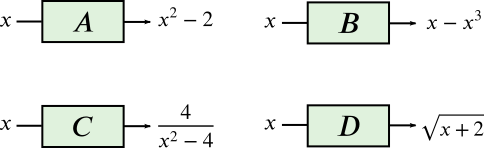
For each rule,
- Define a function by choosing a domain. Now define another function by choosing a different domain.
- For each function you have defined, state the corresponding range of the function.
- Sketch graphs of the functions you have defined.
For each rule,
- What is the largest possible domain you can define within the real numbers?
- What is the smallest possible domain that will define a function with the largest possible range?
Things you might have tried
There are many possible functions that you could define in each case. We will illustrate some of these ideas using rule
We could define a function using rule and letting be any real number. We could write this function as The range is all real numbers greater than or equal to , which we can write as with .
We could also define a function by restricting to be a real number that is greater than or equal to but less than . We could write this as This time, the range is .
Alternatively, we could restrict to being an integer greater than , which would give the following function For this third function, , with always less than a square number, i.e. .
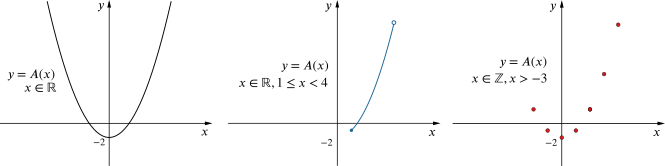
Note the open and closed circles at the ends of the line in the second graph, indicating whether or not the end point is included in the domain.
Sketch graphs
For each rule,
- What is the function with the largest possible domain within the real numbers?
Rules and are defined for all real inputs, so the largest possible domain would be, for instance,
In contrast, there are values of for which rules and are undefined. For instance the largest possible domain of would be,
For each rule,
- What is the smallest possible domain that will define a function with the largest possible range?
Thinking about our three suggested functions for above, we found the ranges were as follows.
| Function | Domain | Range |
|---|---|---|
| 1 | , | |
| 2 | , | , |
| 3 | , |
Out of these three, function 1 has the largest range. Its range includes all the values in the other two ranges and other values too.
In the case of rule , the largest possible range results from the function with the largest possible domain.
Is it true in general that if we make the domain of a function as large as possible, we also make the range as large as possible?
But can we obtain the same range with a smaller domain?
For function 1, it is possible to find two different values of which give the same value of , for example, . So we could remove one of these input values from the domain without changing the range.
We can restrict the domain of to be , , and the range will still be , as required. What happens if we make the domain any smaller?
Another way would be to define for , or . What would the graph of this function look like? What other domains could you have which still give you the same range?
Which of these ideas could be applied to functions which are defined using the other rules?
Are there any of the rules for which the only way to achieve the maximum possible range is to define it on the maximum possible domain? What could you say about such functions?
As we’ll see later, this idea of restricting the domain without limiting the range becomes important when we look at making inverse functions.