Composing gets me nowhere
Excerpt: This resource is designed to be used as an introduction to self-inverse functions. Students are asked to sketch a set of functions, work out which ones are self-inverse and find a graphical connection between them.
Warm-up
If , for , what is ?
By we mean the composition of with itself, sometimes written as .
The composition of with itself is a function whose output is the same as the input value. We call a self-inverse function. Can you explain why we use this name?
Note that the composition is undefined at even though the function is defined.
Answer
Can you find any other functions that behave in this way when composed with themselves?
Problem
Sketch the following functions and determine which of them are self-inverse.
What do the graphs of the self-inverse functions have in common?
Sketch and find equations for some other self-inverse functions.
Solution
In order to sketch the graph of it is helpful to rewrite it as This reveals that the graph is a transformation of .
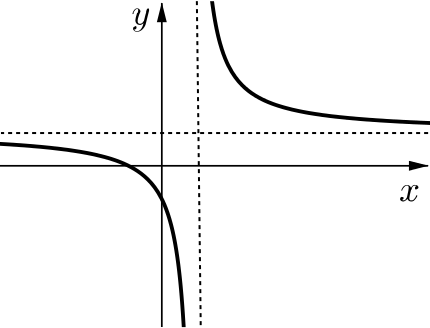
We compose with itself:
So is self-inverse.
Strictly, for to be self-inverse, we should check that its range exactly matches its domain since its output is used as its own input in the composition.
What are the domain and range of ?
By rewriting we find that, as for , its graph is a transformation of .
so is not self-inverse.
What is different about that makes it self-inverse while is not?
Composing, we find
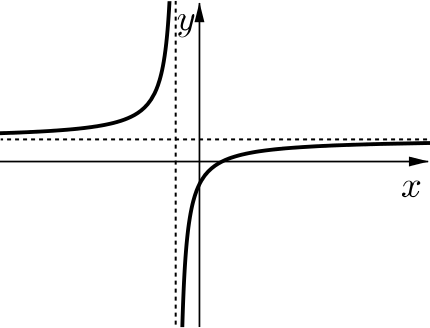
What happens if we compose with itself to make the function (which could be written as )?
Of the remaining functions, we find that , and are self-inverse.
Functions , , and
We have sketched the four self-inverse functions on the same set of axes.
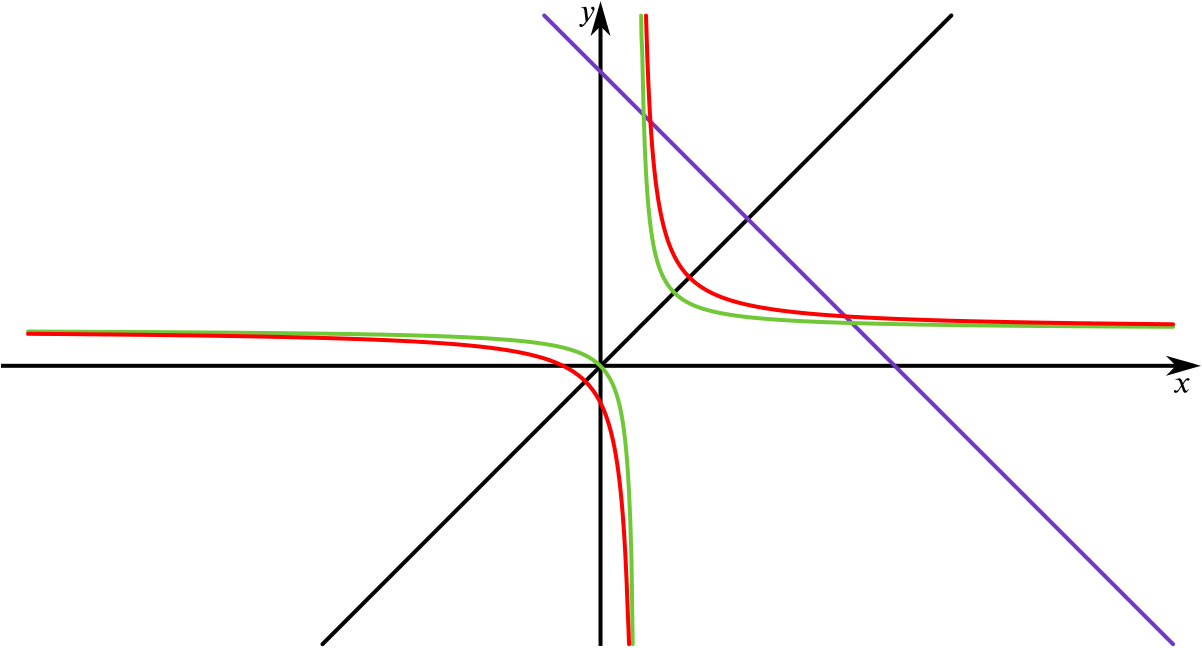
We remember that the graphs of any function and its inverse are reflections of one another in the line . So it is no surprise that the graph of each self-inverse function is a reflection of itself in .
Can you match up the four functions with their graphs?
By thinking about the reflection property we can see that any straight line parallel to the purple line in the graph above will represent a self-inverse function. Can you write down a generalised form of the equation?
Also, any translation of will be self-inverse so long as the origin is transformed to a point on the line . What about stretches, reflections and other transformations?
Can you find any other families of self-inverse functions?