Liquidity Ratios (Cambridge International A-Level Business)
The meaning and importance of liquidity
-
Liquidity is the ability of a business to pay back its short-term debts, e.g. its suppliers
-
A businesses that cannot pay its debts is considered insolvent
- If a business cannot pay its suppliers, raw materials or components may not be delivered and production will be delayed
- If it cannot repay an overdraft, banking facilities may be withdrawn, and its credit rating will suffer
- Creditors may force it to stop trading and sell its assets so that the debts owed to them are repaid
The current ratio
- The Current Ratio is a quick way to measure liquidity and the outcome is expressed as a ratio
- All forms of current asset are considered in this ratio
- The current ratio is an effective liquidity measure for businesses that hold little stock
- The result indicates how well current assets can cover short-term debt
- It is calculated using the formula
Worked Example Packer Sports Ltd has current assets of $15,545, current liabilities of $5,060 and an inventory figure of $8,250.
Calculate Packer Sports Ltd’s current ratio.
[2]
Step 1: Substitute the values into the equation
= \frac{\ 15 , 545 }{$ 5 , 060}
= 3.07 : 1$ (2)
- In this example, Packer Sports Ltd has $3.07 of current assets to cover each $1 of short-term debt**
The acid test ratio
-
The acid test ratio is a precise and realistic way to measure liquidity, especially for businesses that hold large amounts of inventory
-
It is expressed as a ratio
-
It is also known as the liquid capital ratio
-
The least liquid form of current assets (inventory) is deducted so the acid test ratio provides a more realistic measure of the businesses ability to meet short-term debts quickly
- It often takes time to sell inventory so it is excluded
-
It is calculated using the formula
-
Worked Example Packer Sports Ltd has current assets of $15,545, current liabilities of $5,060 and an inventory figure of $8,250.
Calculate Packer Sports Ltd’s acid test ratio.
[3]
Step 1: Subtract inventory from current assets
\ 15 , 545 - $ 8 , 250
= $ 7 , 295$ (1)
Step 1: Substitute the values into the equation
$\text{Acid} \text{test} \text{ratio} = \frac{ \text{Current} \text{assets} - Inventory}{Current liabilities}
= \frac{ $ 7 , 295}{$ 5 , 060}
= 1.44$(1)
Step 2: Express the outcome as a ratio
(1)
- In this example, Packer Sports Ltd has $1.44 of the most liquid current assets to cover each $1 of short-term debt**
Methods of improving liquidity
- A business will often need to take quick, decisive steps to improve their liquidity
Ways to improve liquidity
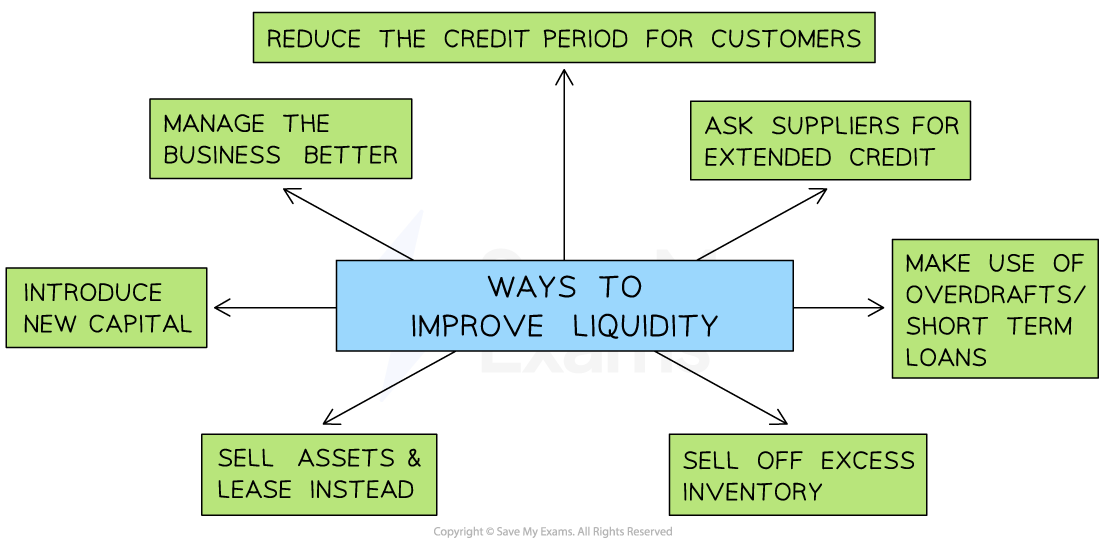
*Liquidity can be improved in a number of ways *
Methods to improve liquidity
| Method | Explanation |
|---|---|
| Manage the business better | - Use cash flow forecasts to identify potential cash flow issues before they arise and take appropriate action - Budget effectively and consider adopting zero budgeting to carefully control spending - Set clear financial objectives and look for ways to reduce costs and increase income wherever possible |
| Reduce the credit period offered to customers | - Collecting money owed from customers more quickly will **increase the level of current assets **in the business - Customers may move to competing businesses that offer better credit terms |
| Ask suppliers for an extended repayment period, e.g an extension from 60 to 90 days | - Current liabilities will not be reduced - The business can use cash it would have paid to suppliers for other purposes - Suppliers may be unwilling to extend credit terms |
| **Make use of overdraft facilities or short-term loans | - Current liabilities will** increase** - The business can spend more money than it has in its bank account - Banks may be reluctant to lend to businesses with cash-flow problems |
| Sell off excess inventory | - Less liquid current assets will be reduced and** converted into more liquid forms of current asset **(e.g. cash) - Storage and security costs may also be reduced - Inventory may need to be sold at a low price to attract sales |
| ** Sell assets and lease fixed assets instead **(e.g. sale & leaseback) | - Both current assets and current liabilities will increase - The business will continue to have the use of assets but must make regular payments to the leasing company |
| ** Introduce new capital and reduce **drawings out of the business | - Current assets will be increased - New capital may be** introduced by the owner or from additional investors - This may result in the dilution of control of the business |
Was this revision note helpful?