Managing Employee Performance (Cambridge International A-Level Business)
Measurement of employee performance
-
The effectiveness of a business's workforce can be measured in a number of ways, including
- Labour productivity
- Absenteeism
- Employee costs as a percentage of turnover
-
These metrics are compared over time, between functional areas, branches or outlets, or against competitors
-
They can provide the basis for workforce planning and performance management
1. Labour productivity
-
Labour productivity measures output per worker during a specified period of time
- It is expressed as a number of units and calculated using the formula
- Businesses aim to increase the level of labour productivity to improve competitiveness
The link between high labour productivity and competitive edge
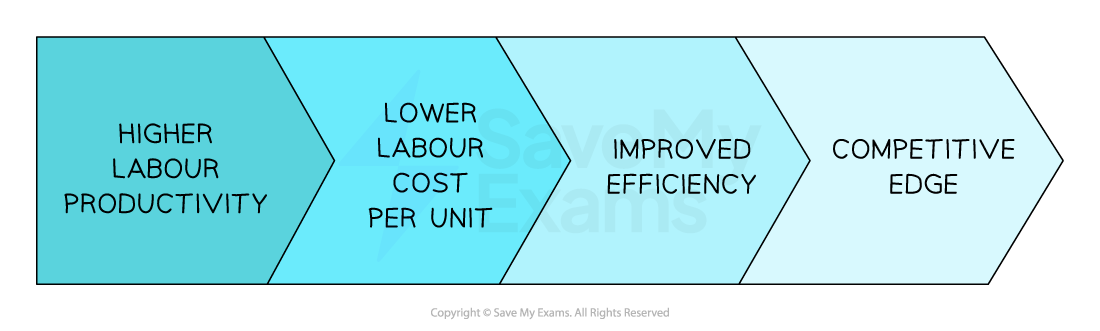
Higher labour productivity improves businesses competitiveness
Worked Example The table shows the number of pairs of luxury wool socks produced by StrumpMani* *in 2023 and 2024
Year Units Produced 2023 46,000 2024 69,000 In 2023 StrumpMani* *employed 50 staff. In 2024 the number of staff employed by the business increased by 20%
Calculate the percentage change in labour productivity between 2021 and 2022.
[4]
Step 1 - Calculate labour productivity for 2023
(1)
Step 2 - Calculate labour productivity for 2024
(1)
Step 3 - Calculate the percentage difference between the two years ((new-old) / old)
$= \frac{ 1 , 150 - 920 units}{920 units} \times 100
= 25 %$ (1)
Step 4 - Identify whether the percentage difference is an increase or decrease
- Labour productivity has increased by 25% (1 mark)
2. Absenteeism
- The absenteeism rate is a measure of the proportion of staff were absent from work during a specific period of time (e.g. a day, week or month)
- It is expressed as a percentage and is calculated using the formula
-
High levels of absenteeism can cause several problems for a business, including
- Absence due to illness requires sick pay to be paid
- Hiring temporary staff to cover for those absent increases costs
- Output is likely to be temporarily reduced if staff are key to production process
- Other staff may become demotivated if they have to constantly cover for absent workers
- A wider culture of absenteeism may develop
Worked Example On January 16th twenty-two of Belling Stoneworks Ltd's 189 employees were absent.
Calculate Belling Stoneworks Limited's absenteeism rate on January 16th.
(2)
Step 1: Substitute the values into the formula
$= \frac{22}{189} \times 100
= 11.64 %$ (2)
3. Employee costs as a percentage of turnover
-
This metric shows how much of a business’s revenue is spent on paying employees
- It helps assess how efficiently the workforce is being used
-
It is calculated using the formula:
Worked Example In the 2022–2023 financial year, Tesla had:
- Revenue = £5,297 million
- Employee costs = £2,894 million
Calculate the employee costs as a % of turnover between 2022 and 2023.
[2]
Step 1 - Substitute the values into the formula
$= \frac{ 2 , 894 million}{5 , 297 million} \mathrm{x} 100
= 54.6 %$ (1)
Step 2 - Present the final answer
- 54.6% of turnover was spent paying staff (1)
Causes and consequences of poor employee performance
Causes of poor employee performance
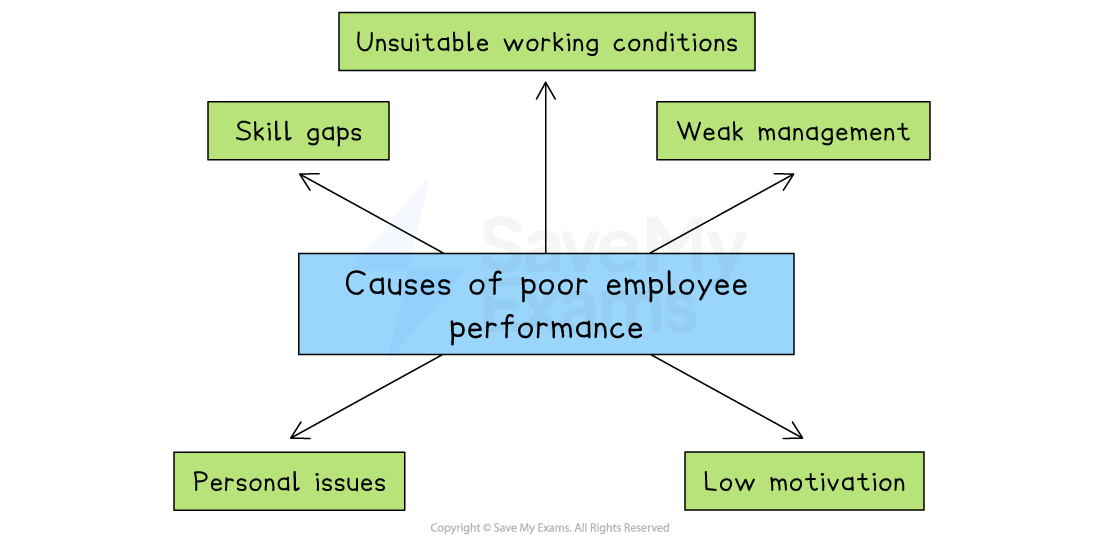
Skills gaps, low motivation, weak management and poor working conditions can affect employee performance
-
Skills gaps
- Weak recruitment or training means staff lack the skills or knowledge to do a job properly
-
Low motivation
- Poor pay, little recognition or limited career prospects may cause employees to make less effort with their work
-
Weak management
- Unclear goals, poor communication or inconsistent feedback can confuse staff, reducing their productivity
-
Unsuitable working conditions
- Unsafe, uncomfortable or poorly equipped workplaces can reduce output
-
Personal issues
- Health, stress or family problems can distract employees from work
Consequences of poor employee performance
| Consequence | Impact | Example |
|---|---|---|
| Falling productivity | - Unit costs rise, so prices become less competitive | - A car-assembly plant with outdated training builds fewer cars per hour than rivals in Japan, forcing it to charge higher prices |
| Quality errors | - More defects and complaints harm the firm’s reputation | - A smartphone maker in China ships handsets with faulty cameras, leading to negative online reviews and returns |
| Missed deadlines and lost sales | - Late deliveries drive customers towards rivals | - An online fashion retailer in Germany misses pre-Christmas shipping dates; shoppers switch to a competitor with guaranteed delivery |
| Higher absenteeism and turnover | - Extra spending on recruiting and training replacement staff | - A fast-food chain in Brazil sees many staff call in sick or quit, so managers spend time and money hiring and retraining new crew members |
| Low team morale | - Poor performers drag down colleagues, weakening the business's culture | - In an Indian call centre, constant errors by a few agents frustrate co-workers, lowering overall enthusiasm and service quality |
Strategies for improving employee performance
-
Key HR objectives include
- Raising labour productivity, as this lowers labour cost per unit, improving business competitiveness
- Reducing absenteeism, as this can reduce training costs and overtime payments, and can build a positive team spirit
- Reducing labour costs as a proportion of revenue, as this increases efficiency and lowers unit costs
Ways to improve employee performance
Financial rewards
-
Paying workers more or sharing profits may increase commitment and effort, leading to higher output and productivity
-
Bonuses and commissions are only paid when they have been earned or if targets have been met
-
Attendance and loyalty rewards may improve the intrinsic motivation of workers as they feel valued
Employee share ownership
- Rewarding senior executives and managers with shares may increase their commitment to achieving objectives
- Employees who own shares in the business may work harder and take less time off as they have a financial stake in the success of the business
Consultation
- Consultation involves managers obtaining the views of employees when making decisions
- Workers are likely to feel more involved within the business and work hard, and may be less likely to take days off work
Empowerment
- Providing employees with autonomy and responsibility to make their own decisions and work on their own behalf encourages them to use knowledge and experience and develop their own solutions
- Workers must be properly trained and equipped with the necessary resources to be properly empowered
- Leaders need to be prepared to hand over authority and focus on providing encouragement, praise and feedback
Was this revision note helpful?
Build on this topic