Methods of Investment Appraisal (Cambridge International A-Level Business)
The need for investment appraisal
-
Investment appraisal involves comparing the expected future cash flows of an investment with the initial expenditure on that investment
-
A business may want to analyse
- How soon the investment will recoup the initial outlay
- How profitable the investment will be
-
Before an investment can be appraised key data will need to be collected, including
- Sales forecasts
- Fixed and variable costs data
- Pricing information
- Borrowing costs
-
The collection and analysis of this data is likely to take some time
- It requires significant experience to interpret the data appropriately before the investment appraisal can take place
Payback period
- The payback period is a calculation of the amount of time it is expected an investment will take to pay for itself
- The payback period is calculated using the formula
Worked Example Gomez Carpets is considering an investment in a new storage facility at a cost of $200,000. It expects additional net cash flow of $30,000 per year as a result of the investment.
Calculate the payback period for the investment.
(3)
Step 1: Substitute the values into the formula
= \frac{\ 200 , 000}{$ 30 , 000}
= 6.67 \text{years}$ (1)
Step 2: Convert the outcome to years and months
(1)
Evaluating the use of the payback method
| Advantages | Disadvantages |
|---|---|
| - It is a simple method to calculate and understand - It is particularly useful for businesses where cash flow management is vital - Businesses can identify the point at which an investment is paid back and contribute positively to cash flow - It is also useful when new technology is introduced regularly - Businesses purchasing equipment can calculate whether an investment ‘pays back’ before an upgrade is available | - It provides no insight into the profitability of investments - Payback only considers the total length of time to recover an investment - Neither the timing nor the future value of cash inflows is considered - This method may encourage a short-termism approach - Potentially lucrative investments may be dismissed as they take longer to pay back than alternatives |
Average rate of return
-
The average rate of return compares the average profit per year generated by an investment with the value of the initial capital cost
-
The average rate of return is calculated using the formula and is expressed as a percentage
- This makes it easy to compare different investment options
Worked Example Creative Frames, a small artwork framing business based in Bermuda, is considering an investment of $40,000 in new machinery. Megan, the business owner, believes that total returns over a 6-year period will be $76,000
Calculate the average rate of return of the proposed investment.
(4)
Step 1 - Deduct the capital cost from the total returns
= \ 76 , 000 - $ 40 , 000
= $ 36 , 000$ (1)
Step 2 - Divide the outcome by the number of years of use
= $ 36 , 000 / 6 years > > = $ 6 , 000(1)Step 3 - Substitute the values into the formula
(1)
Step 4 - Multiply the outcome by 100 to find the percentage
$= 0.15 \times 100
= 15 %$ (1)
Evaluating the use of average rate of return
| Advantages | Disadvantages |
|---|---|
| - ARR considers all of the net cash flows generated by an investment over time - ARR is easy to understand and compare the percentage returns with each other | - As it depends on an average of cash flows it ignores the timing of those cash flows - The opportunity cost of the investment is ignored as values are neither expressed in real terms nor adjusted for the impact of interest rates and time |
The meaning of net present value
-
The net present value (NPV) takes into account the effects of interest rates and time
-
It recognises
- The fact that that **money received in the future is often worth less **than money received today (inflation)
- The** opportunity cost** of not having the money available for other uses
Calculation of net present value
-
To calculate the NPV of an investment, the value of all future net cash flows in today’s terms need to be calculated first and then discounted using a table
-
The cost of the initial investment is deducted from the total of the discounted net cash flows
- If future net cash flows minus the initial investment are positive, then the investment is likely to be worthwhile
- If the sum of future net cash flows minus the initial investment is negative, then the investment is unlikely to be worthwhile
-
Discounted cash flows are calculated using discount tables, which allow future cash flows to be expressed in today’s terms
Discount factors at different rates of interest
Discount factors at different levels of interest
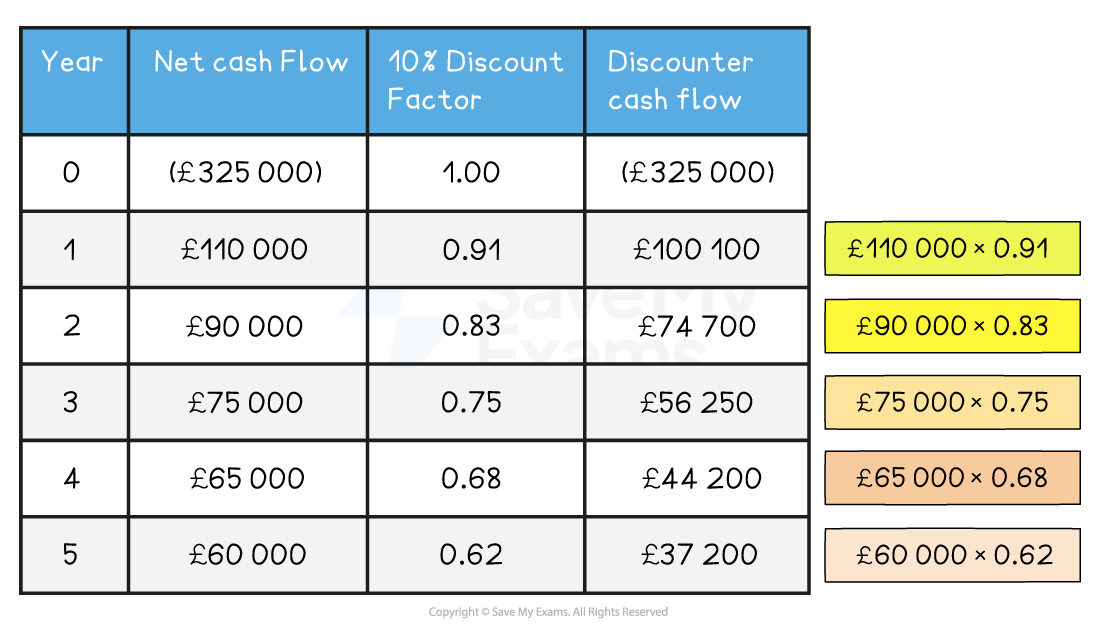
Worked Example Brownsea Sightseeing Tours Ltd is considering purchasing a new pleasure craft at a cost of £325,000. It expects the investment to achieve the following net cash flows over five years of operation
Year Net cash flow (£) 10% discount factor (2dp) 0 (325,000) 1.00 1 110,000 0.91 2 90,000 0.83 3 75,000 0.75 4 65,000 0.68 5 60,000 0.62 Using a 10% discount factor, calculate the NPV of the leisure craft investment.
(4 )
Step 1: Calculate the discounted cash flow for each year by multiplying the net cash flow by the discount factor
(3)
Step 2: Add together the discounted cash flow values for each year, including Year 0
$( \pounds 325 , 000 ) + \pounds 100 , 100 + \pounds 74 , 400 \pounds 56 , 250 + \pounds 44 , 200 + \pounds 37 , 200
= ( \pounds 12 , 550 )$ (1)
- The net present value of the investment is -£12,550
Interpretation of net present value
- The outcome of the NPV calculation often determines the decision a business makes about an investment
Net present value outcomes
| NPV result | Interpretation |
|---|---|
| Positive | - The project is expected to earn more than it costs - It should be accepted unless qualitative factors suggest otherwise |
| Zero | - The project breaks even, meaning future returns equal the cost of the investment - The investment decision may depend on other factors |
| Negative | - The project is expected to make a loss - It should usually be rejected unless qualitative factors suggest otherwise |
-
However, care should be taken when assessing NPV outcomes
-
The discount rate matters
- Choosing a higher rate makes future cash inflows seem smaller
-
NPV uses estimated figures
- These forecasts may not be accurate
-
Case Study
SoluTech Energy is a medium-sized renewable energy company based in Indonesia. The business is focused on providing sustainable power solutions to rural communities and small businesses
The management team is considering a new investment: installing a set of high-efficiency solar panels at one of their key partner sites. The goal is to reduce long-term energy costs and demonstrate the company’s commitment to clean energy
- The initial investment required is $50,000
- After forecasting cash inflows and applying a suitable discount rate (to account for risk and time value of money), SoluTech estimates that the project will generate $60,000 in present value terms over the next few years
Net present value calculation
NPV = $ 60 , 000 - $ 50 , 000 > > = $ 10 , 000Business decision
- Since the NPV is positive, SoluTech concludes that the investment will add value to the business
- The project is expected to generate a return above its cost, so the company decides to go ahead with the investment
Was this revision note helpful?
Build on this topic