SWOT Analysis (Cambridge International A-Level Business)
Exam board Cambridge International · A-LevelUpdated 2025-07-08
Conducting a SWOT Analysis
-
SWOT Analysis is an analytical tool used by businesses to identify
- Internal strengths and weaknesses
- External opportunities and threats
-
It can help senior managers understand the current business position and future changes that may occur so that appropriate strategic decisions may be made
-
Before a SWOT analysis can be compiled
- Managers should decide whether the whole business,a specific product or a new project is to be analysed
- Financial and operations data and staff or customer feedback should be reviewed carefully rather than rely on hunches
- Economic, social, technological and competitive trends should be carefully reviewed to identify expected opportunities and threats
- Findings should be cross-checked with independent reports before the most important factors are considered
Factors considered in a SWOT analysis
| Strengths | Weaknesses |
|---|---|
| - What the business is good at - Qualities that separate the business from rivals - Internal resources such as skilled staff or a particular innovation - Possession of assets such as capital, patents or intellectual property - A loyal customer base - Effective leadership | - What the business does poorly - Ways in which the business lags behind competitors - Resource or capital limitations, including labour and finance - Lack of a competitive advantage - Lack of a unique selling proposition (USP) - Poor online presence |
| Opportunities | Threats |
| - Options a business may exploit to enjoy further success - Developing markets for specific products become apparent - Few competitors exist - A changing legal or political environment positively impacts on business processes and decisions - Social or technological developments create an emerging need for the businesses' products - Economic indicators becoming more favourable - A potential for positive media coverage of the business | - Hazards that have the potential to damage business performance - New or emerging competitors are gaining market share - A changing legal or political environment negatively impacting on business processes and decisions - Social or technological developments threaten obsolescence of products - Economic indicators becoming less favourable - Negative press coverage - Changing customer attitudes towards the business |
Using the information from a SWOT analysis
-
Once a SWOT Analysis has been completed by a business, appropriate decisions can be made to improve performance
- Strengths should be harnessed
- Weaknesses should be eliminated
- Opportunities should be seized
- Threats should be mitigated
Example SWOT analysis
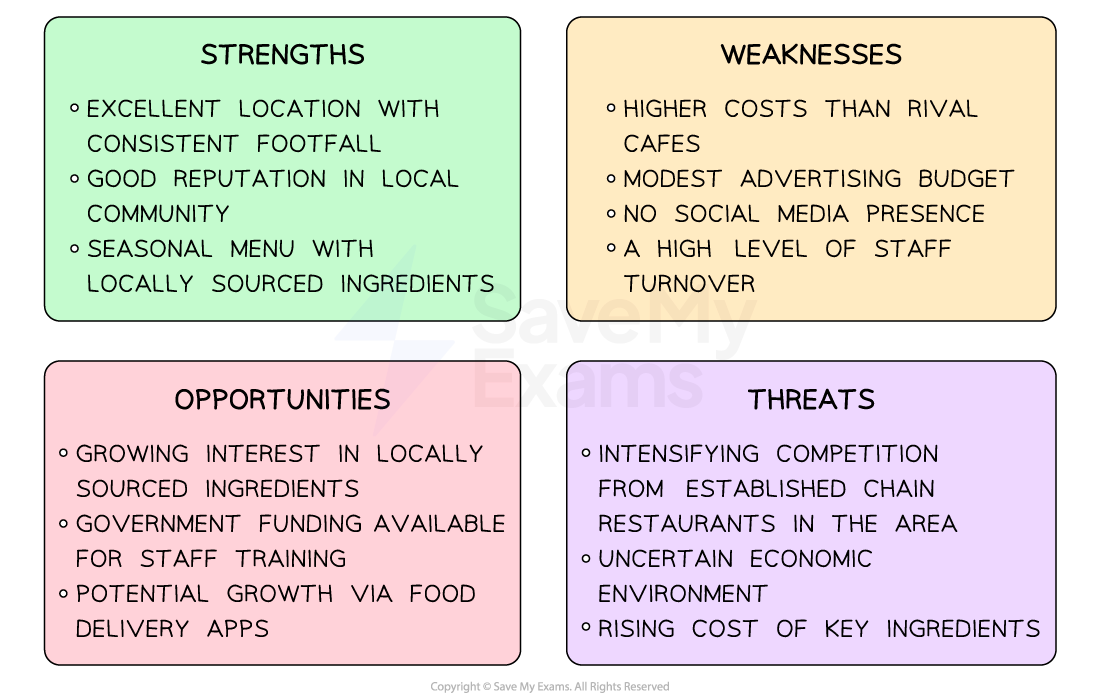
An example of a SWOT Analysis for a small cafe business
-
Having compiled the SWOT analysis, the cafe owner may
- Seize the opportunity presented by the growing interest in locally sourced ingredients by promoting the cafe's strength of its seasonal, locally sourced menu, especially given the threat from large competitors
- Make use of the government funding for staff training to attempt to reduce staff turnover
- Target a geographically wider target market by teaming up with delivery apps and establishing a social media presence
Strengths and weaknesses of SWOT analysis
Strengths and weaknesses of a SWOT analysis
- Understanding what the tool does well and where it falls short helps a company judge whether a SWOT analysis is suitable for its planning needs
Strengths of using SWOT analysis when planning strategy
-
Easy to understand
- Listing strengths, weaknesses, opportunities and threats is straightforward
- Managers and employees at all levels can join in
-
The big picture in one place
- SWOT shows both internal and external factors together
- This helps businesses see how everything connects
-
Helps set priorities
- Matching strengths to opportunities and threats to weaknesses helps managers decide which goals to tackle first
-
Low-cost and flexible
- It needs only discussion and basic research
- A business can update the analysis quickly when conditions change
Weaknesses of using SWOT analysis when planning strategy
-
Too basic
- A simple four-box list can leave out important details
- Managers may miss hidden problems or opportunities
-
Depends on opinions
- The points written in each box reflect who is in the room
- Personal bias can make the analysis less accurate
-
Only a snapshot
- SWOT shows conditions at one moment in time
- If markets change quickly, the analysis can go out of date fast
-
No clear action steps
- SWOT highlights issues but does not tell managers how to fix weaknesses or use strengths
- Extra tools and planning are often still needed
Factors affecting the usefulness of SWOT analysis
| Factor | Explanation |
|---|---|
| Quality and relevance of data used | - If the information used for analysis is outdated, incomplete or biased, it can lead to flawed conclusions and ineffective decision-making |
| Objectivity and bias | - If the analysis is influenced by personal biases, preconceived notions or subjective opinions, it can undermine the usefulness of the analysis |
| Depth of analysis | - Superficial analysis may overlook important factors or fail to capture the complexity of the organisation's environment |
| Stakeholder involvement | - Diverse perspectives can provide a broader understanding of the organisation's strengths, weaknesses, opportunities and threats, increasing the usefulness of the analysis |
| Dynamic nature of the business environment | - Market conditions, technology and consumer preferences change over time, so regular updates and revisions to the analysis are necessary to ensure its usefulness |
Was this revision note helpful?
Build on this topic