Using Budgets Effectively (Cambridge International A-Level Business)
An introduction to budgets
-
A budget is a financial plan that a business (or department in the business) sets regarding costs and revenue
- The budget is usually closely aligned with the business objectives
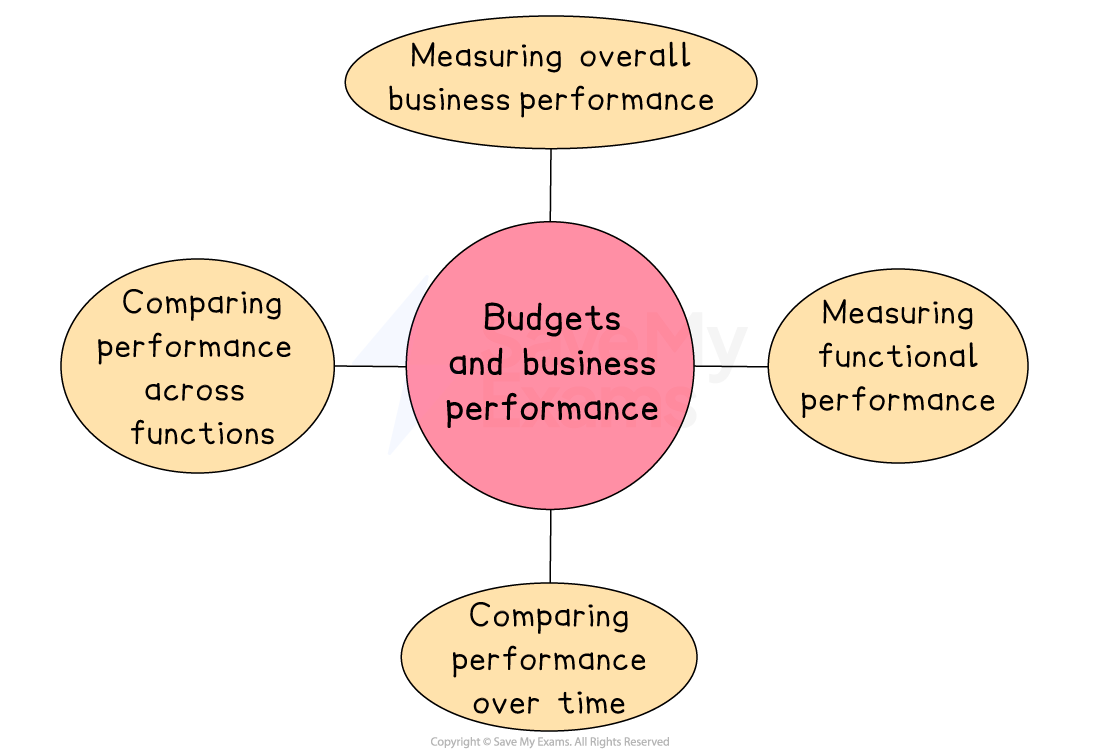
Budgets can be used to compare overall business performance and compare functional performance over time
Measuring performance with budgets
Measuring overall business performance
-
Budgets allow managers to assess how well the whole business is performing
- Compare actual income and expenses with budgeted figures to identify profit levels, cost control, or overspending
- Helps judge if the business is meeting its financial goals, such as revenue targets or profit margins
- Variances *help explain good or poor performance
Measuring functional performance
-
Each function, e.g. marketing, operations, HR, usually has its own budget
- Comparing actual department spending and results with the budget shows how well each area is performing
- Helps hold managers accountable for cost control and meeting targets
- Encourages efficient use of resources within each function
Comparing performance over time
- Budgets help track performance year-on-year or month-on-month
- Businesses can spot trends, such as rising costs or improving efficiency
- Helps with long-term planning and forecasting
Comparing performance across functions
- Budgets help compare different departments at the same time, even if their roles are different
- This supports fair decision-making on things like bonuses, promotions or extra funding
Types of budgets
1. Incremental budgets
-
An incremental budget is based on last year’s figures, with small adjustments made to reflect expected changes
- Changes could include inflation, wage rises or modest increases in sales and costs
Evaluating the use of incremental budgets
| Advantages | Disadvantages |
|---|---|
| - Quick and easy to prepare - Last year’s figures with small adjustments are used, saving time and effort | - Carry forward inefficiencies - Past mistakes or unnecessary spending can be repeated. |
| - Stable and predictable - They are suitable for well-established businesses with consistent operations and costs | - Discourage innovation - Departments may stick to old habits rather than improving or reviewing spending |
2. Flexible budgets
-
A flexible budget is adjusted depending on the level of output or sales
- Instead of using one fixed figure, it shows what income and expenses should look like at different levels of activity
Evaluating the use of flexible budgets
| Advantages | Disadvantages |
|---|---|
| - Adapt to changes in activity - Budgets can be adjusted based on actual output or sales, giving a more accurate picture of performance | - More complex to prepare - They require detailed data and strong forecasting, which can take time and skill |
| - Better control and planning - Managers can compare actual performance to the correct budget level, helping to identify efficiency or overspending | - It is not suitable for all businesses - It may not be needed in small firms with steady, predictable activity levels |
3. Zero budgeting
-
Zero budgeting is when every department or manager must justify all spending
- Rather than using the previous year’s budget as a starting point, each cost must be reviewed and approved individually
Evaluating the use of zero budgeting
| Advantages | Disadvantages |
|---|---|
| - Encourages cost control - Every cost must be justified, which helps reduce waste and unnecessary spending | - Time-consuming - Each department must explain all costs from scratch, making it a slow process |
| - Promotes careful planning - It forces managers to think critically about what they actually need and prioritise spending. | - May demotivate staff - Constant questioning of expenses can feel discouraging or lead to underfunding important areas |
The use of budgets
- Budgets can play an important role in the day-to-day management of a business
- They help with planning, decision-making, control, and monitoring of non-financial performance
Ways budgets are used
Allocating resources
- Budgets help businesses decide where money and resources should be focused
- Each department receives funding based on its needs and priorities, ensuring efficient use
Control within a business
- Budgets set clear financial limits to help prevent overspending
- Managers are accountable for staying within their budget, which improves discipline and control
Monitoring non-financial performance
- Budgets can track spending on non-financial goals like customer service, training, or sustainability
- This ensures resources support wider business objectives
Variances
-
Once budgets have been set, managers carry out variance analysis to compare actual performance to the targets set in the budget
- A budget variance is a difference between the figure budgeted and the actual figure achieved by the end of the budgetary period
-
Variance analysis seeks to determine the reasons for the differences between the actual figures and the budgeted figures
Types of variance
| Favourable (F) | Adverse (A) |
|---|---|
| - This is where the actual figure achieved is better than the budgeted figure - A favourable variance in a costs budget is where the actual figure is lower than the budgeted figure - A favourable variance in a revenue or profit budget is where the actual figure is **higher **than the budgeted figure | - This is where the actual figure achieved is** worse than** the budgeted figure - An adverse variance in a costs budget is where the actual figure is higher than the budgeted figure - An adverse variance in a revenue or profit budget is where the actual figure is lower than the budgeted figure |
Calculating and interpreting variances
- A budget variance is calculated by subtracting the budgeted figure from the actual figure
Worked Example Selected financial information for Barwicks PLC (2024)
£m Budgeted sales revenue 12,460 Actual sales revenue 13,718 Budgeted total costs 8,420 Actual total costs 10,627 Using the data, calculate the total profit variance for Barwicks PLC in 2024. You are advised to show your working.
(4)
Step 1: Calculate budgeted profit for 2024
equals space £ 12 comma 460 space minus space £ 8 comma 420
equals space £ 4 comma 040 **(1)
Step 2: Calculate actual profit for 2024
equals space £ 13 comma 718 space minus space £ 10 comma 627
equals space £ 3 comma 091** (1)
Step 3: Subtract budgeted profit from the actual profit for 2024
equals space £ 3 comma 091 space minus space £ 4 comma 040
equals space minus £ 949 space **(1)
Step 4: Identify the nature of the variance
- In this case, the variance is **adverse **because the actual profit for 2024 is lower than the budgeted profit for the year
- The correct answer is** £949 A**** (1)
Evaluating budgets
-
Budgets can be useful management tools because they help maintain financial control by monitoring income and expenditure
- This allows managers to spot potential overspending or cash flow problems early
-
Budgets also help measure performance by setting financial targets that can be compared with actual results
- This makes it easier to assess how well a department or the whole business is performing and whether corrective action is needed.
-
However, budgets are based on forecasts and assumptions, which means managers make inappropriate decisions if market conditions change or if estimates are wrong
-
Strict budgets may reduce flexibility
- Managers may feel restricted and unable to respond quickly to unexpected opportunities or urgent problems if they are required to stick closely to a fixed spending plan
Advantages and disadvantages of budgeting
| Advantages | Disadvantages |
|---|---|
| - A budget shows every department how much they can spend and what sales targets to hit, so activities line up with overall business objectives | - Gathering data, negotiating figures and revising budgets can take up management time, especially for smaller firms |
| - Preset spending limits highlight overspending quickly and encourage managers to look for savings | - Once set, budgets can discourage managers from seizing unexpected opportunities or reacting quickly to market changes |
| - Comparing actual results with budgeted figures pinpoints good and poor performance and can provide evidence for bonuses, promotions or identifying training needs | - Managers may overestimate cost forecasts or understate sales to make targets easier to beat, reducing the budget’s accuracy |
Was this revision note helpful?
Build on this topic