Force Field Analysis and Scenario Planning (Cambridge International A-Level Business)
Force field analysis
-
Force field analysis involves managers identifying the driving and restraining forces that surround a strategic change decision
- Once identified these forces can be analysed to determine whether a decision should go ahead
Driving forces
-
Driving forces are factors that could justify that strategic change is needed
-
Internal driving forces may include:
- Outdated machinery or product lines
- Declining team morale
- The need to increase profitability
-
External driving forces may include:
- A volatile market
- Disruptive technologies e.g. AI
- Changing demographic trends
-
Restraining forces
-
Retraining forces are factors that could prevent or limit change
-
Internal restraining forces may include:
- Fear of the unknown
- The existing organisational structure
- "That's not how things are done here" attitudes
-
External restraining forces may include:
- Existing commitments to partner organisations
- Government legislation
- Obligations towards customers
-
Weighting the forces
-
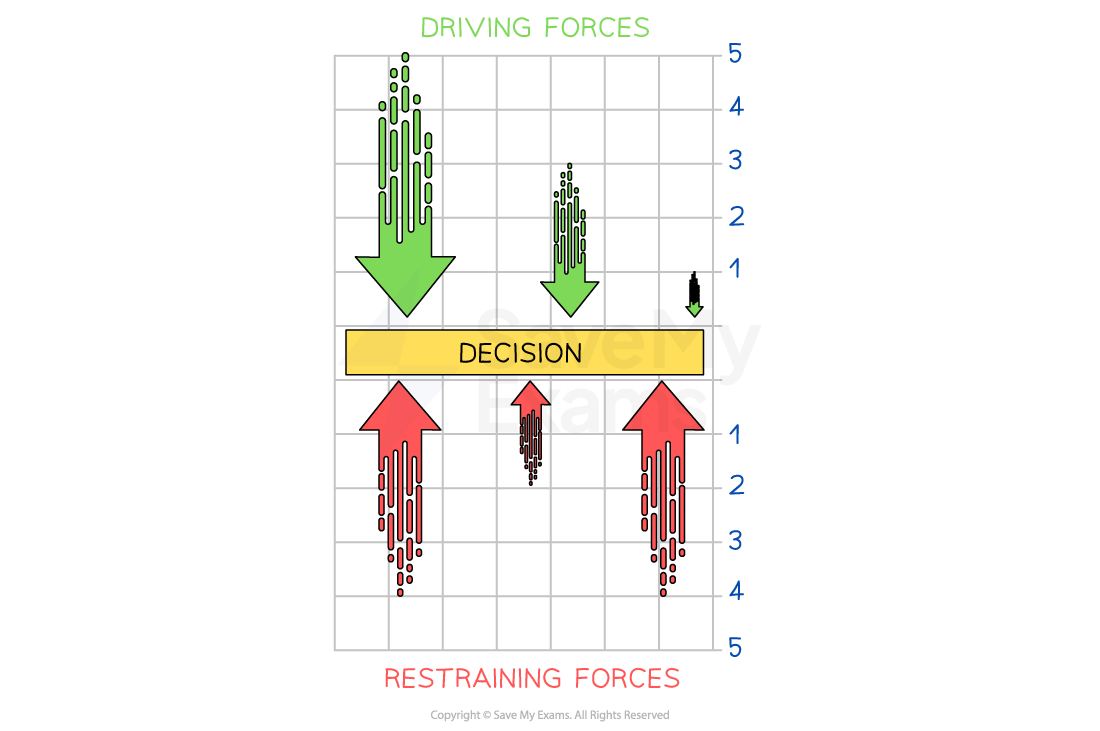
Driving forces and restraining forces are weighted from 1 to 5 in terms of their relative importance
- A value of 5 is most important and 1 least important
Example force field analysis
A simple example of a force field analysis
-
In this case, four driving forces justify a decision for change
- Their weightings are 5, 4, 3 and 2
- The total value of these driving forces is 5 + 4 + 3 + 2 = 14
-
In this case, four restraining forces prevent or limit change
- Their weightings are 4, 3, 2 and 1
- The total value of these restraining forces is 4 + 3 + 2 + 1 = 10
-
The relative weight of driving forces is greater than the relative weight of restraining forces
- There is a good chance that this decision would be successful
- To maximise the chance of success, driving forces could be strengthened or restraining forces weakened or eliminated
Worked Example After several years of poor financial performance, the owners of Lujosa Ltd are considering the relocation of their factory from Spain to Indonesia.
Department managers have provided feedback on the idea. They have identified the following driving and restraining forces.
Force Description Weighting Driving - Need to reduce production costs to increase profitability 5 - Outdated production machinery in Spanish factory affects volume and quality of output 3 - Difficulty of recruiting and retaining skilled employees in Spain 1 Restraining - Costs of relocation including construction and fitting of a brand new factory in Indonesia 4 - Employee resistance to job losses 2 - Disruption to production during the change period 4 (a) Use force field analysis to determine whether Lujosa's owners should go ahead with the decision [4]
Step 1: Construct the force field analysis
[1]
Step 2: Calculate the relative weight of driving forces
[1]
Step 3: Calculate the relative weight of restraining forces
[1]
Step 4: Compare the relative weights of driving and restraining forces
- The relative weight of restraining forces (10) is greater than the relative weight of driving forces (9)
- There is little chance that this decision would be successful and should be abandoned
[1]
(b) Identify two actions Lujosa's owners could take to allow the move to Indonesia to go ahead [2]
Relevant actions include
- Outsource production during the relocation process
- Research ways to reduce costs of building and fitting of the new factory
- Consult and engage with workers to reduce fears of redundancy
[2]
Evaluating force field analysis
- Force field analysis is a valuable technique for assessing the factors influencing a situation
- However it has limitations, particularly in situations where precision is required
- It is most effective when used alongside other decision-making tools to ensure a comprehensive understanding of the situation
| Strengths | Weaknesses |
|---|---|
| - Simple and visual - Easily understood by stakeholders - Simple diagram makes it accessible | - Subjective - Relies on perceptions/judgements of individuals or teams - Can lead to bias in the analysis |
| - Comprehensive - Considers both the driving forces and restraining forces - This helps in understanding the complexity of a situation | - Lacks quantitative data - Challenging to assign specific weights or measures to the forces, which limits the precision of the analysis |
| - Identifies most critical factors - Visualising/ranking helps clarify which forces have the most significant impact on the desired change | - Snapshot - Does not account for how forces might change over time - This is crucial in dynamic/evolving business environments |
| - Assists decision-making - Provides a structured way to evaluate pros and cons of a proposed change or decision | - Doesn't provide solutions - It is a diagnostic tool, not a prescriptive one - Managers need to develop appropriate strategies |
| - Aids communication - Teams discuss and share their perspectives on the driving and restraining forces - Leads to a shared understanding/better collaboration | - Limited in complex situations - Oversimplifies analysis and fails to capture the intricacies of the problem |
Scenario planning
-
Scenario planning is used to prepare for different possible futures
-
Rather than predicting exactly what will happen, a company imagines several plausible “what‐if” situations
- E.g. a sudden change in the law, a new competitor entering the market or rapid shifts in customer tastes
-
Leaders can spot early warning signs and act before problems or opportunities become urgent.
-
-
It involves asking a series of linked questions
Scenario planning questions
| What would this situation look like? | How would we respond? |
|---|---|
| - What if a new technology cuts our production costs in half? - What if our biggest international market imposes high tariffs? | - The company outlines actions that would work well under each scenario - e.g., invest in that new technology or seek new markets |
| Which steps overlap? | How do we monitor early signals? |
| - By comparing across scenarios, managers spot strategies that help, no matter which future arrives - E.g. building a flexible supply chain might help both if costs fall due to new technology or tariffs change | - The business agrees on a few key indicators to watch, such as patent applications in a new technology or early news of trade barriers - If those indicators appear, they know which scenario is becoming more likely and can shift resources accordingly |
The benefits of scenario planning
-
Helps avoid surprises
- Rather than being caught off‐guard, the company has thought through several possibilities in advance and may, therefore, have something of a plan
-
Focuses on flexibility
- Instead of committing to one rigid plan, the firm builds capabilities, such as adaptable suppliers or skills training that help in multiple different futures
-
Improves decision‐making
- Teams practice 'if‐then' thinking, such as 'If oil prices double, then we switch to electric vehicles in our fleet'
- This makes real choices easier when change happens
Was this revision note helpful?
Build on this topic