Approaches to Marketing Strategy (Cambridge International A-Level Business)
Consistency of the marketing strategy
- Marketing strategies need to be consistent and coordinated carefully to ensure that they are fully focused on achieving marketing objectives
Features of an effective marketing strategy
| Consistent | Coordinated | Focused |
|---|---|---|
| - Marketing strategies reflect and reinforce business and brand values - They are appropriate for the product to which they are applied - They are **suitable for the intended target market such as mass or niche markets | - Marketing budgets, the** marketing mix and the **promotional mix **must be tied together - The cooperation of relevant functional managers is vital - Mixed messages need to be avoided to ensure customers fully buy in to the product | - Strategies must be focused on achieving the business's** specific marketing objectives** - They should be adapted when objectives change and regularly reviewed to ensure they retain this focus - Unfocused strategies should be discarded |
The importance of consistency
- Consistency in marketing means that all parts of a business’s marketing plan and activities work together in a unified and coordinated way
- Messages, branding, pricing, and customer experience feel the same across all platforms and over time
- This builds trust, strengthens the brand, and avoids confusion
How do businesses achieve consistency?
| Method | Explanation |
|---|---|
| Clear marketing objectives | - All strategies and actions are based on shared goals such as growing market share |
| Strong brand identity | - Using the same logos, colours, tone of voice and design across all marketing materials |
| Integrated marketing mix | - Making sure product, price, place, and promotion all send the same message to customers |
| Communication | - Ensuring all employees understand and follow the brand and marketing strategy in interactions with customers |
Case Study Apple's consistent marketing strategy
Apple has built a strong brand based on design, innovation, and simplicity
These ideas influence how the company creates its products, advertises them, and treats its customers
Branding
- Whether a customer is looking at a product, a store, or a website, the clean and modern Apple style is always the same
Product design
- Apple focuses on high-quality, simple design across its whole range, from iPhones to MacBooks
Promotion
- Apple uses minimalistic advertising with strong emotional appeal
- The same tone and style are used globally
Customer experience
- In Apple Stores around the world, the layout, service and atmosphere are consistent
Because of this consistency, customers trust Apple and feel confident in their products
This helps maintain customer loyalty and enables premium pricing
Coordinated marketing strategy
- A coordinated marketing strategy means all parts of the marketing plan work together smoothly
- This involves making sure that every department involved, such as sales, product design, advertising, and customer service, is aligned with the overall marketing goals
- Good coordination avoids mixed messages and improves efficiency
How do businesses achieve coordination?
| Method | Explanation |
|---|---|
| Shared objectives | - All departments follow the same goals, such as increasing sales or launching a new product |
| Cross-department teamwork | - Marketing teams work closely with other departments like production, finance and customer service |
| Planning meetings | - Regular communication helps keep everyone informed and pulling in the same direction |
| Consistent marketing mix | - The 4Ps all support the same overall strategy |
Case Study Well-coordinated marketing strategy at Coca-Cola
- Coca-Cola shows excellent coordination across its global marketing activity
- This coordination helps Coca-Cola stay as one of the world’s most recognisable and successful brands.
Product
- Taste, packaging, and quality are consistent worldwide
Promotion
- Advertising campaigns, such as "Share a Coke", are used across many countries with local adaptations
Sales and distribution
- Coca-Cola works closely with retailers, restaurants, and vending machine suppliers to ensure availability
Customer service
- Support teams know the marketing campaigns and brand message to create a consistent customer experience
Marketing strategy and its focus on objectives
-
A marketing strategy focused on objectives ensures that every marketing decision is aimed at achieving clear, specific goals
- These objectives may include increasing sales, building brand awareness or entering a new market
- When marketing activities are aligned with these goals, the business is more likely to succeed
How businesses ensure focus on objectives
| Method | Explanation |
|---|---|
| Setting SMART objectives | - Goals should be Specific, Measurable, Achievable, Realistic, and Time-bound |
| Performance tracking | - Businesses regularly check progress using sales data, customer feedback, and market research |
| Strategic planning | - Every part of the marketing plan, including the 4Ps, supports key objectives |
| Regular reviews | - Businesses adjust their strategy if the objectives aren’t being met |
Case Study Nike's focused marketing strategy
Nike is a good example of a company that keeps its marketing focused on clear objectives
With this clear focus, Nike remains competitive and keeps growing its customer base worldwide
Objective
- Strengthen customer loyalty and grow global market share among young, active consumers
Strategies
- Use high-profile athletes and inspirational advertising to build emotional connections
- Launch targeted campaigns like “Just Do It” that support its brand message and appeal to its audience
- Track performance through sales figures, social media engagement, and customer surveys
Information technology in marketing
- Information technology (IT) tools and applications are extensively used in marketing for a variety of purposes
Where are IT tools and applications used in marketing?
Social media
-
Businesses use platforms like Instagram, TikTok and YouTube to build and maintain a presence
-
Regular posts link products to trends, creating modern word-of-mouth promotion
-
Social media enables fast, interactive communication using video and sound
-
Customer comments and reviews can support market research
- E.g. Forever 21 uses Instagram to share images and short videos promoting new products and events
Websites
-
Most firms use a website, sales platform, or both
-
These allow online selling and quick sharing of company info like press releases
-
Blogs and vlogs help drive traffic to sales platforms.
- Zalando, based in Germany, is an online mall for top European fashion brands and own labels like Kickz
- Businesses create databases of customers who opt in to email updates
- These emails share news of new products, offers and events quickly and cheaply
Mobile
- Many businesses use mobile apps for browsing and purchases
- Text messages can promote offers, share links and gather feedback
In-store
- Technology in stores attracts and engages customers
- Digital signage promotes offers and ranges while enhancing store ambience
- Custom systems give live updates on stock to staff and shoppers
Artificial intelligence in marketing
- It is argued that marketing is the business function where artificial intelligence (AI) has significant potential to make a positive impact
Current uses of AI in marketing
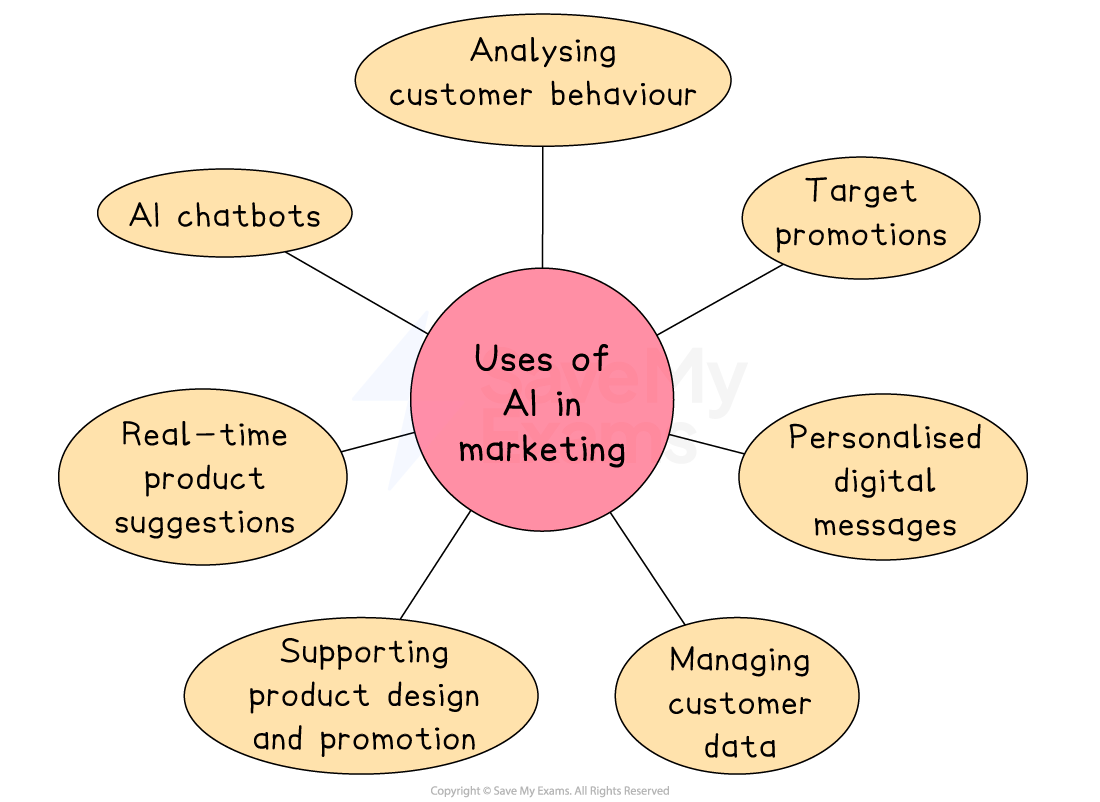
AI can be used to analyse customer behaviour, personalise digital messages, make real-time product suggestions and support customer service
Analysing customer behaviour
- AI can study huge amounts of data from sources like social media, smart speakers, online shopping and product reviews
- This helps businesses understand what customers like, how they shop and what influences their decisions
Targeted promotions
- Using real-time data, AI can quickly send the right adverts or offers to the right customers
- This makes marketing more effective and personalised
Personalised digital messages
- AI can create and send custom messages to individuals based on their interests, shopping history and past interactions with the business
Managing customer data
- AI helps organise and analyse customer profiles by combining information from various devices and apps
- This gives businesses a clearer picture of their audience
Supporting product design and promotion
- AI gives product designers and marketers detailed insights into what customers want
- This helps them create and promote products that are more likely to succeed
Real-time product suggestions
- While a customer is shopping online, AI can recommend products based on their past or current activity
- This can influence what the customer chooses to buy
AI chatbots
- Many businesses use AI-powered chatbots to answer customer questions automatically
- These bots are available 24/7 and help improve customer service without needing human staff at all times
AI in marketing: key concerns
| Consumer resistance | Capital investment requirements | Careful human supervision is required |
|---|---|---|
| - Many consumers are unhappy about the large-scale collection of data - The use of AI in marketing can increase the possibility of discrimination *and the misuse of information - E.g., a customer's credit rating is reduced because AI determines that others who shopped where he shopped had a poor repayment history | - AI systems require a significant investment in hardware,processing power,software,**highly skilled employees **such as programmers and training - These high costs increase barriers to entry for small firms and increase the competitive advantage of already-powerful firms - This may have the effect of reducing competition and choice for customers | - AI systems require close supervision to ensure that programming errors are identified and corrected swiftly - AI systems** lack the creativity and imagination of humans,** so output may be perfected by human touch - Ensuring that AI-generated promotional activity is focused on marketing objectives is a judgement best made by a human |
Was this revision note helpful?
Build on this topic