Cost Information (Cambridge International A-Level Business)
The need for accurate cost information
- Cost information refers to data about all the costs involved in producing and selling a product
Why is accurate cost information needed?
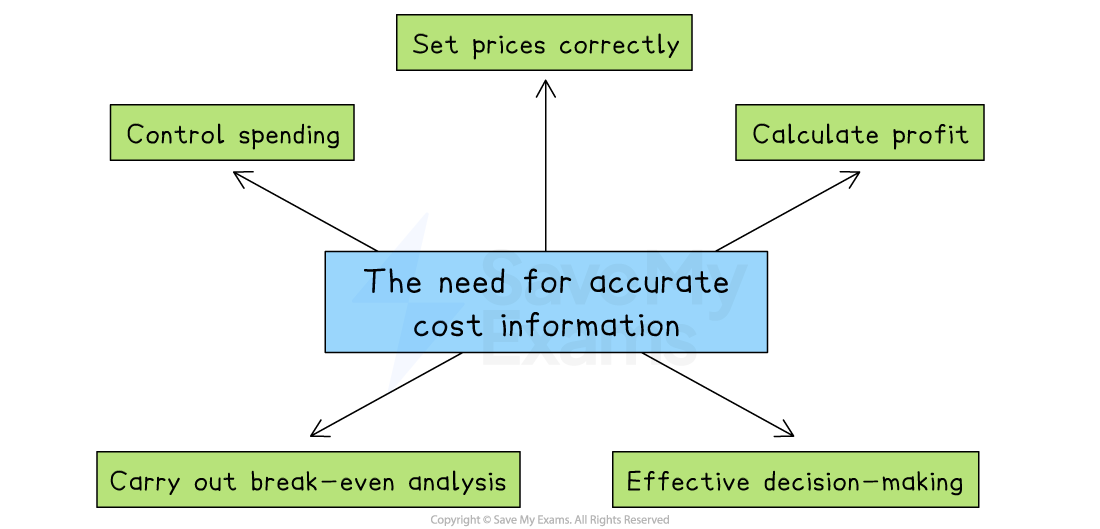
Accurate cost information is needed to set prices, calculate profit, make decisions, calculate break-even and control spending
-
To set prices correctly
- If a business underestimates its costs, it may set prices too low and make a loss
- Overestimating costs may lead to prices that are too high, reducing demand
-
To calculate profit
- Accurate costs help calculate gross profit and net profit, important for judging performance
-
For decision-making
-
Managers use cost data to decide whether to
- Launch a new product
- Continue or stop production
- Change suppliers or production methods
-
-
To carry out break-even analysis
- This helps decide how many units need to be sold to cover all costs.
- Accurate costs make break-even analysis more reliable
-
To control spending
- Comparing actual costs with budgets helps identify areas of overspending and take action
Types of costs
- In preparing goods and services for sale, businesses incur a range of costs
- These costs can be broken into different categories
Fixed costs
-
Fixed costs do not change according to output
-
These have to be paid whether the output is zero or 5,000
- Examples include rent, management salaries, insurance and bank loan repayments
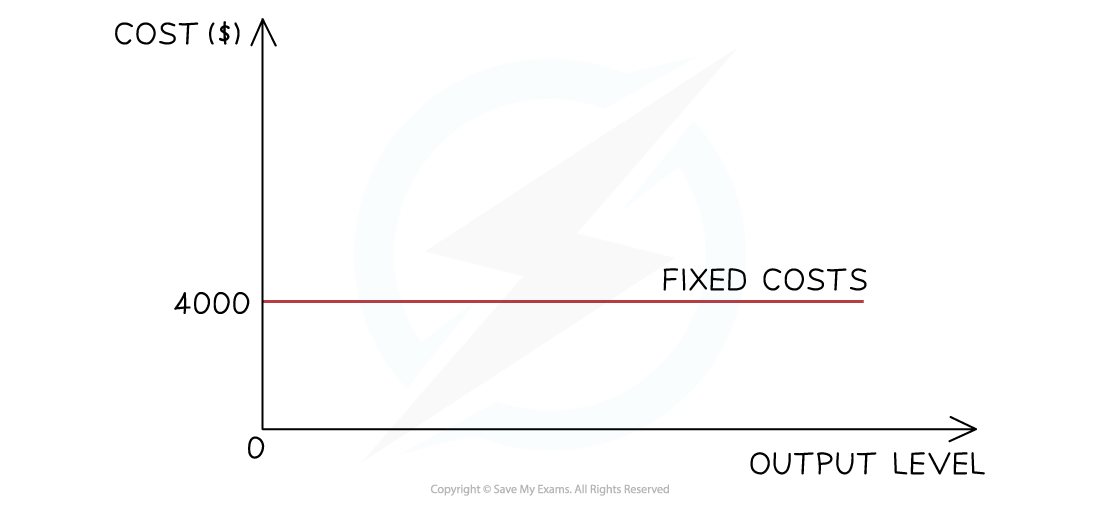
- Fixed costs in this instance are $4,000
Variable costs
-
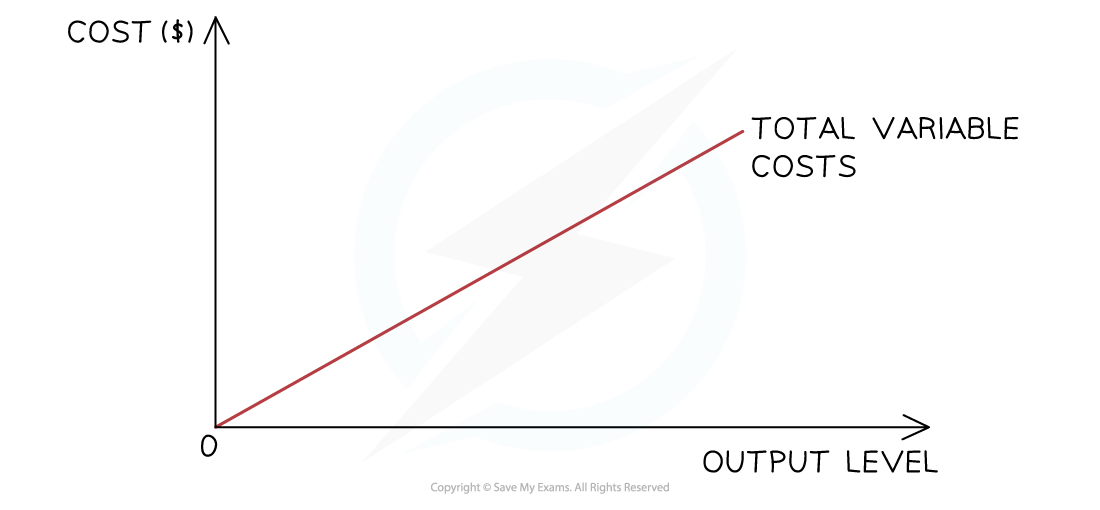
Variable costs rise proportionally with output
-
These increase as output rises and decrease as output falls
- Examples include raw material costs and wages of workers directly involved in production and packaging
-
At some point, a business may benefit from a purchasing economies, so the rise will no longer be proportional
Total costs
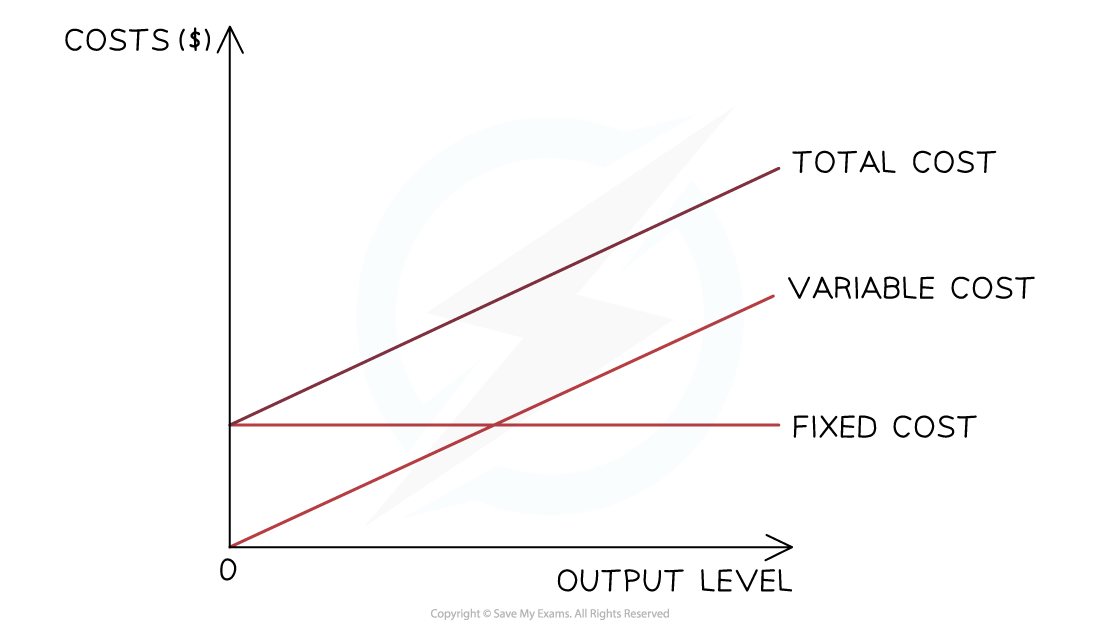
- Total costs is the combination of all fixed and variable costs involved in producing a certain level of output
- Total costs cannot be zero, as all organisations have some level of fixed costs
An alternative way to classify costs
Direct costs
-
These are costs that can be directly traced to a specific product, service, or department
-
They relate specifically and exclusively to the production of a particular item
-
Direct costs can be fixed or variable
- For example, a one-off licence fee for a software product is a direct fixed cost if it applies only to that product
-
Examples of direct costs include:
- The cost of raw materials used to make a table
- Wages paid to factory workers assembling a specific product
- Packaging for a single product line
Indirect costs
-
Indirect costs are costs that cannot be traced directly to a specific product, job, or service
- They support overall operations and are shared across departments or products
- These costs are necessary for production or business operations, but they are not directly linked to any one unit of output
-
Indirect costs can also be fixed or variable
- For example, the monthly rent paid for a shared office space is an indirect fixed cost, as it supports multiple departments but does not vary with output
-
Examples of indirect costs include:
- Rent and utility bills for a factory or office
- Salaries of supervisors or administrative staff
- Office supplies and insurance
- Depreciation of machinery used across several product lines
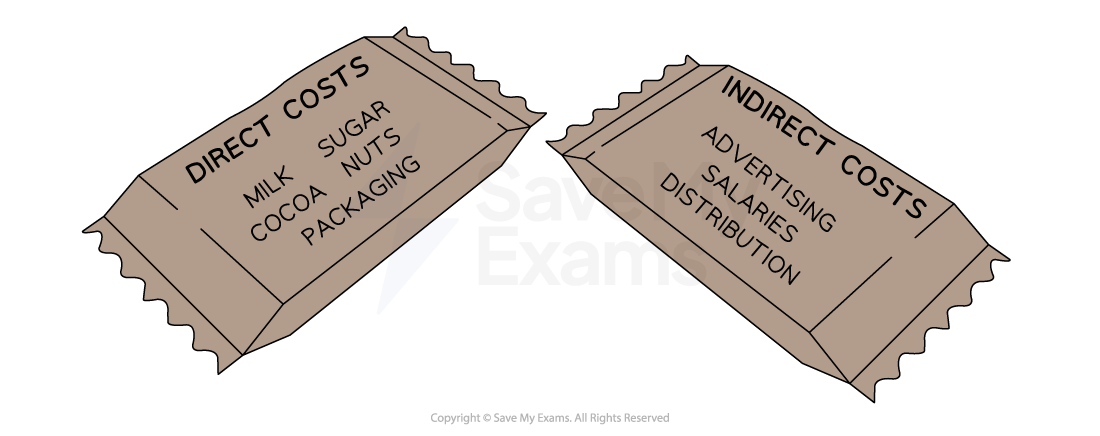
Examples of direct and indirect costs for a chocolate manufacturer
Comparison: direct vs indirect costs
| Feature | Direct costs | Indirect costs |
|---|---|---|
| Traceability | - Directly linked to one product/job | - Shared across products/departments |
| Examples | - Raw materials, direct labour | - Rent, admin wages, factory lighting |
| Can be fixed or variable? | - Yes | - Yes |
Using cost information to make decisions
- Cost data helps businesses make key decisions
Total costs (TC)
- Total costs information can be used to assess how much money is needed to produce at a certain level and is vital for budgeting and cash flow forecasting
Worked Example
SupaJuice produces 12,400 bottles of its premium fruit juice drink each month.
- It incurs monthly fixed costs (e.g. rent, salaries) of $25,700
- Variable costs per unit (e.g. bottles, fruit) of $1.24
Calculate the business's annual total costs.
(3)
Step 1: Calculate monthly variable costs
= 12 , 400 \\times \ 1.24$
equals space $ 15 comma 376 (1)
Step 2: Calculate monthly total costs
equals space 25 comma 700
equals space $ 41 comma 076 (1)
Step 3: Calculate annual total costs
= \ 41 , 076 \times 12 \text{months}$
equals space $ 492 comma 912 (1)
Average costs (AC)
- Average cost is the cost of producing one unit of output, calcualted using the formula
- The average cost helps a businesses set prices that cover costs and leave room for profit
- It is also used to compare efficiency over time or between different products
Worked Example Supajuice has been approached by a large supermarket chain that wants to buy a large volume of its juice each month. The supermarket chain is willing to pay $2.95 for each bottle.
Explain whether SupaJuice should accept the supermarket's offer.
(3)
Step 1: Calculate the average cost of producing each bottle
equals space Monthly space total space cost space divided by space Monthly space output
equals $ 41 comma 076 space divided by space 12 comma 400 space bottles
equals space $ 3.31 (1)
Step 2: State your answer and give a reason
- SupaJuice should not accept the supermarket's offer (1), as it would make a loss of $0.36 ($2.95 - $3.31) on each bottle (1)
Marginal cost (MC)
- Marginal cost is the cost of producing one extra unit of output, calculated using the formula
- The marginal cost helps a business decide whether producing extra units is profitable
- It is a key consideration for decisions about increasing production, pricing, and entering new markets
- It can also be used for special order pricing and decisions about increasing output
Worked Example SupaJuice is considering increasing its output from 12,400 to 13,000 bottles per month. This will increase monthly total costs by $2,750.
Explain whether SupaJuice should increase its output if it sells each bottle of juice for $4.75.
Step 1: Calculate the marginal cost
equals space $ 2 comma 750 space divided by space 600 space bottles
equals space $ 4.58 (1)
Step 2: State your answer and give a reason
- SupaJuice should increase output (1), as the marginal cost is $0.17 ($4.75 - $4.58) less than the selling price, allowing a profit to be made on each bottle sold (1)
Using cost information to make pricing decisions
- Cost information can help shape a business’s entire pricing strategy, including how to respond to competition, customer demand and market conditions
Cost information and pricing decisions
Setting a minimum price point
-
Accurate cost data ensures prices are set above total or marginal cost
-
This prevents selling at a loss and is especially important for new products where cost estimates may change as production increases
- E.g. A small electronics company launching a smart speaker knows its unit cost is $40 and avoids pricing below that, even during a promotion
Choosing between pricing strategies
- Businesses choose strategies like penetration pricing, skimming, or competitive pricing
- Cost information helps assess whether these options are financially sustainable
Adjusting prices when costs change
- When input costs, such as raw materials or wages, rise, cost data helps decide whether to increase prices or reduce other costs while keeping prices stable
Responding to competitors' prices
- Cost information helps businesses know how low they can reduce prices in response to rivals without making a loss
- This is essential in price wars or competitive markets
Planning discounts and promotions
- Even during sales or promotions, businesses must at least cover variable costs
- Accurate cost information prevents making a loss as a result of short-term discounts
Using cost information to monitor and improve business performance
-
Cost information is a vital tool for monitoring business performance
-
It helps businesses
- Track profitability
- Set and measure performance targets
- Identify problems early
- Make better decisions for the future
- Become more efficient and competitive
Uses of cost information in relation to business performance
| Use | Explanation |
|---|---|
| Calculate and monitor profits | - Businesses use cost data to calculate gross profit and net profit, and then compare them over time or between products. - This shows how well the business is performing financially |
| Calculate profit margins | - Calculating gross profit margin and net profit margin helps measure profitability as a percentage of sales - This is useful for comparing performance between departments, products or time periods |
| Set performance targets | - Managers use cost and profit data to set targets for departments or teams, e.g. reduce costs by 5% or improve profit margins - These targets help guide decision-making and performance management. |
| Identify areas of inefficiency | - By comparing actual costs with budgeted costs, businesses can spot where they are overspending or wasting resources |
| Support decision-making and planning | - Cost data helps businesses decide whether to launch new products, enter new markets or increase production - If predicted costs are too high, plans may be revised or cancelled |
| Reduce waste and improve efficiency | - Cost analysis can highlight areas of waste in labour, materials or energy - This helps improve efficiency and lower costs over time |
Was this revision note helpful?
Build on this topic