The Role of Management in Facilitating Communication (Cambridge International A-Level Business)
Exam board Cambridge International · A-LevelUpdated 2025-07-15
The role of informal communications
-
Informal communication is the casual, unofficial way that people in a business share information
- It is not planned or written down in official records
- The style is friendly and conversational, often using everyday language
- Messages travel outside the formal chain of command, so they can move quickly across levels and departments
-
Informal communication can occur in a range of situations, including
-
Water-cooler chats
- Quick conversations in the corridor, kitchen or staff room
-
Instant-messaging or group apps
- Short texts or emoji exchanges on WhatsApp, WeChat, Slack, etc
-
Social gatherings
- Talking during lunch breaks, team socials or company sports events
-
Benefits and risks of informal communication
| Benefits | Risks |
|---|---|
| - Fast information flow - Staff can warn each other of a problem immediately, without waiting for formal meetings | - Rumours and gossip - Wrong facts can spread quickly, damaging morale or reputation |
| - Builds team spirit - Friendly chat helps people feel connected, boosting motivation and cooperation | - No written record - Decisions made informally may be forgotten or disputed later |
| - Encourages ideas - Casual talk makes employees more willing to share creative suggestions | - Can bypass managers - Important issues might skip the chain of command, leaving leaders unaware |
| - Reduces stress - A quick joke or personal story can ease tension during busy periods | - Exclusion risk - Staff who are not part of the social circle may feel left out or unfairly treated |
Communication and business efficiency
-
Clear, timely and two-way communication is vital for an efficient business
- It can can save time, cut costs or raise output when managed well
How communication affects business efficiency
| Aspect | Impact on efficiency | Example |
|---|---|---|
| Clarity and accuracy | - Clear, jargon-free messages reduce mistakes and the amount of rework | - A warehouse worker picks the right items first time when orders are precise |
| Speed of information flow | - Fast, real-time updates shorten decision times and reduce bottlenecks | - A WhatsApp alert warns drivers of a traffic jam, rerouting deliveries instantly |
| Feedback channels | - Two-way communication surfaces problems early, so fixes are quicker and cheaper | - Factory operators report a loose bolt before it causes a costly machine stop |
| Cross-department coordination | - Shared platforms (e.g. Slack, Teams) align schedules and resources, avoiding duplication | - Marketing and production compare launch dates, preventing excess inventory building up |
| Employee engagement | - Open, respectful dialogue boosts morale and effort, raising output per worker | - A suggestion box in a Kenyan tea plant cuts water waste by 10%. |
| Customer and supplier links | - Timely, transparent updates build trust and streamline the supply chain | - A Chinese electronics firm shares live stock data with suppliers, reducing lead times |
Ways of improving communication
- As communication is crucial to improving efficiency, managers should take steps to improve the way information moves around and outside of a business
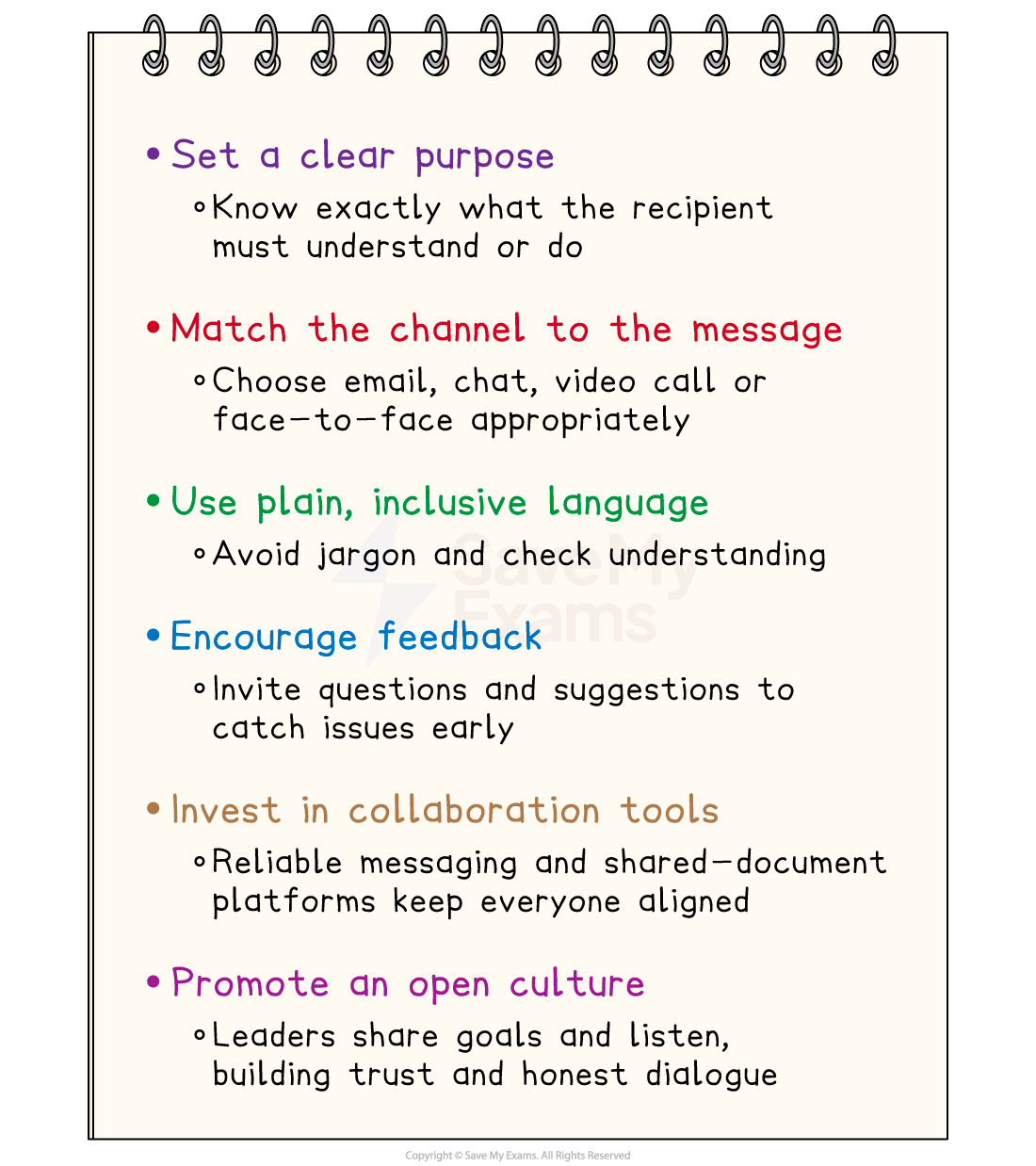
Steps managers can take to improve communication
-
Sending a clear message through the most suitable channel, whether email, chat, video or face-to-face, reduces errors and speeds up decisions
- This saves a business time and money
-
Encouraging two-way,inclusive dialogue by using plain language and inviting feedback brings problems to light early
- It can also encourage new ideas and keep employees motivated.
-
Equipping teams with modern digital tools for chat, video calls and shared files keeps everyone coordinated, wherever they work
- This improves customer service and helps achieve faster growth
Was this revision note helpful?
Build on this topic