Motivation Methods in Practice (Cambridge International A-Level Business)
Financial motivators
- Financial incentives are rewards or payments given to employees in return for their labour or improved performance
Financial incentives and motivation theory
| Financial incentive | Explanation | Link to motivation theory |
|---|---|---|
| Piece rate | - Employees are paid according to the number of units or pieces they produce - Commonly used in manufacturing or assembly line settings to encourage workers to produce more | - Taylor’s Scientific Management - Focused on output and financial reward as the main motivator |
| Time rate | - Employees are paid based on the number of hours they work, often at an hourly wage - This method values time over output | - A hygiene Factor in Herzberg’s Theory - Provides financial security but doesn't directly motivate higher performance |
| Salary | - A fixed monthly or annual payment not based on hours worked or output - Offers stability and is often linked to professional or office-based roles | - A hygiene Factor in Herzberg’s Theory - Removes dissatisfaction (e.g. worrying about pay), but does not itself motivate employees to achieve more |
| Commission | - A percentage of sales revenue is paid to workers who sell products or services - Commonly used in sales roles and motivates staff to sell more | - A hygiene factor in Herzberg’s theory because it provides financial reward but doesn’t always lead to long-term motivation on its own - When combined with public recognition (like 'Salesperson of the Month'), it can meet esteem needs in Maslow’s hierarchy, making employees feel valued and respected for their achievements |
| Bonus | - An additional payment is given to staff as a reward for achieving specific goals, completing projects on time, or exceeding expectations | - Connects to Esteem Needs in Maslow’s Hierarchy (achievement) but Herzberg warned using bonuses as main pay can harm motivation and behaviour (e.g. banking crisis example) |
| Profit share | - A portion of the company’s profits are shared with employees, encouraging them to work as a team and support the business’s success | - A motivator in Herzberg’s Theory - Linked to increased responsibility and recognition (staff feel like part-owners) |
| Performance-related pay | - Staff are paid based on how well they meet targets or performance goals - Criticised for being open to bias and demotivation if unfair | - A hygiene Factor in Herzberg’s Theory - May cause dissatisfaction and is often viewed as unfair, especially if targets are unclear or subjective |
| Fringe benefits | - Extra non-cash rewards such as company cars, health insurance, gym membership, or staff discounts - Designed to improve employee satisfaction and retention | - A hygiene Factor in Herzberg’s Theory - Makes the work environment more comfortable but does not directly motivate improved performance |
Advantages of using financial motivators
- Quickly boosts performance
- Financial rewards like bonuses or commissions can lead to an immediate increase in effort and output
- Easy to measure and manage
- Targets linked to pay, such as volume of sales or units produced, are clear and simple to monitor
- Attracts skilled employees
- High pay and incentives can help a business compete for top talent in the job market
Disadvantages of using financial motivators
- Can reduce teamwork
- If pay is based on individual results, employees may compete instead of working together
- Short-term focus
- Employees may focus only on rewards and ignore quality, customer service or long-term goals
- Costly for the business
- Bonuses, commission and other financial rewards can become expensive, especially if not linked to overall profit
Non-financial motivators
-
Many people want challenge, recognition and opportunities for development from their work
-
According to Herzberg, motivators like job enrichment, promotion, and recognition increase job satisfaction by giving responsibility and purpose
- Empowerment and participation in decision-making help employees feel trusted, which boosts motivation
-
According to Maslow, non-financial rewards meet higher-level needs like belonging, esteem and self-fulfilment
Examples of non-financial motivators
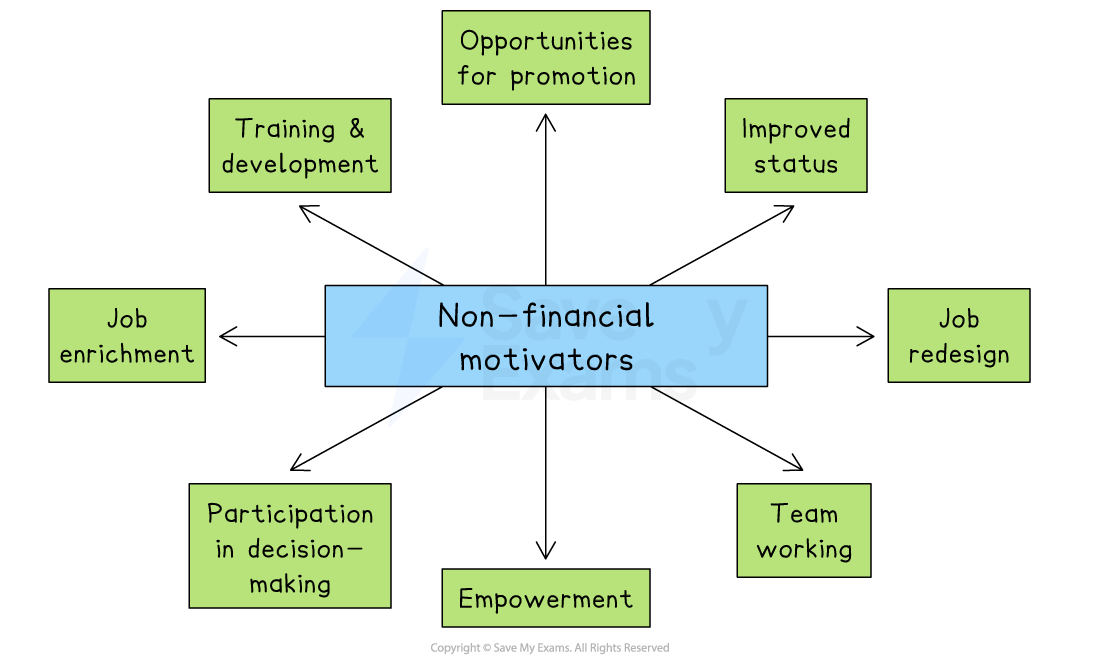
Non-financial motivators include improved status, opportunities for promotion and job enrichment
- Training and development help employees improve their skills and grow in confidence, making them feel more capable and valued
- Opportunities for promotion encourage employees to work harder by offering a clear path to higher-level roles and responsibilities
- Improved status gives employees a higher job title or position, increasing their sense of importance and recognition
- Job redesign involves changing job roles to make them more interesting or meaningful, which can reduce boredom and boost motivation
- Team working encourages collaboration and a sense of belonging, helping employees feel supported and connected
- Empowerment means giving employees the freedom to make decisions, which increases trust, confidence, and motivation
- Participation in decision-making involves employees in business decisions, making them feel respected and more committed to the outcomes
- Job enrichment adds more challenging or meaningful tasks to a role, giving employees a sense of achievement and purpose
Motivation theories in practical situations
- Businesses use motivation theories to understand what motivates their staff and then apply these ideas to improve performance, job satisfaction, and staff retention
Applying Taylor's theory
-
Taylor suggested that workers should be given simple tasks and paid based on how much they produce
-
Businesses may use performance-based pay systems
- For example, factory workers are paid per unit made
- Tasks are often simplified and repeated to improve speed and efficiency
- Close supervision and clear instructions are given to employees
Case Study Dhaka Stitchworks Ltd is a clothing manufacturer based in Bangladesh that supplies T-shirts to international fashion brands
The business employs over 200 factory workers and follows a piece-rate payment system, where each worker is paid £2 for every completed T-shirt
This system encourages workers to sew as many garments as possible each day, as their earnings depend on how much they produce
Supervisors monitor the production line closely and give clear instructions, in line with Frederick Taylor’s idea that efficiency improves when tasks are simple and output is rewarded
The factory has achieved high productivity levels using this approach. However, some workers feel their work is repetitive and physically tiring. A few have left the job due to the lack of variety and long hours
Applying Herzberg's two-factor theory
- Businesses make sure basic hygiene factors, such as fair pay and a clean and safe environment, are in place
- Then they focus on motivators by giving employees responsibility, chances for promotion or by recognising achievements
Case Study KrakSoft Technologies is a software company based in Kraków, Poland, specialising in developing mobile apps and digital solutions for clients across Europe. The business employs over 80 software developers, designers and project managers
Hygiene factors
- Employees receive competitive salaries and enjoy modern, comfortable offices
- They also benefit from flexible working arrangements and remote work options
Motivators
- Staff are regularly praised for achievements, with monthly recognition awards and performance bonuses
- They are encouraged to lead projects and attend international technology conferences
- They also take part in career development programmes tailored to their goals
Outcomes
- Employees are engaged, creative and willing to take on responsibility
- Staff turnover is low, and the work environment is known for being both productive and positive
Employee participation
-
Employee participation means involving workers in decisions that affect the running of the business
-
This can lead to greater motivation, better communication and improved performance
- However, it may slow decision-making, and managers must be open to listening and acting on employee input
Ways employees participate
| Method | Explanation |
|---|---|
| Team meetings | - Regular meetings allow employees to share ideas, give feedback and stay informed about business goals |
| Suggestion schemes | - Employees are encouraged to submit ideas for improvements - Good suggestions may be rewarded |
| Works councils or staff forums | - Groups of employee representatives meet with management to discuss workplace issues and policies |
| Trade unions | - Represent employees' interests in discussions with management, especially on pay and working conditions |
| Surveys and feedback tools | - Employees give their views on the workplace, helping managers understand staff concerns and suggestions |
| Project groups or task forces | - Employees join temporary teams to work on specific projects or solve problems collaboratively |
| Quality circles | - Small groups of workers meet regularly to suggest improvements in production or service quality |
| Shared ownership or profit-sharing schemes | - Employees feel like part-owners of the business and are more likely to support long-term success |
Was this revision note helpful?
Build on this topic