Stimulating Contraction in Striated Muscle (Cambridge International A-Level Biology)
Spec point —
15.1.10· describe the roles of neuromuscular junctions, the T-tubule system and sarcoplasmic reticulum in stimulating contraction in striated muscle
Stimulating contraction in striated muscle
- Striated muscle contracts when it receives an impulse from a motor neurone via the neuromuscular junction
- When an impulse travelling along the axon of a motor neurone arrives at the presynaptic membrane, the action potential causes calcium ions to diffuse into the neurone
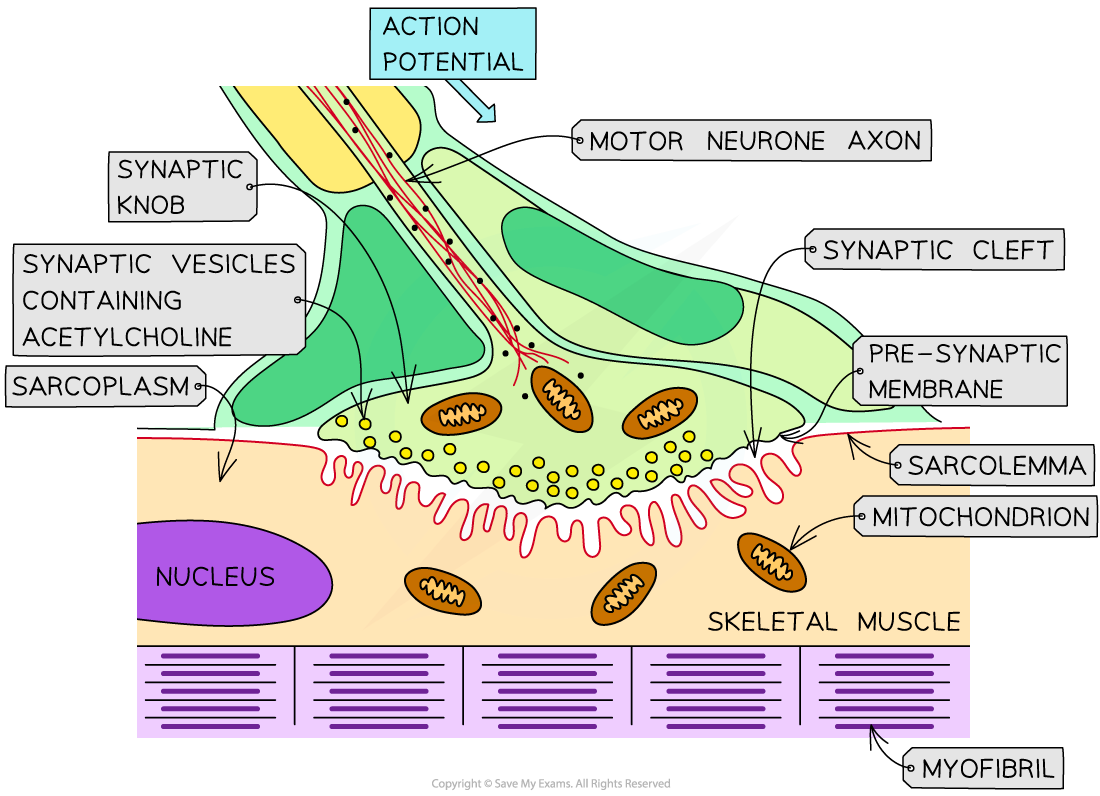
The neuromuscular junction is where the nerve impulse arrives at a muscle cell
-
Inward diffusion of Ca2+ ions stimulates vesicles containing the neurotransmitter acetylcholine (ACh) to fuse with the presynaptic membrane
- The ACh that is released diffuses across the neuromuscular junction and binds to receptor proteins on the sarcolemma (surface membrane of the muscle fibre cell)
- This stimulates ion channels in the sarcolemma to open, allowing sodium ions to diffuse in
- This depolarises the sarcolemma, generating an action potential that passes down the T-tubules towards the centre of the muscle fibre
-
These action potentials cause voltage-gated calcium ion channel proteins in the membranes of the sarcoplasmic reticulum (which lie very close to the T-tubules) to open
- Calcium ions diffuse out of the sarcoplasmic reticulum (SR) and into the sarcoplasm surrounding the myofibrils
- Calcium ions bind to troponin molecules, stimulating them to change shape
- This causes the troponin and tropomyosin proteins to change position on the thin (actin) filaments
- The myosin-binding sites are exposed on the actin molecules
-
The process of muscle contraction (known as the sliding filament model) can now begin
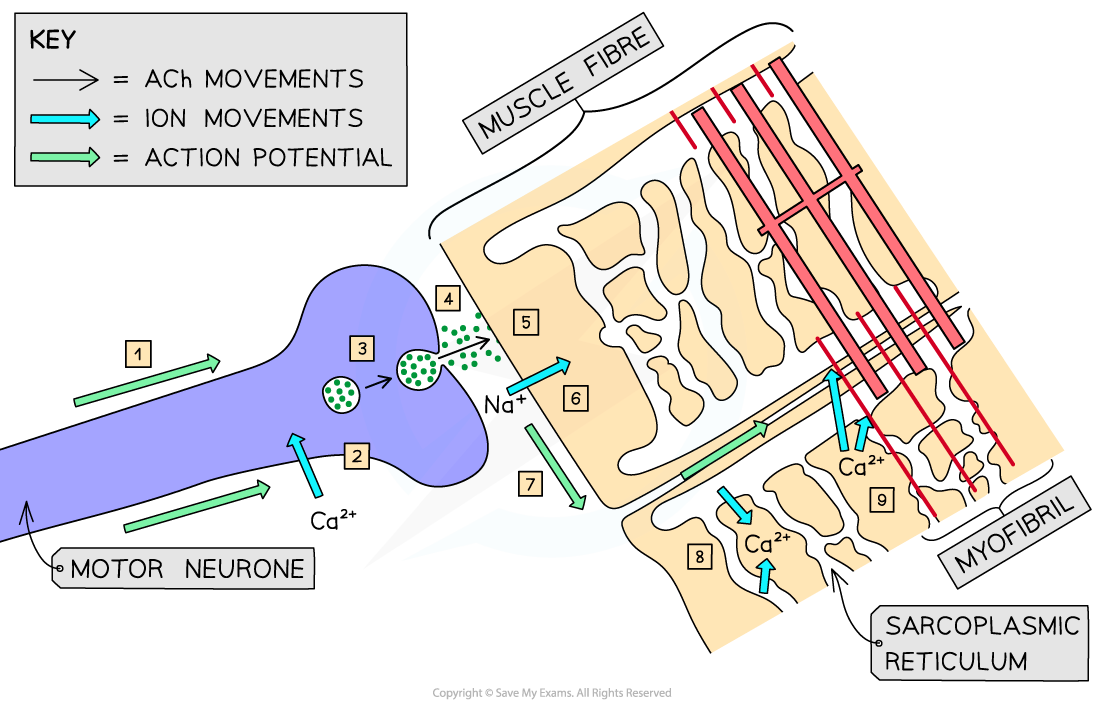
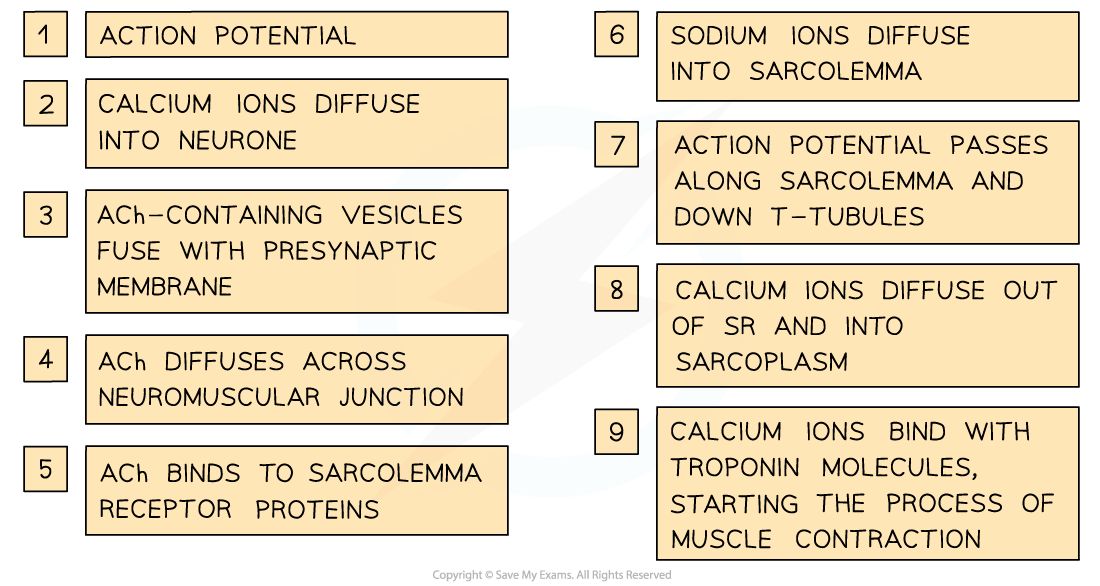
How the myofibrils within muscle fibres are stimulated to contract
Exam Hint You may have noticed that there are a lot of similarities between the events at the neuromuscular junction and those that occur at cholinergic synapses. A cholinergic synapse is between two neurones, a neuromuscular junction is between a neurone and muscle. Make sure you understand the similarities and differences so that you don’t get confused between the two.
Was this revision note helpful?