Speed of Conduction of Impulses (Cambridge International A-Level Biology)
Exam board Cambridge International · A-LevelUpdated 2025-10-10
Spec point —
15.1.7· describe and explain the rapid transmission of an impulse in a myelinated neurone with reference to saltatory conduction
Speed of conduction of impulses
-
The speed of conduction of an impulse refers to how quickly the impulse is transmitted along a neurone
-
It is determined by two main factors:
- the presence or absence of myelin (i.e., whether or not the axon is insulated by a myelin sheath)
- the diameter of the axon
Myelination and saltatory conduction
-
In unmyelinated neurones, the speed of conduction is very slow
-
By insulating the axon membrane, the presence of myelin increases the speed at which action potentials can travel along the neurone:
- In sections of the axon that are surrounded by a myelin sheath, depolarisation (and the action potentials that this would lead to) cannot occur, as the myelin sheath stops the diffusion of sodium ions and potassium ions
- Action potentials can only occur at the nodes of Ranvier (small uninsulated sections of the axon)
- The local circuits of current that trigger depolarisation in the next section of the axon membrane exist between the nodes of Ranvier
- This means the action potentials ‘jump’ from one node to the next
- This is known as saltatory conduction
- This allows the impulse to travel much faster (up to 50 times faster) than in an unmyelinated axon of the same diameter
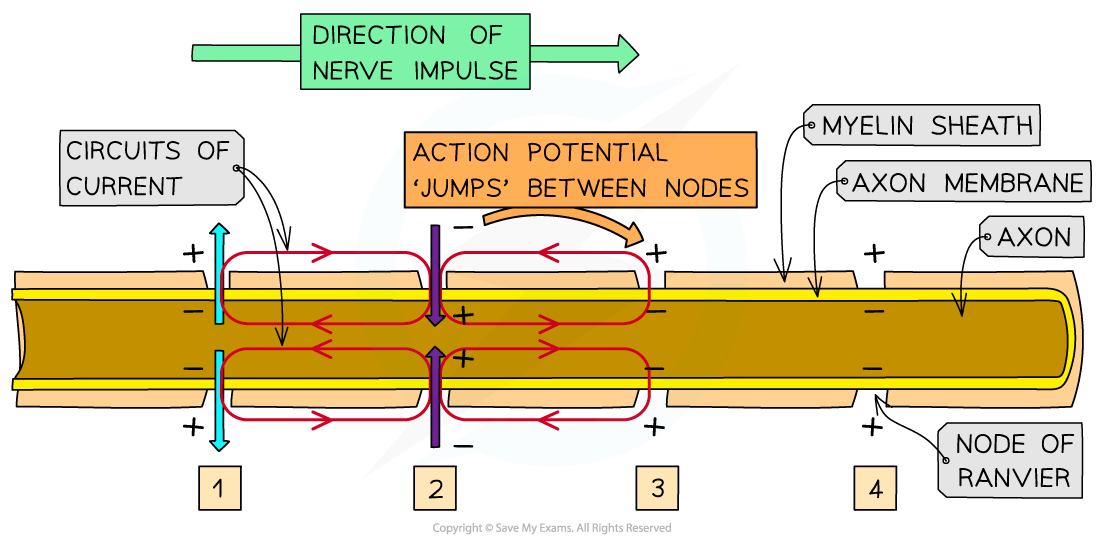
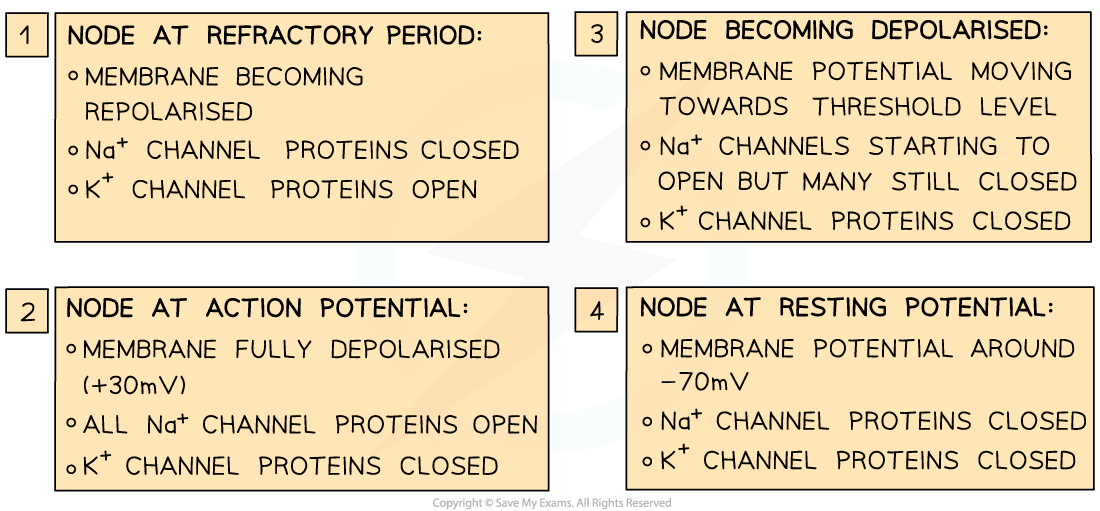
Transmission of an action potential in a myelinated axon by saltatory conduction
Diameter
-
The speed of conduction of an impulse along neurones with thicker axons is greater than along those with thinner ones
- Thicker axons have an axon membrane with a greater surface area over which diffusion of ions can occur
- This increases the rate of diffusion of sodium ions and potassium ions
- This in turn increases the rate at which depolarisation and action potentials can occur
Was this revision note helpful?