Production of Urea (Cambridge International A-Level Biology)
Spec point —
14.1.3· state that urea is produced in the liver from the deamination of excess amino acids
Production of urea
- Many metabolic reactions within the body produce waste products
- The removal of these waste products is known as excretion
- Many excretory products are formed in humans, with two in particular (carbon dioxide and urea) being formed in much greater quantities than others
Urea
-
Urea is produced in the liver
-
It is produced from excess amino acids
-
If more protein is eaten than is required, the excess cannot be stored in the body
-
However, the amino acids within the protein can still provide useful energy
-
To make this energy accessible, the amino group is removed from each amino acid
-
This process is known as deamination:
- The amino group (-NH2) of an amino acid is removed, together with an extra hydrogen atom
- These combine to form ammonia (NH3)
- The remaining keto acid may enter the Krebs cycle to be respired, be converted to glucose, or converted to glycogen / fat for storage
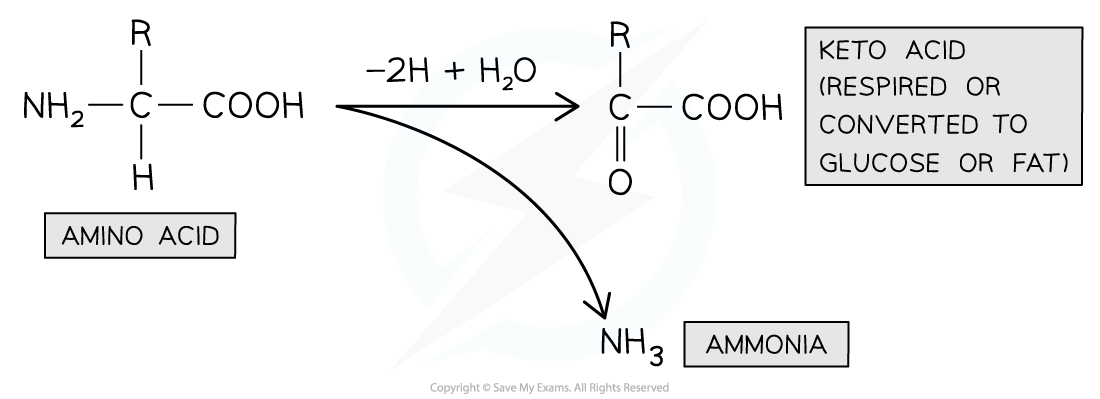
The deamination of an amino acid chemical formulae
-
Ammonia is a very soluble and highly toxic compound that is produced during deamination; it can be very damaging if allowed to build up in the blood
- It dissolves in the blood to form alkaline ammonium hydroxide, disrupting blood pH
- It can impact the reactions of cell metabolism such as respiration
- It interferes with cell signalling processes
-
This is avoided by converting ammonia to urea
- Urea is much less toxic than ammonia, so it can be safely transported in the blood to the kidneys
-
Ammonia is combined with carbon dioxide to form urea

The formation of urea chemical formulae
Was this revision note helpful?
Build on this topic