Common Features: Prokaryotic Organisms (Edexcel IGCSE Science)
Prokaryotes
Spec point —
1.3· "describe the common features shown by prokaryotic organisms such as bacteria Bacteria: these are microscopic single-celled organisms; they have a cell wall, cell membrane, cytoplasm and plasmids; they lack a nucleus but contain a circular chromosome of DNA; some bacteria can carry out photosynthesis but most feed off other living or dead organisms. Examples include Lactobacillus bulgaricus, a rod-shaped bacterium used in the production of yoghurt from milk, and Pneumococcus, a spherical bacterium that acts as the pathogen causing pneumonia."
Prokaryotes
-
All living organisms can be grouped together into groups based on the characteristics and features that they share:
- Plants
- Animals
- Fungi
- Protoctists
- Prokaryotes
-
The prokaryotes are different from the other four groups, which are all eukaryotes
-
Features of prokaryotic organisms include:
- they are single-celled
- they have no nucleus
- the nuclear material is found in the cytoplasm
-
Bacteria are prokaryotic organisms
Bacteria
-
Bacteria share the following biological characteristics:
- they are microscopic,single-celled organisms
- they have a cell wall, cell membrane, cytoplasm and plasmids
- they lack a nucleus but contain a circular chromosome of DNA
- they lack mitochondria and have no other membrane-bound organelles
-
Examples of bacteria include:
-
Lactobacillus bulgaricus
- A rod-shaped bacterium used in the production of yoghurt from milk
-
Pneumococcus
- A spherical bacterium that acts as the pathogen causing pneumonia
-
-
Bacteria feed in different ways:
-
Some bacteria carry out photosynthesis despite having no chloroplasts; this is because they still possess chlorophyll-like substances and have the enzymes necessary to synthesise sugars
-
Most feed on other living or dead organisms
- If they feed on dead organic matter then they are known as saprobionts or decomposers
-
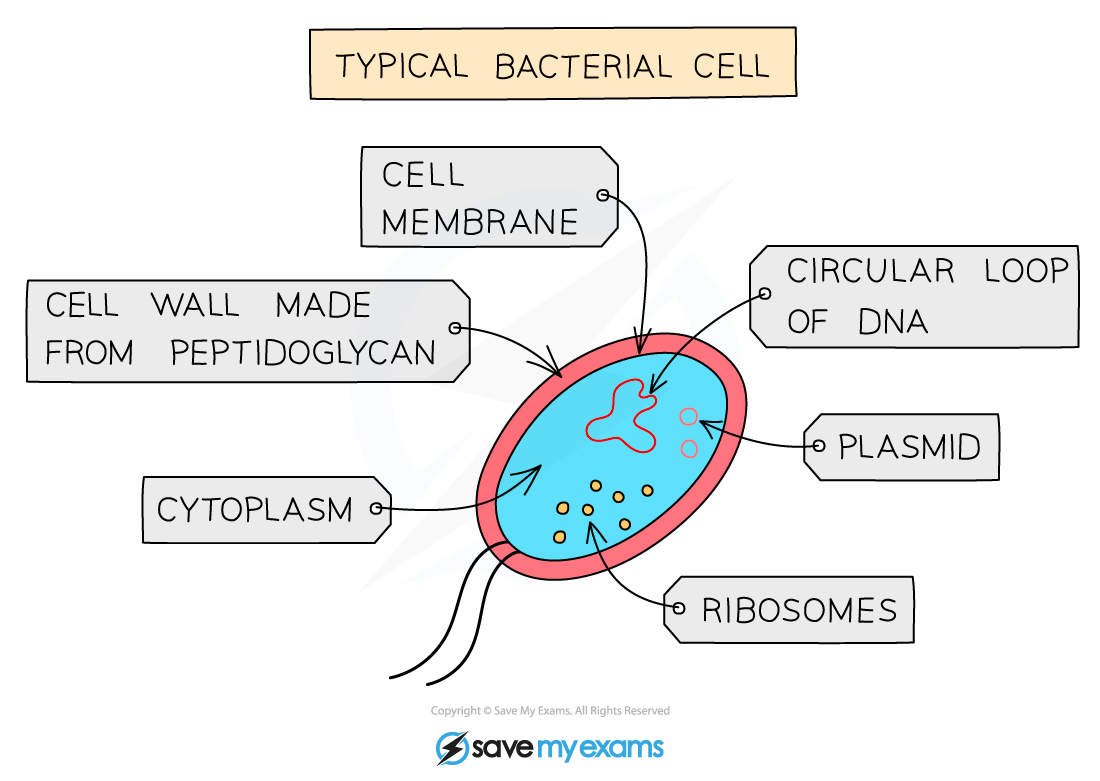
Bacteria have a cell wall, cell membrane, cytoplasm, plasmids and circular DNA
Components of prokaryotic and eukaryotic cells table
| Component | Eukaryotes | Prokaryotes |
|---|---|---|
| Cell membrane | Y | Y |
| Cytoplasm | Y | Y |
| Genetic material | Y - in a nucleus | Y - in the cytoplasm |
| Nucleus | Y | N |
| Cell wall | Some types | Y |
Was this revision note helpful?