Uses & Dangers of Static Electricity (Edexcel IGCSE Physics)
Guided lessons are live for this note
Work through it step by step — key points, depth layers, a worked example and self-checks.
Uses of static electricity
Spec point —
2.28P· explain some uses of electrostatic charges, e.g. in photocopiers and inkjet printers (physics only)
- Electrostatic charges are used in everyday situations such as photocopiers and inkjet printers
Photocopiers
-
Photocopiers use static electricity to copy paper documents, most commonly in black and white
- An image of the document is projected onto a positively charged copying plate
- The plate loses its charge in the light areas and keeps the positive charge in the dark areas (i.e the text)
- A negatively charged black toner powder (the ink) is applied to the plate and sticks to the part where there is a positive charge
- The toner is then transferred onto a new blank sheet of white paper
- The paper is heated to make sure the powder sticks (hence why photocopied paper feels warm)
-
The photocopy of the document is now made
-
Inkjet printers work in a similar way, but instead of the black toner powder, a small jet of coloured ink is negatively charged and attracted to the correct place on the page
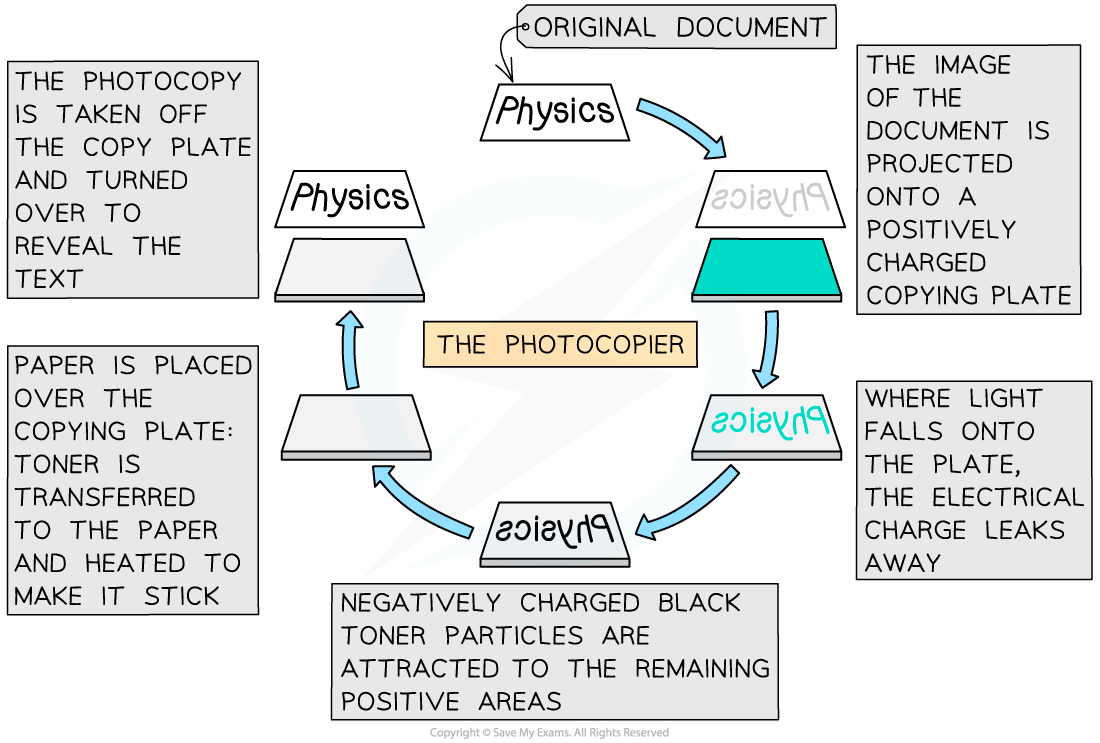
Diagram of the process by which a photocopier prints black text onto paper
Insecticide Sprayers
-
Insecticides are chemicals used to kill pests in order to protect crops
-
In order to spray crops effectively whilst using a minimal amount of chemicals, the sprayer has to deliver the chemicals as a fine mist and cover a large area
-
To achieve this, the insecticide is given an electrostatic charge (e.g. positive) as it leaves the sprayer
-
The droplets of insecticide then repel each other since they are the same charge
- This ensures that the spray remains fine and covers a large area
-
They are also attracted to the negative charges on Earth, so they will fall quickly and are less likely to be blown away
-
A similar technique is used in the spray painting of cars
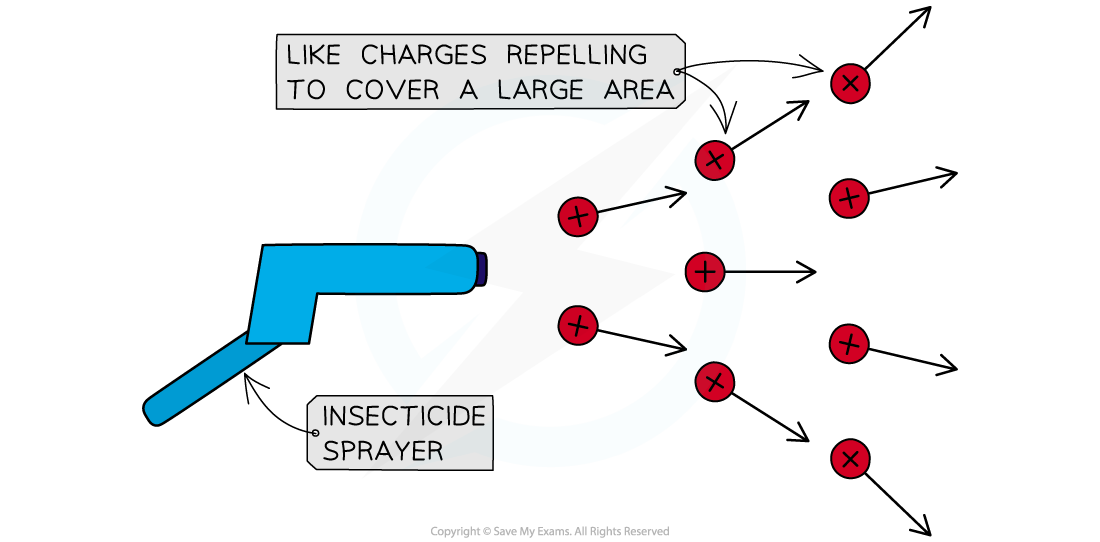
Positively-charged particles leaving the sprayer repel one another, covering a larger area and preventing particles from grouping together.
Dangers of static electricity
Spec point —
2.27P· explain the potential dangers of electrostatic charges, e.g. when fuelling aircraft and tankers (physics only)
-
There are various situations where static electricity can pose a hazard, for example:
- the risk of electrocution (e.g from lightning or a loose connection in an electrical appliance)
- the risk of a fire or explosion due to a spark close to a flammable gas or liquid
-
Static electricity can cause sparking
- This is where a large amount of charge builds up, producing a large potential difference across a gap
- If the potential difference is large enough, current can travel through the air between objects – this is a spark
-
There are dangers of sparking in everyday situations such as fuelling vehicles such as cars and planes
-
Earthing is used to prevent the dangerous build-up of charge
- This is done by connecting the vehicles to the Earth with a conductor
Fuelling Vehicles
-
A build-up of static charge is a potential danger when refuelling aeroplanes
-
Fuel runs through pipes at a fast rate
- This fuel is very flammable
-
The friction between the fuel (a liquid insulator) and the pipe causes the fuel to gain charge
-
If this charge were to cause a spark, the fuel could ignite and cause an explosion
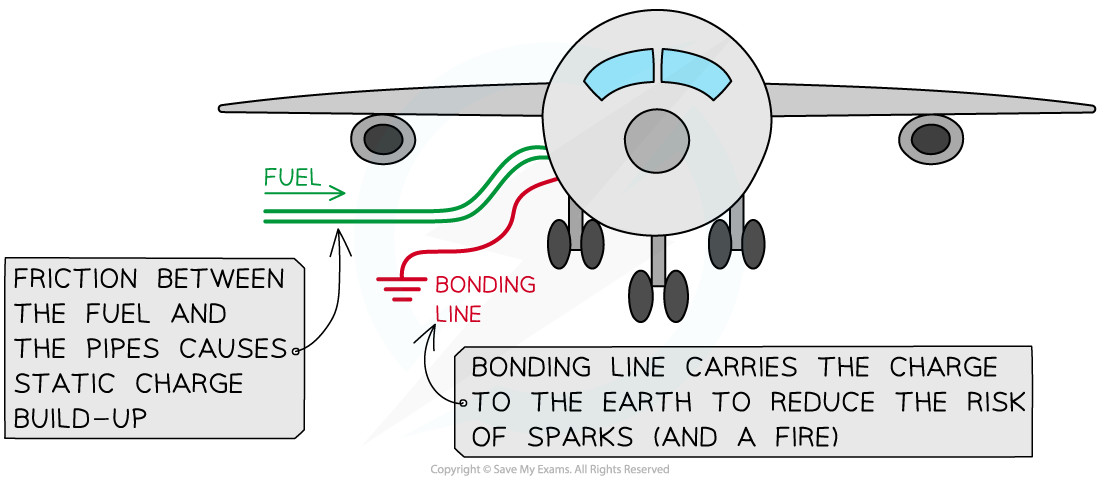
A diagram showing how the bonding line reduces the chance of sparks when fuelling a plane
-
This is prevented by the fuel tank being connected to the Earth with a copper wire called the bonding line during the refuelling
-
The conductor earths the plane by carrying the charge through to the Earth which removes the risk of any sparks
- It is easier for charge to flow down the bonding line than to spark, so sparks are very unlikely to occur
Exam Hint
You could be asked to explain other dangers and uses in your exams
They may ask you to explain the movement of charge in terms of electrons
If asked to explain a danger:
- State what the danger is (electrocution? fire?)
- Explain how the charge can be removed to get rid of the risk i.e earthing (think about which way the electrons have to move)
If asked to explain a use, think carefully about the forces exerted due to static electricity and what they will do
Was this revision note helpful?
Build on this topic