13 marksmedium
(b)
Prove algebraically that
is an even number
for all positive integer values of .
41 questions · 142 marks · ≈ 2 hours
Prove algebraically that
is an even number
for all positive integer values of .
Show that is an even number for all positive integer values of .
is an integer greater than
Prove algebraically that is always an even number.
Prove that the difference between two consecutive square numbers is always an odd number. Show clear algebraic working.
is a multiple of 5
Prove, using algebra, that is always a multiple of 20
Ali thinks that the value of will be a prime number for any whole number value of .
Is Ali correct? You must give a reason for your answer.
is a positive number.
is a negative number.
For each statement, tick the correct box.
| Always true | Sometimes true | Never true | |
|---|---|---|---|
| is positive | square | square | square |
| is positive | square | square | square |
| is positive | square | square | square |
| is positive | square | square | square |
is an integer.
Prove that is a square number.
Which of these is a correct identity?
Circle your answer.
Mo says, “ will be a prime number for all integer values of from 1 to 9”
Show that Mo is wrong. You must show that your value of is not prime.
Tick whether the following statement is true or false.
Give a reason for your answer.
When is a positive integer, the value of is always a factor of the value of .
True False
Prove that the mean of any four consecutive even integers is an integer.
Prove that the sum of four consecutive whole numbers is always even.
Give an example to show that the sum of four consecutive integers is not always divisible by 4.
Prove that
is a multiple of
for all positive integer values of .
Prove that the square of an odd number is always 1 more than a multiple of 4
Prove that , for all positive values of ,
Prove algebraically that the difference between the squares of any two consecutive integers is equal to the sum of these two integers.
Prove algebraically that the product of any two odd numbers is always an odd number.
Show that
Prove that the difference between a whole number and the cube of this number is always a multiple of
Prove algebraically that the difference between the squares of any two consecutive odd numbers is always a multiple of 8
is the middle integer of three consecutive positive integers.
The three integers are multiplied to give a product.
is then added to the product.
Prove that the result is a cube number.
Expressions for consecutive triangular numbers are
and
Prove that the sum of two consecutive triangular numbers is always a square number.
is a positive integer.
Prove algebraically that is a cube number.
and are positive whole numbers with
is a prime number.
Why are and consecutive numbers?
is a positive integer.
Prove that is an even number.
The lengths of the sides of a right-angled triangle are all integers. Prove that if the lengths of the two shortest sides are even, then the length of the third side must also be even.
Express as a single fraction.
Simplify your answer.
Using your answer to part (a), prove that if m and n are positive integers and , then
Prove algebraically that the difference between the squares of any two consecutive odd numbers is always a multiple of 8
(i) Factorise .
(2 marks)
(ii) is a positive whole number.
The expression can never have a value that is a prime number. Explain why.
(1 mark)
is an integer.
Prove algebraically that the sum of and is always a square number.
Here are the first five terms of an arithmetic sequence.
7 13 19 25 31
Prove that the difference between the squares of any two terms of the sequence is always a multiple of 24.
Given that can be any integer such that , prove that is never an odd number.
The product of two consecutive positive integers is added to the larger of the two integers.
Prove that the result is always a square number.
A square ABCD is in a circle with the corners touching the circumference.
Use algebraic proof to show that the fraction of the circle that is taken up by square is .
Prove that when the sum of the squares of any two consecutive odd numbers is divided by 8, the remainder is always 2 Show clear algebraic working.
Using algebra, prove that, given any 3 consecutive whole numbers, the sum of the square of the smallest number and the square of the largest number is always 2 more than twice the square of the middle number.
Using algebra, prove that, given any 3 consecutive even numbers, the difference between the square of the largest number and the square of the smallest number is always 8 times the middle number.
Here are the first four terms of a sequence of fractions.
The numerators of the fractions form the sequence of whole numbers The denominators of the fractions form the sequence of odd numbers
Write down an expression, in terms of , for the term of this sequence of fractions.
Using algebra, prove that when the square of any odd number is divided by the remainder is
The table gives information about the first six terms of a sequence of numbers.
| Term number | 1 | 2 | 3 | 4 | 5 | 6 |
|---|---|---|---|---|---|---|
| Term of sequence |
Prove algebraically that the sum of any two consecutive terms of this sequence is always a square number.
Prove that is always positive.
The diagram shows a cross placed on a number grid.
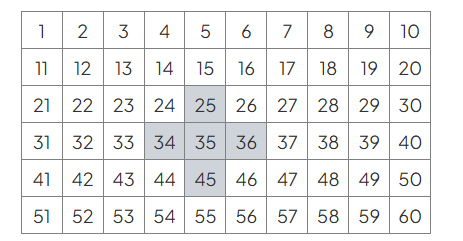
is the product of the left and right numbers of the cross. is the product of the top and bottom numbers of the cross. is the middle number of the cross.
Show that when
Prove that, for any position of the cross on the number grid above,