Economic Activity & Energy Practical Skills (Edexcel IGCSE Geography)
Aims of Economic Activity and Energy Fieldwork
Spec point —
4GE1-S9.128
Aims, sampling, equipment & risk assessment
Economic activity and energy enquiry
- In this fieldwork enquiry, the focus is on developing energy resources
- To undertake an energy fieldwork enquiry there are a range of practical skills and methods that will be used
- These can apply to any energy fieldwork
- The fieldwork enquiry should be linked to geographical theory
Aims and hypothesis
-
The aims and hypothesis come from questions asked about developing energy resources, such as:
- What are people's views and opinions regarding a new wind farm?
- Why do people have the views and opinions they do?
- What environmental impact does a new renewable energy plant have on the surrounding area?
-
Examples of an aim could include:
- An investigation into the impact of a new renewable energy plant
- An investigation into people's opinions of a wind farm expansion
-
Examples of a hypothesis could include:
- The environmental quality will increase with distance from the new renewable energy plant
- People living in the local area will be opposed to the expansion of a wind farm
-
After establishing the aims and hypothesis of the fieldwork, the next steps are as follows:
- Selecting the sites – this will involve sampling
- Deciding on the equipment to be used
- Considering any health and safety issues – completing a risk assessment
- Data collection methods
Worked Example Study Figure 1, which shows a wind farm development in Lincolnshire
Suggest two possible geographical aims for an investigation of the wind farm
(2 Marks)
Answer:
- An investigation into local people's views of the wind farm development (1)
- An investigation into the impact on the environmental quality of the wind farm development (1)
Site selection and sampling
-
To collect the data it is not practical to look at the environmental impact in all areas around the development, such as a wind farm, nor to ask all local people their opinion
-
To select the sites used, sampling should be used to reduce bias
-
There may be situations where access to the sample sites may be limited, meaning an opportunistic approach to sampling may need to be taken
- This should be as close as possible to the site selected using sampling
-
The most commonly used sampling strategies for an economic activity and energy enquiry are:
- Systematic- sampling of sites at regular intervals around the energy development
- Random – the use of random sampling means that all sites have an equal chance of being selected, which eliminates bias
- Stratified– if completing a questionnaire, the population selected should be representative of the whole population. For example, if 10% of the population is over 65, then 10% of the sample should be over 65
-
Site location can be recorded using GPS to give an accurate location using latitude and longitude
Worked Example Study Figure 1 shows the methodology of a student investigating the impact of a new renewable energy plant
**Explain one type of sampling method chosen by the student **
(2 Marks)
Method Purpose Details Secondary data from websites Background information on the sample sites Use Google search to find information and local history books Photographs A visual record of the sample sites Take photographs of the different sites Environmental Quality Survey Record environmental quality across the area At six regular sites along a transect Questionnaire People's views and opinions Completed 24 questionnaires – four at each site
Answer:
- Systematic (1) collecting data in an ordered or regular way** (1)**
- Opportunistic (1) collecting evidence where possible/appropriate (1)
Equipment
-
To complete the economic activity and energy enquiry measurements, a range of equipment is needed
-
The equipment includes the following:
- Clipboard for holding record sheets
- Environmental quality survey
- Questionnaires
- Pencil for writing in data
- Camera to take photographs of sites
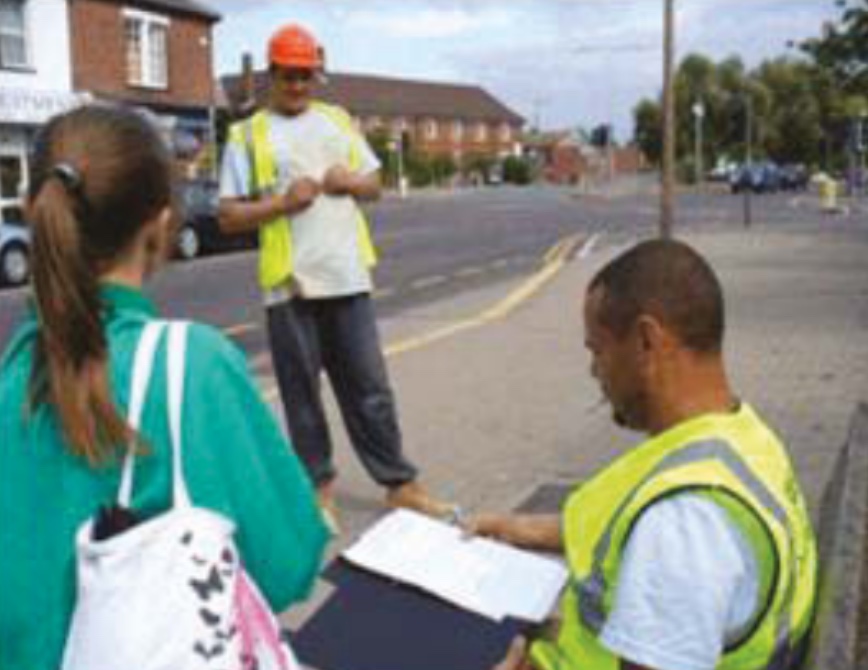
Worked Example Study Figure 1 shows a student collecting opinions regarding a new renewable energy plant
**How is the student collecting the opinions? **
(1 Mark)
** A.** Visiting people's homes
B. Asking people in the street
C. An online questionnaire
D. A postal questionnaire
Answer:
- B (1) – the student is asking people in the street
Risk assessment
-
Any fieldwork will involve consideration of health and safety using a risk assessment
-
Risks associated specifically with economic activity and energy may include:
- Weather conditions
- Traffic
- Working in an unfamiliar place
- Contact strangers
Worked Example Identify two health and safety risks of carrying out an energy fieldwork enquiry
(2 Marks)
Answer:
- traffic accidents (1)
- mugging/crime (1)
- unfamiliar environment (1)
- getting lost (1)
- construction sites (1)
Equipment for Investigating Economic Activity and Energy
Spec point —
4GE1-S9.128
Using equipment in the field
-
The data collection methods depend on the aims/hypothesis of the fieldwork
- In energy fieldwork, the only equipment which may be used is a digital decibel meter
- Other data collection may include questionnaires, traffic counts and environmental quality surveys
-
Data collection should include both quantitative and qualitative methods
Questionnaires
-
Questionnaires can be used to gather the attitudes of local people towards a wind farm expansion or the building of a renewable energy plant
-
An example of a statement question would be:
- 'The expansion of the wind farm has led to increased visual pollution in the area. Do you strongly agree, agree, disagree or strongly disagree?'
-
An example of a closed question would be:
- 'How long have you lived in this area?'
-
An example of an open question would be:
- 'What are your views on the expansion of the wind farm at...?'
-
-
The questionnaires can be used to gather a large data sample
Worked Example **Describe the factors to be considered in preparing a questionnaire **
[4 marks]
Answer:
- How many questions (1)
- Layout of the questionnaire (1)
- Decide on sample size** (1)**
- Decide on sample composition (1)
- Number of questions: (1) open (1) closed (1) Or award max to 2 well-developed (described) factors e.g. sample composition (1) > spread of different ages (1)
Environmental quality surveys
-
Environmental quality surveys (EQS) can be used to compare different sites around the energy development
- A survey would be completed for each site
- Care needs to be taken to be as objective as possible
| Feature | Negative | -2 | -1 | 0 | 1 | 2 | Positive |
|---|---|---|---|---|---|---|---|
| Pavements | Pavements damaged and cracked in a poor state of repair | Good quality pavements in an excellent state of repair | |||||
| Buildings | Buildings look derelict and uncared for | Buildings look well cared for | |||||
| Litter | Lots of litter | No litter | |||||
| Traffic | Lots of traffic and congestion | No traffic | |||||
| Green space | No green space, trees or vegetation | Lots of green space, trees and other vegetation | |||||
| Graffiti | Lots of graffiti | No graffiti |
Worked Example Identify one advantage of using a questionnaire
(1 Mark)
A. It is a time-consuming method
B. They can provide a mix of qualitative and quantitative data
C. Provides all the data needed for the enquiry
D. Guarantees response from everyone the questionnaire is given to
Answer:
- **B **(1)****- Questionnaires can include both open and closed questions, meaning that both qualitative and quantitative data can be gathered
Photographs and field sketches
- Photographs and field sketches are qualitative data
- Just as with any data collection and presentation, they have their strengths and weaknesses
- In an energy enquiry, photographs and field sketches can be used to show the development of new energy sources and the impact that these developments have
- Photographs are also useful for illustrating the data collection methods used
Worked Example Explain why field sketches are a useful form of primary data
(2 Marks)
Answer:
- Can capture lots of detail (1), which means they can be examined properly after the field trip has ended (1)
- Highlights specific features which relate to other data collected (1) so can be used to support other forms of data collection (1)
- Easy to annotate to show details (1) so can help with analysis (1)
Exam Hint
- Annotations and labels are not the same
- A label is a simple descriptive point e.g. 'wind turbine'
- Whereas annotations are labels with a more detailed description or explanatory point
- For instance, commercial wind turbines are massive and often perceived as visually unappealing, resulting in visual pollution.
Was this revision note helpful?