Rate & Rise of Megacities (Edexcel IGCSE Geography)
Rate of Urbanisation
Spec point —
4GE1-S6.069
Factors affecting the rate of urbanisation
-
The main factors affecting the rate of urbanisation are:
- Speed of economic development
- Rate of population growth
-
Speed of economic development
- Economic growth drives urbanisation
- The faster the growth of secondary and tertiary employment sectors, the faster the growth of urbanisation
-
Rate of population growth
-
Economic growth needs a supply of labour
-
This demand can be met in two ways:
- Natural increase in urban population is a slow way of meeting demand
- Rural-urban migration– this is the more important source of labour, as it attracts a wider pool of people into the urban region
-
Rise of Megacities
Spec point —
4GE1-S6.069
- Megacities are urban regions with over 10 million residents
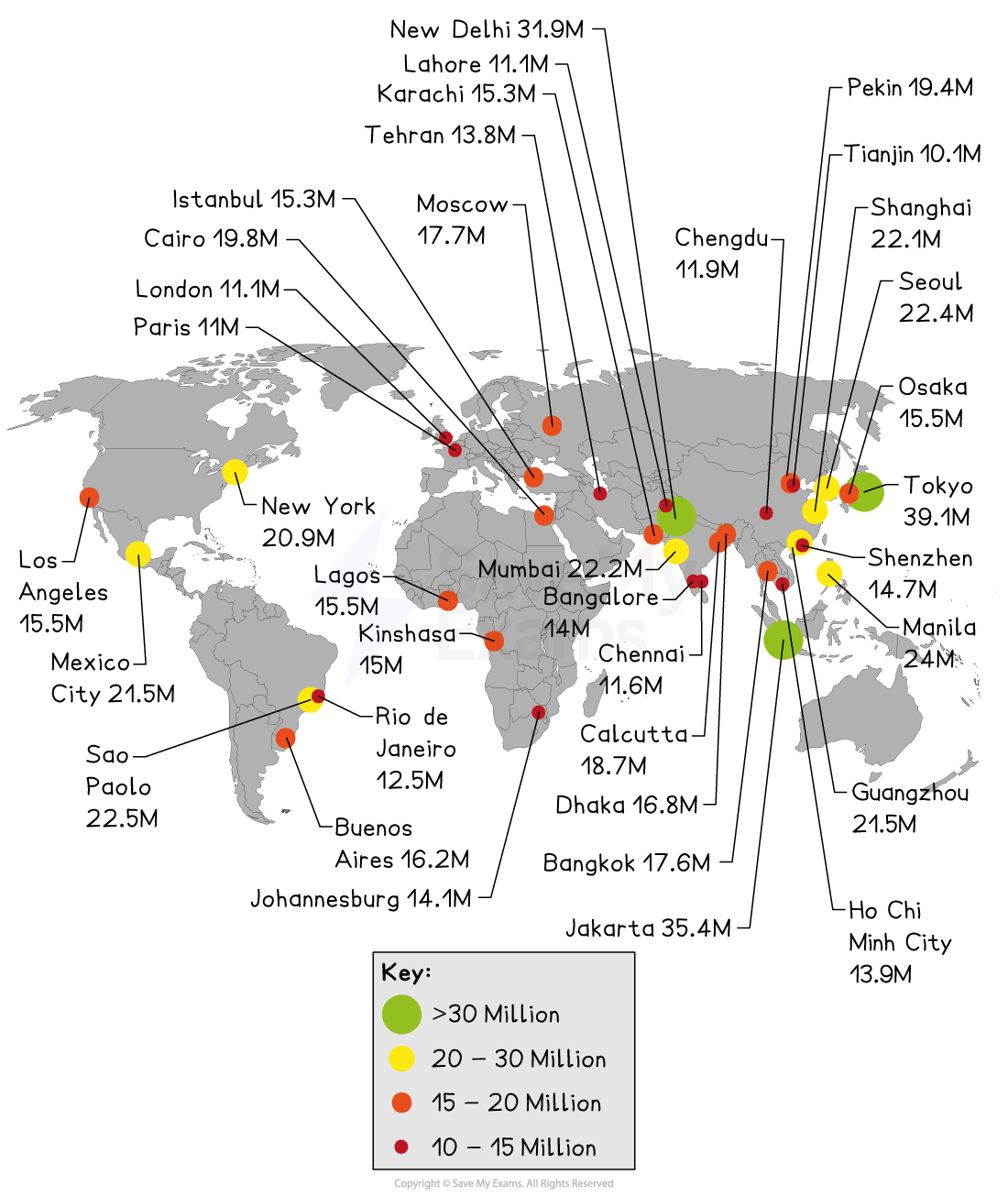
Map showing the location of world megacities
- In 2007, more people lived in an urban environment than a rural one
- By 2050 it is thought that more than two-thirds (7 billion) of the world's population will live in urban areas
- This scaling up of the urban environment is the fastest in human history
- The largest growth of megacities is seen in Asia
Reasons for growth
-
The four main factors for the growth of megacities are:
- Economic development
- Population growth
- Economies of scale
- Multiplier effect
Economic development
- Encourages population growth, which leads to the desirability of goods and services
- All megacities act as service centres within the formal economic sector
- However, megacities in developing and emerging countries are also important manufacturing centres (Mumbai in India or Dhaka in Bangladesh) with thousands working in the informal economy
Population growth
- Young people are drawn to live in megacities with their vibrancy, fast pace and opportunities
- There is also ‘internal growth', where people who have moved into the cities have children, thereby sustaining population growth (Mexico City, Mumbai, Pearl River Delta in China)
Economies of scale
- It is cheaper to provide goods and services in one place than spread across several cities
- Financial savings for local governments in respect of infrastructure provision
- Communication and transport are centralised, making savings in time and money
Multiplier effect
- As a city prospers, it acts as a beacon to people and businesses
- This encourages inward investment
- This leads to yet more development and growth
- Generating further need for skills and labour and job growth
- This cycle multiplies the positive effects and growth continues (San Francisco and the digital development)
World cities
-
Megacities have a powerful attraction for people and businesses
-
They are **influential cores with large peripheries
-
World or global cities can be any size but exert particular** influences around the globe; they are:
- considered prestigious, with status and power
- critical hubs in the global economy
-
The three top (alpha) world cities are:
- London
- New York
- Tokyo
-
These are the financial centres of the world, each with smaller networks of world cities feeding into them
-
There are only four world cities in the Southern Hemisphere:
- Sydney
- Rio de Janeiro
- Sao Paulo
- Buenos Aires
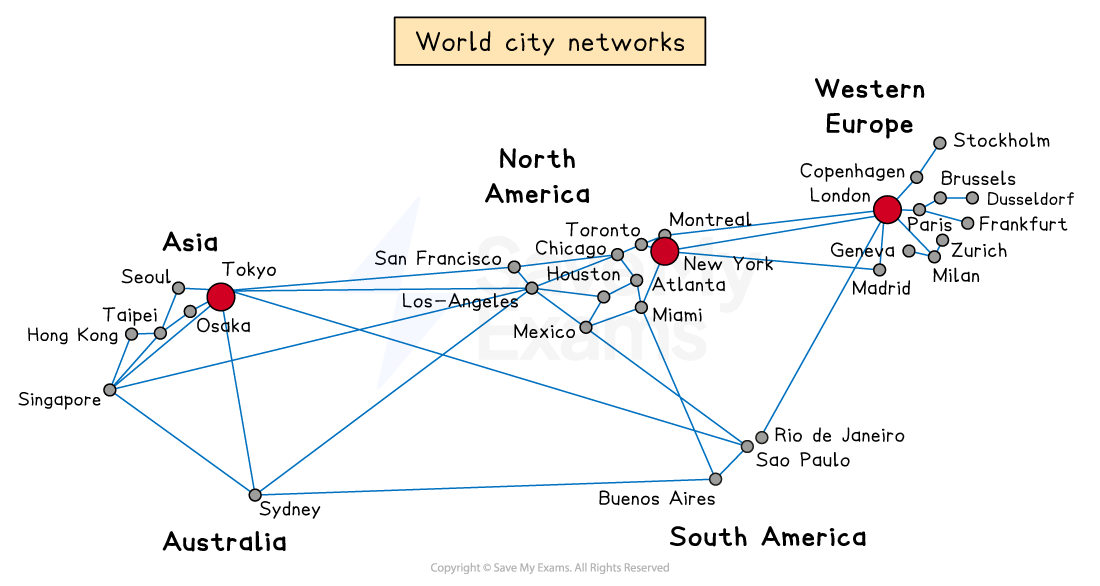
World city network
Was this revision note helpful?